
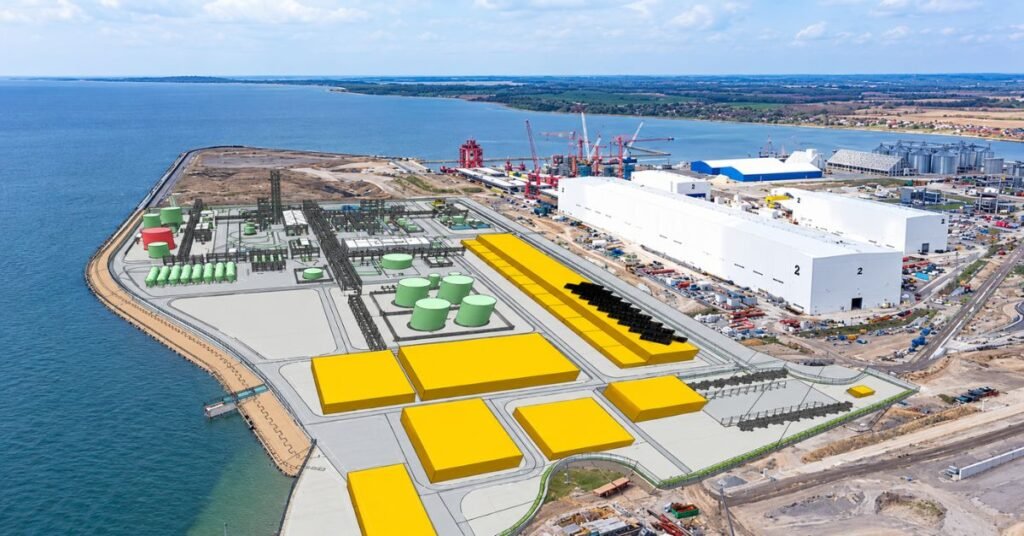
Plug Power has confirmed that its 5-megawatt GenEco electrolyser is operational at Avina Clean Hydrogen’s facility in Vernon, California, adding hydrogen production capacity for heavy-duty transport serving the Los Angeles–Long Beach port complex.
Announced on 19 November 2026, the containerised proton exchange membrane (PEM) system has a production capacity of 2.1 tonnes of hydrogen per day. The site combines production, vehicle refuelling and regional distribution, with facilities designed to serve more than 50 heavy-duty trucks daily.
How will the facility serve freight operators?
The station offers round-the-clock dispensing at 350-bar and 700-bar pressures for trucks and buses. According to Plug, it is designed to fill vehicle tanks to more than 95% capacity within 30 minutes.
Hydrogen can also be loaded into tube trailers for delivery to customers across the Los Angeles region. Hyfluence Systems supplied two heavy-duty refuelling stations, compression and storage equipment, and a HyLoader trailer-filling unit.
The project was developed with the City of Vernon and Vernon Public Utilities. Plug Chief Executive Officer José Luis Crespo said the commissioned system was now producing hydrogen for a facility intended to serve regional freight fleets.
How does current capacity compare with the original plan?
Avina’s original project announcement described a facility capable of producing up to four tonnes of compressed hydrogen daily. The company held its groundbreaking ceremony on 30 October 2024 and initially targeted commercial operations from July 2025.
The November announcement confirms 2.1 tonnes per day of capacity associated with Plug’s electrolyser. It does not establish that the earlier four-tonne daily design capacity has been commissioned.
The original development announcement also identified FASTECH as a project partner and highlighted Vernon Public Utilities’ role in providing electricity. Avina positioned the plant as infrastructure for replacing diesel-powered transport activity with hydrogen-powered vehicles.
What does the announcement establish about operating status?
The latest confirmation follows earlier statements about the facility’s readiness. Avina had described the site as ready for commercial operations in April 2026, while the Hydrogen Fuel Cell Partnership reported in June that it was approaching commercial operation.
The precise date when hydrogen production and customer deliveries first began remains unclear. The November announcement should therefore be understood as confirmation that Plug’s installed electrolyser is operational, rather than evidence that every part of the facility started simultaneously on that date.
Similarly, production capacity and designed daily vehicle throughput do not establish actual utilisation or the volume of hydrogen currently being sold.
How is the hydrogen produced?
Electrolysis uses electricity to separate water into hydrogen and oxygen. In a PEM electrolyser, a specialised solid membrane allows hydrogen ions to pass through as part of that process.
The emissions associated with electrolytic hydrogen depend substantially on the electricity used. Renewable or other low-emission power can reduce the production footprint, while electricity generated from fossil fuels adds upstream emissions.
Avina’s original project description referred to clean electricity. However, the latest commissioning announcement does not provide a verified lifecycle emissions figure or detailed electricity-sourcing information for the operating installation.
For port-linked logistics, the facility’s immediate role is supplying road transport and regional hydrogen customers. It adds production and refuelling infrastructure supporting freight movements around the Southern California ports, rather than a marine bunkering service.
Recent Posts
Marine
Lloyd’s Register approves nuclear classification framework for ships and offshore units
Marine
IGFA forms three committees to support Hong Kong’s green marine fuel market
Methanol
Fratelli Cosulich lays keel for final tanker in four-vessel methanol-ready programme