
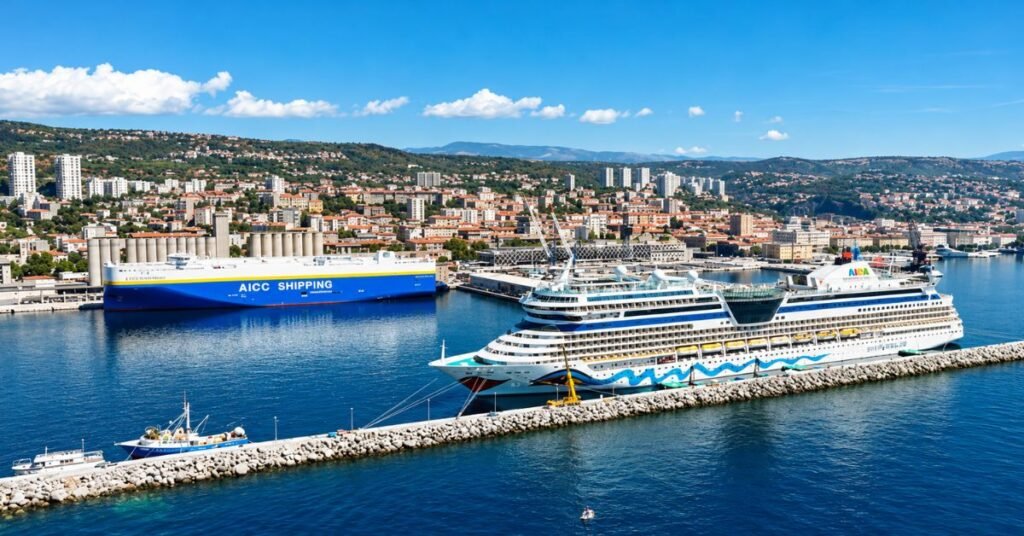
Croatia’s Rijeka Port Authority has selected Končar as the preferred bidder for an €11.49 million shore-power installation covering both of its container terminals. The project will enable suitably equipped vessels to draw electricity from land while berthed, reducing the use of onboard auxiliary engines.
The installations are planned for Adriatic Gate Container Terminal (AGCT) at Brajdica and Rijeka Gateway at the Zagreb Deep Sea Container Terminal. Implementation is expected to take approximately two years, ahead of European Union requirements applying to certain vessels from January 2030.
What will the shore-power project deliver?
The latest procurement announcement specifies 10 megawatts of capacity at Brajdica and 7.5 megawatts at Rijeka Gateway, with provision for two vessels to connect simultaneously.
Onshore power supply (OPS) allows ships to meet their electrical requirements at berth without continuously operating auxiliary generators. The project is intended to reduce local exhaust emissions and noise during container-handling operations.
Port authority director Denis Vukorepa said contract signing was expected within weeks following completion of the procurement process. The €11.49 million procurement value excludes value-added tax. The reported timetable therefore concerns a forthcoming installation programme, rather than an operational service.
How is the investment being funded?
The installation forms part of the wider POR2CORE-OPS infrastructure project, supported by the EU’s Connecting Europe Facility.
Croatia’s official transport-project portal lists total eligible costs of €15.46 million and an EU contribution of €13.14 million, equivalent to 85% of eligible expenditure. These figures cover the broader project and are distinct from the equipment and construction procurement value.
The funded scope includes detailed designs, technical specifications, permits, equipment procurement, installation and commissioning at both terminals. Its objective is to introduce shore-side electricity at facilities that connect maritime cargo movements with rail and road transport.
The project portal retains an earlier estimated completion date of 31 May 2027. More recent procurement reporting indicates an implementation period of approximately two years, so that earlier date should not be presented as the current commissioning commitment.
Why is the 2030 deadline important?
Under FuelEU Maritime, container ships and passenger ships above 5,000 gross tonnage will generally have to use shore power, or qualifying zero-emission technology, while berthed at EU ports covered by the Alternative Fuels Infrastructure Regulation from 1 January 2030.
From 2035, the requirement extends to other EU ports equipped with shore-power facilities. The rules include specified exceptions, so the obligation does not apply identically to every vessel call.
FuelEU Maritime also requires operators to monitor electricity received from shore and relevant information about port stays. Installing equipment is therefore one part of a wider compliance process involving vessel compatibility, connection procedures and operational reporting.
How does the project fit Rijeka’s container expansion?
The investment spans Rijeka’s two principal container terminals. AGCT is controlled by International Container Terminal Services Inc., while Rijeka Gateway is a joint venture between APM Terminals and Croatia’s ENNA Group.
Rijeka Gateway began commercial operations in September 2025 with an initial annual capacity of 650,000 twenty-foot equivalent units. The terminal represented an investment of approximately €380 million.
Extending shore power to both locations will add vessel-side electrification to Rijeka’s container infrastructure. The port authority expects the project to make Rijeka the first northern Adriatic port offering shore electricity to container ships, although that distinction remains dependent on commissioning and developments at neighbouring ports.
Recent Posts
Marine
Lloyd’s Register approves nuclear classification framework for ships and offshore units
Marine
IGFA forms three committees to support Hong Kong’s green marine fuel market
Methanol
Fratelli Cosulich lays keel for final tanker in four-vessel methanol-ready programme