
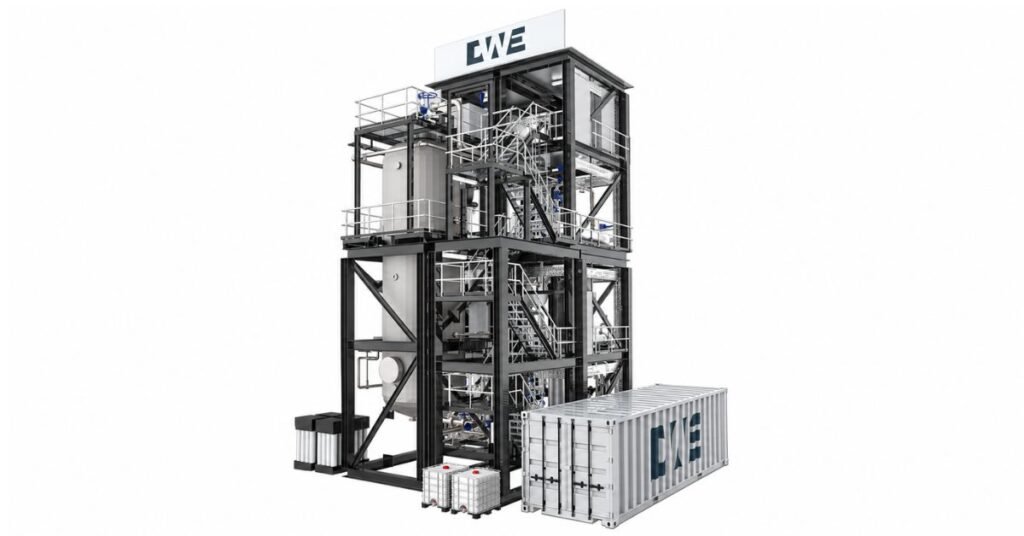
BASF and German engineering company DWE have announced a collaboration to develop modular renewable methanol production facilities, targeting faster deployment of plants supplying shipping, chemicals and synthetic-fuel markets.
Announced on 18 November 2026 in Deggendorf and Ludwigshafen, Germany, the partnership combines DWE’s Power-to-Liquid (PtL) process technology with BASF’s SYNSPIRE methanol synthesis catalysts. The companies aim to simplify project execution and enable developers to expand production progressively as demand and hydrogen availability increase.
How will the modular production concept work?
DWE’s standardised synthesis units are designed for small and medium-scale projects at both new industrial sites and existing facilities. Additional modules can be installed in parallel to increase capacity.
The units are designed to operate between 30% and 100% load. According to the companies, this flexibility allows developers to align investment and production with available inputs and market requirements.
DWE Vice President for Business Development Dr Stefan Koch said the concept addresses developers’ requirements for simpler engineering, faster implementation and a defined route to expansion. BASF’s Senior Vice President for Chemical Catalysts and Adsorbents, Dr Yaqian Liu, emphasised the importance of combining technology and project-delivery expertise.
The announcement did not identify a first customer, plant location, investment value or production capacity.
What does DWE contribute to project delivery?
DWE’s renewable methanol process uses catalytic conversion of carbon dioxide and hydrogen. Its offering includes reactors and a process licence, supplied through a prefabricated synthesis module tested at the factory.
The company’s approach moves manufacturing and much of the process-engineering work into controlled factory conditions. Activities at the project site then concentrate on installation, connection and commissioning.
DWE says this arrangement can reduce risks at the points where different equipment and systems connect, while shortening construction schedules. It also aims to reduce engineering, procurement and construction costs by standardising equipment and consolidating delivery responsibilities.
These are intended benefits of the modular approach. The collaboration announcement does not provide quantified savings against a conventional plant design.
What role will BASF’s catalysts play?
BASF’s SYNSPIRE portfolio covers methanol production using different feedstocks, including conventional synthesis gas and carbon dioxide combined with renewable hydrogen.
The company introduced SYNSPIRE Methanol VARIO in 2021 for applications including carbon dioxide-rich synthesis gas. Its SYNSPIRE Methanol ZERO catalyst, commercially introduced in 2024, is designed specifically for e-methanol production using carbon dioxide and green hydrogen.
BASF identifies catalyst stability, conversion performance and service life as important considerations when adapting methanol production to changing feedstocks. Its product development has included testing at hte GmbH and BASF and partner laboratories.
The DWE agreement refers to the SYNSPIRE portfolio without specifying which catalyst variant will be used in individual customer projects.
Why is renewable methanol relevant to maritime fuel supply?
Methanol can serve both as a shipping fuel and as a chemical feedstock. DWE also identifies potential downstream applications in synthetic hydrocarbons and sustainable aviation fuel, allowing production projects to address several markets.
The International Renewable Energy Agency distinguishes renewable e-methanol, produced using renewable hydrogen and renewable carbon dioxide sources, from conventional methanol made using natural gas or coal. Bio-methanol follows a separate route based on biomass and other biological feedstocks.
That distinction matters when assessing marine-fuel emissions: methanol’s environmental performance depends on its production pathway and inputs. The BASF–DWE initiative targets production using renewable energy and non-fossil carbon sources, with modular deployment intended to make those projects easier to implement.
Recent Posts
Marine
Lloyd’s Register approves nuclear classification framework for ships and offshore units
Marine
IGFA forms three committees to support Hong Kong’s green marine fuel market
Methanol
Fratelli Cosulich lays keel for final tanker in four-vessel methanol-ready programme