
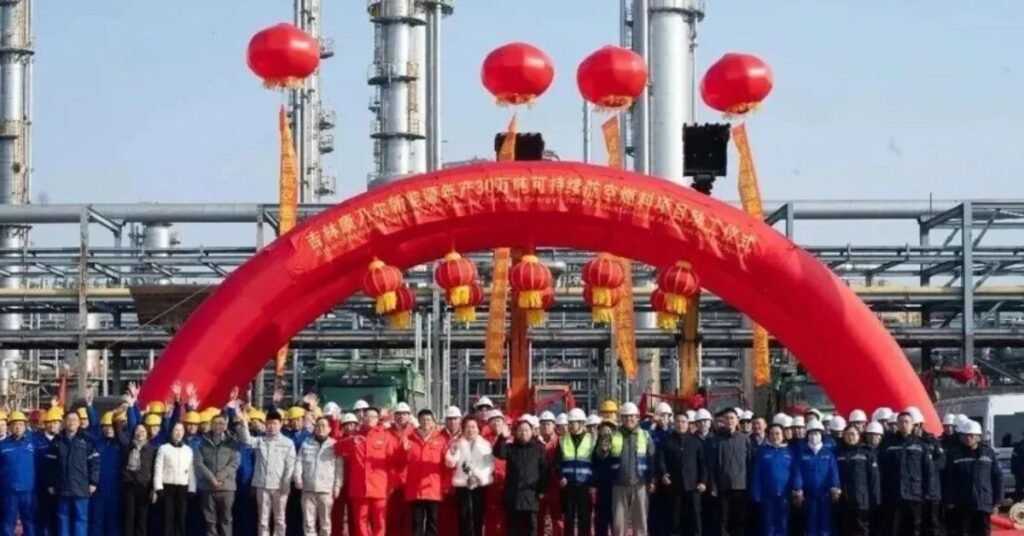
Jilin Connell New Energy has begun construction of a sustainable aviation fuel (SAF) project in Jilin City, north-east China, with a reported annual capacity of 300,000 tonnes. The project broke ground on 17 November 2026 and is intended to convert green methanol into aviation fuel using Honeywell UOP’s eFining technology.
The development involves an investment of RMB4.8 billion and targets completion and commissioning in December 2027. It will build on Connell’s existing chemical manufacturing infrastructure, linking methanol production with a new downstream market for lower-carbon transport fuels.
What will the Jilin facility produce?
The project will use a methanol-to-jet (MTJ) process to manufacture aviation fuel, extending Connell’s existing methanol-to-olefins (MTO) production chain.
Construction-stage information puts the proposed SAF capacity at 300,000 tonnes annually. However, Honeywell’s announcement of its technology agreement on 28 April 2026 specified 280,000 tonnes a year. The available announcements do not explain the difference between these figures.
Honeywell described the planned facility as potentially one of the world’s largest single MTJ production units. Its announcement supports the project’s substantial scale, although it does not establish an unqualified claim that it will be the world’s largest green-hydrogen-based aviation fuel plant.
Where will the green methanol come from?
Connell Group and China Huadian Corporation are developing a separate green methanol project in Songyuan, also in Jilin province, with planned capacity of 900,000 tonnes annually.
The upstream development is intended to supply the aviation fuel facility, whose methanol requirement is reported at approximately 800,000 tonnes a year. Local authorities have allocated 3 gigawatts of renewable energy capacity and designated industrial land to support the methanol project.
The two developments are therefore planned as connected parts of a fuel-production chain. The stated capacities remain project targets, rather than operating output.
How does methanol become aviation fuel?
Honeywell’s eFining technology can process methanol derived from different renewable pathways. These include methanol produced through biomass gasification and e-methanol synthesised from green hydrogen and carbon dioxide.
This flexibility is significant when describing the project’s fuel credentials. Green methanol does not necessarily mean exclusively hydrogen-based e-methanol: the production route and feedstock source determine that distinction.
Honeywell said the Connell project would extend an existing MTO installation downstream and could draw on north-east China’s biomass, wind and solar resources. The companies’ technology relationship dates back to 2016, when Connell selected Honeywell’s MTO technology for chemical production.
How does the project fit the wider aviation fuel market?
The Jilin development adds to a growing portfolio of proposed methanol-based aviation fuel facilities.
In August 2024, Honeywell announced that Inner Mongolia Jiutai Group had selected eFining technology for a planned facility producing 100,000 tonnes of SAF annually from e-methanol. That project was designed to use methanol made from carbon dioxide and green hydrogen.
More recently, in February 2026, Verso Energy selected the same technology for seven planned production sites across France, Finland and the United States. Honeywell described those projects as using renewable electricity, hydrogen and carbon dioxide from biological sources to produce synthetic aviation fuel.
Connell’s construction milestone advances another large proposed source of aviation fuel demand for renewable methanol. Its next operational milestones will be completion of the conversion facility and availability of the upstream feedstock needed to support production.
Recent Posts
Power & Propulsion
Everllence 175D Marine Engine Targets 1,500 Hours of Unmanned USV Operation
Tugboats
Zhejiang’s First Fully Electric Tugboat Enters Service at Ningbo-Zhoushan Port
Marine
ABB to acquire Ziehl-Abegg for $2.65 billion, expanding HVAC and industrial cooling portfolio