
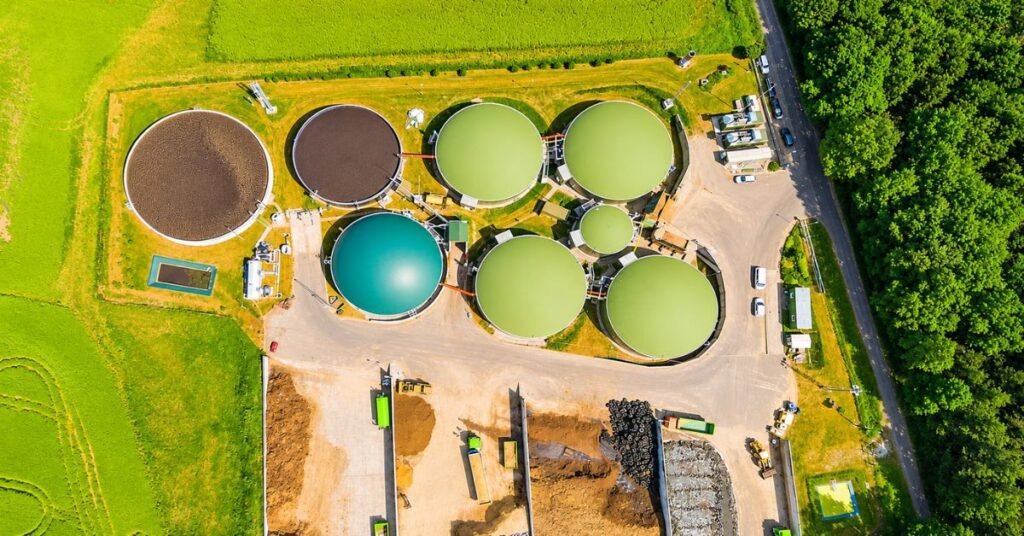
Blending approximately 17–20% compressed biogas (CBG) into compressed natural gas (CNG) could bring vehicle lifecycle emissions close to zero or below, according to a Confederation of Indian Industry (CII)–EY report. The finding depends on the assessed waste feedstocks and emissions accounting assumptions, rather than representing a universal outcome for every vehicle or biogas supply chain.
The report, India’s Compressed Biogas Opportunity: Pathway to Energy Security, Import Substitution and Decarbonisation, was launched at the 14th CII Bio-Energy Summit in New Delhi on 17 November 2026. It examines production, infrastructure, financing and demand conditions affecting the sector’s expansion.
What supports the carbon-neutrality estimate?
The model uses lifecycle assessment inputs from The Energy and Resources Institute (TERI), feedstock data and EY-Parthenon analysis. It assumes vehicle efficiency of 23 kilometres per kilogram of fuel.
Under these assumptions, conventional CNG produces an estimated 143 grams of carbon dioxide equivalent per kilometre, while the assessed CBG pathway carries a negative lifecycle value of approximately 689 grams. Blending 17% CBG brings the calculated balance close to zero; a 20% blend produces an estimated negative balance of 23 grams per kilometre.
The negative value reflects credits for avoiding emissions from decomposing organic waste. It does not mean that a vehicle removes carbon dioxide from the atmosphere while being driven. The model’s per-kilometre figures should also not be applied directly to heavy trucks with different fuel consumption.
Why do feedstock and methane leakage matter?
Independent analysis by the International Energy Agency (IEA) explains that biogas production both avoids and generates emissions across its lifecycle.
Using manure and landfilled food waste can capture methane that would otherwise escape during decomposition. However, methane losses during processing, upgrading and storage can reduce those benefits. Consequently, the climate performance of biomethane varies with the waste source, production process and operational controls.
The IEA identifies covered digestate storage, appropriate digester operation, treatment of upgrading off-gases, and leak detection and repair programmes as measures for limiting emissions. These factors are central to determining whether an individual supply chain delivers the reductions assumed in lifecycle modelling.
What blending requirements already apply in India?
India’s CBG Blending Obligation covers CNG used in transport and piped natural gas supplied to domestic consumers through city gas distribution networks.
The government’s published schedule sets blending obligations at 1% for financial year 2025–26, 3% for 2026–27 and 4% for 2027–28. The requirement rises to 5% from 2028–29 onwards.
These mandated levels remain below the report’s modelled 17–20% range. The policy is intended to stimulate domestic CBG demand, substitute imported liquefied natural gas, conserve foreign exchange and support waste-based energy production.
What will determine adoption by transport fleets?
CII identifies commissioning, dependable feedstock supply, improved plant utilisation and stronger infrastructure connections as priorities for translating policy support into commercial production. Its report also examines pricing, project bankability and customer readiness.
Pipeline access remains a practical constraint. The IEA estimates that only around 10% of India’s biomethane potential lies within 10 kilometres of a natural gas transmission pipeline. Plant location and connection costs therefore influence how economically fuel can reach users.
For logistics operators, the report presents a potential route to reducing lifecycle emissions through fuel substitution. Achieving that outcome requires reliable fuel delivery and verified supply-chain emissions, alongside compliance with the applicable blending and fuel-quality requirements.
Recent Posts
Power & Propulsion
Everllence 175D Marine Engine Targets 1,500 Hours of Unmanned USV Operation
Tugboats
Zhejiang’s First Fully Electric Tugboat Enters Service at Ningbo-Zhoushan Port
Marine
ABB to acquire Ziehl-Abegg for $2.65 billion, expanding HVAC and industrial cooling portfolio