
Emissions monitoring and fuel-system readiness rank among the leading decarbonisation priorities identified by experts from South Korean shipping companies, according to a study published on 20 November 2026. The findings highlight the importance of internal management capabilities as operators prepare for tighter international environmental requirements.
Published in Environmental Science and Pollution Research, the study was authored by Jia-Rong Chen, Dong-Wook Kwak, Sun-Ho Bang and Young-Joon Seo. It examines managerial priorities associated with the International Maritime Organization’s (IMO) 2030 ambitions.
Which measures received the highest priority?
The researchers applied the Best–Worst Method, a comparative decision-making approach, to assessments from ten shipping-company experts. They evaluated four broad dimensions and 14 sub-criteria.
Management systems received the highest relative weight, at 0.397, followed by fuel systems at 0.340. Technical equipment scored 0.158 and policy responses 0.105.
Among individual measures, ship carbon-emission monitoring systems ranked first at 0.208. Dual-fuel propulsion followed at 0.168, ahead of alternative-fuel adaptation capability at 0.127.
These are relative priority scores, not estimated emissions reductions or recommended budget allocations. The small expert sample also limits the extent to which the findings can represent the wider shipping industry. The publicly accessible abstract does not provide the full methodology or sensitivity analysis.
Why is emissions monitoring commercially important?
Existing international requirements already connect vessel operations with measurable carbon performance. The IMO’s Carbon Intensity Indicator (CII) applies to covered ships of 5,000 gross tonnage and above, requiring annual assessment of operational carbon intensity.
The framework makes fuel-consumption and operational information central to demonstrating performance. It also distinguishes operational efficiency from the technical characteristics assessed through the Energy Efficiency Existing Ship Index.
These requirements provide practical context for investment in emissions-management systems: operators need reliable information to assess performance and support compliance, alongside decisions on engines, equipment and fuels.
What do the IMO’s 2030 ambitions require?
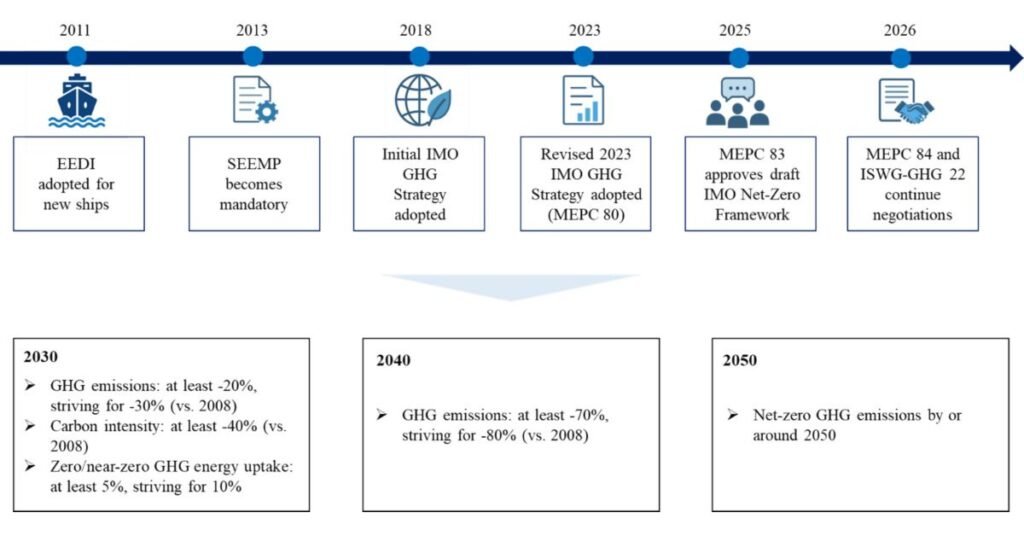
The IMO’s revised greenhouse gas strategy, adopted in July 2023, sets an indicative checkpoint to reduce total annual emissions from international shipping by at least 20%, while striving for 30%, by 2030 compared with 2008.
Separately, it targets a reduction of at least 40% in carbon dioxide emissions per unit of transport work across international shipping by 2030.
Zero or near-zero-emission technologies, fuels and energy sources should account for at least 5% of shipping’s energy use by that year, with an ambition to reach 10%. These are sector-wide strategic objectives, rather than identical reduction obligations imposed on every vessel.
The strategy also calls for consideration of emissions across the fuel lifecycle, helping prevent reductions onboard from simply shifting emissions to fuel production elsewhere.
How do European rules reinforce the need for better data?
For operators serving European markets, FuelEU Maritime adds another layer of fuel-performance requirements. The regulation sets progressively tighter limits on the greenhouse gas intensity of onboard energy, starting with a 2% reduction in 2025 and increasing to 6% in 2030 against its reference value.
Its assessment includes carbon dioxide, methane and nitrous oxide across the fuel lifecycle. Consequently, choosing a fuel involves more than measuring emissions at the ship’s exhaust.
European Commission guidance requires covered companies to record information including fuel consumption at sea and at berth, port calls, electricity received from shore and relevant emissions factors. Ship-specific annual reports must then undergo verification.
This regulatory context reinforces the operational connection between data systems and fuel selection. A vessel’s ability to use a different fuel must be supported by information demonstrating the resulting emissions performance and compliance position.
Recent Posts
Power & Propulsion
Everllence 175D Marine Engine Targets 1,500 Hours of Unmanned USV Operation
Tugboats
Zhejiang’s First Fully Electric Tugboat Enters Service at Ningbo-Zhoushan Port
Marine
ABB to acquire Ziehl-Abegg for $2.65 billion, expanding HVAC and industrial cooling portfolio