
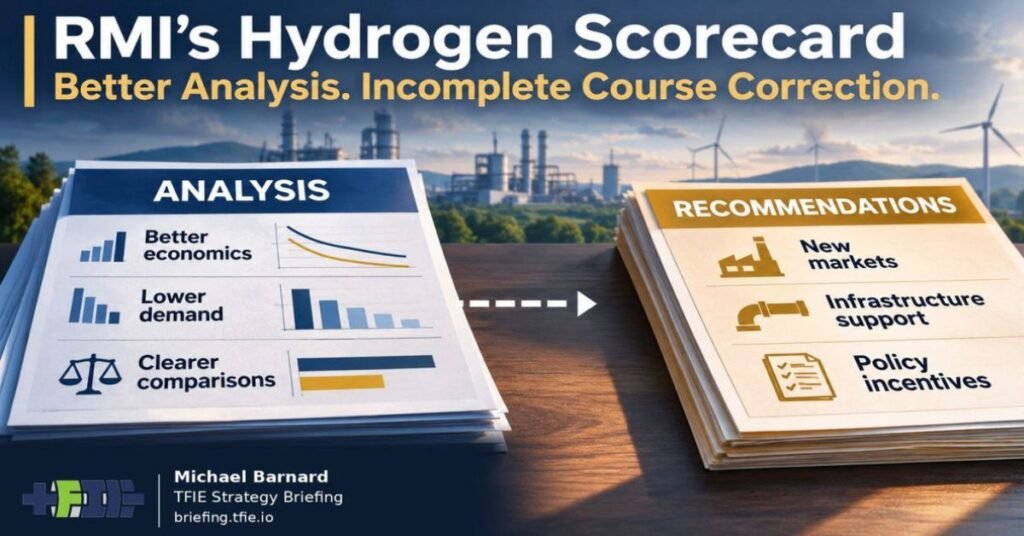
Hydrogen investment strategies need stronger comparisons with competing technologies before public funding supports new markets, analyst Michael Barnard argued in a commentary published on 22 November. His assessment of research by energy-transition organisation RMI highlights questions affecting Indian freight operators, green-fuel producers and infrastructure developers: where hydrogen is commercially justified, and where direct electrification offers better value.
Barnard credits RMI with more realistic assessments of hydrogen costs and demand, but questions whether its recommendations for subsidies and infrastructure sufficiently reflect those findings. His conclusions are an analytical critique, rather than a regulatory decision or an announcement of changes to RMI’s programmes.
What does RMI’s research show about hydrogen trucks?
RMI’s February 2026 study of hydrogen trucking in India compares diesel, battery-electric and hydrogen-powered vehicles across port terminal operations, e-commerce deliveries, construction transport and long-haul freight.
Its baseline modelling finds that fuel-cell electric trucks could become cheaper to operate than diesel alternatives by 2040, particularly in heavy-duty applications. However, they are not projected to achieve total cost of ownership parity with battery-electric trucks over the modelled period, including long-haul operations.
Hydrogen fuel costs offset potential savings from smaller batteries and lower vehicle purchase costs. RMI estimates that achieving parity with battery-electric trucks in 2030 would require hydrogen prices of approximately ₹300–400 per kilogram, around half its projected level.
RMI nevertheless identifies operational circumstances that could favour hydrogen, including tight schedules and limited charging time. It recommends pilots, vehicle incentives, refuelling infrastructure support and measures to reduce fuel costs. A separate lower-cost hydrogen scenario suggests that parity could become more achievable during 2030–2040.
Why are investment recommendations being questioned?
Barnard argues that hydrogen support should depend on evidence that a particular transport or industrial requirement cannot be met more effectively by alternatives.
He recommends explicit comparisons between technologies, clear investment thresholds and conditions for discontinuing support when commercial assumptions fail. His central concern is that identifying a cost disadvantage should influence whether infrastructure is developed, rather than automatically justify additional subsidies.
The distinction matters for freight investment because a technology’s ability to perform a task does not, by itself, establish that it offers the lowest-cost route to decarbonisation.
What does this mean for ammonia and methanol supply?
RMI’s August 2026 report on China’s green ammonia and methanol industries identifies a substantial gap between announced supply and market development.
By the end of 2025, announced production capacity exceeded 20 million tonnes for green ammonia and 23 million tonnes for green methanol. These figures describe project announcements, not operational output.
The report says production costs remain two to three times those of conventional pathways, while demand has not expanded at the same pace as supply ambitions. It identifies a particular oversupply risk for green ammonia.
RMI recommends stronger certification, lower production costs and demand development in shipping, chemicals and heavy industry. Its findings underline the importance of assessing fuel availability alongside credible buyers, rather than relying on announced capacity alone.
Where is demand development already focused?
Existing industrial consumption provides one route. In September 2026, RMI, the Center for Green Market Activation and 3Degrees launched the Green Ammonia Buyers Alliance to aggregate demand linked to fertiliser production.
The initiative connects food and beverage companies seeking lower supply-chain emissions with ammonia projects needing bankable customers. Its procurement approach addresses an existing industrial input, offering a different commercial proposition from establishing an entirely new fuel application.
For maritime fuel developers, the broader debate centres on matching production and infrastructure investment with identifiable end uses, realistic costs and purchasing commitments.
Recent Posts
Power & Propulsion
Everllence 175D Marine Engine Targets 1,500 Hours of Unmanned USV Operation
Tugboats
Zhejiang’s First Fully Electric Tugboat Enters Service at Ningbo-Zhoushan Port
Marine
ABB to acquire Ziehl-Abegg for $2.65 billion, expanding HVAC and industrial cooling portfolio