
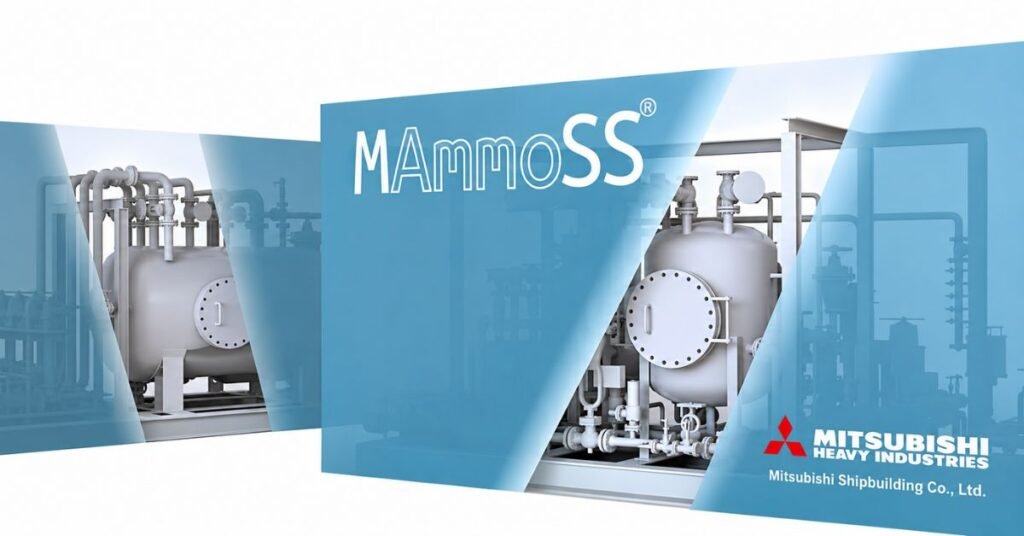
Mitsubishi Shipbuilding will supply ammonia fuel handling systems and provide the basic design for the fuel tanks on four Japanese car carriers scheduled for completion in 2030. The company announced its selection on 26 November 2026. The vessels, two each for K Line and NYK Line, are part of a project to link green ammonia procurement, including planned supplies from India, with ship-to-ship bunkering in Japan’s Chubu region.
What will Mitsubishi Shipbuilding supply?
The Mitsubishi Ammonia Supply and Safety System (MAmmoSS) combines equipment that feeds ammonia from the onboard tanks to the engines with a system for treating excess ammonia gas. Integrated controls link the two functions and provide for emergency shutdown. Mitsubishi Shipbuilding, part of Mitsubishi Heavy Industries, will also draw up the basic design for the vessels’ ammonia fuel tanks.
The four carriers will use dual-fuel engines capable of running on ammonia. The project partners say the tanks will be sized to carry enough ammonia for trans-Pacific voyages. The vessels will incorporate measures to prevent and detect leaks and neutralise ammonia if a leak occurs.
Who will build and operate the ammonia-fuelled car carriers?
Shin Kurushima Dockyard will lead the basic vessel design. It will work with Imabari Shipbuilding and Nihon Shipyard on the joint design and construction programme. Kawasaki Kisen Kaisha, known as K Line, and Nippon Yusen Kabushiki Kaisha, known as NYK Line, will each introduce two ships. The carriers are expected to transport finished vehicles for customers including Toyota Motor Corporation.
How will green ammonia reach the ships?
Energy company JERA plans to procure ammonia made using renewable energy from locations including India. It will develop ship-loading facilities at the ammonia receiving terminal next to its Hekinan Thermal Power Station. A dedicated bunkering vessel will load fuel there and transfer it directly to the car carriers, primarily at the ports of Nagoya and Mikawa.
Kyokuyo Shipyard will build the bunker vessel, which is also scheduled for completion in 2030. NYK or a wholly owned subsidiary will own and operate it. K Line and NYK plan to set up an equally owned joint venture to sell and supply the fuel. The seven project partners announced the broader plan on 27 October 2026, with Mitsubishi’s selection adding the supplier for the carriers’ onboard ammonia handling systems.
Japan has already tested ship-to-ship ammonia bunkering on a separate project. In September 2026, NYK and its partners transferred ammonia from the Shoei Maru to an ammonia-fuelled medium gas carrier at Japan Marine United’s Ariake Shipyard. The Chubu project sets out how similar transfers would support regular commercial car carrier operations.
FAQs
When are Japan’s four ammonia-fuelled car carriers due?
All four are scheduled for completion in 2030, the same year as the dedicated ammonia bunkering vessel.
What role could India play in the project?
JERA has identified India as one of the intended sources of green ammonia for the Chubu supply chain. The joint announcement did not name an Indian supplier or specify procurement volumes.
Recent Posts
Power & Propulsion
Wärtsilä 25 engines selected for four new Royal Wagenborg EasyMax 2.0 vessels
Ammonia
Höegh Autoliners receives ammonia fuel tank for ninth Aurora-class car carrier
EV
Gondan to build three battery-electric ferries for Gothenburg’s southern archipelago