
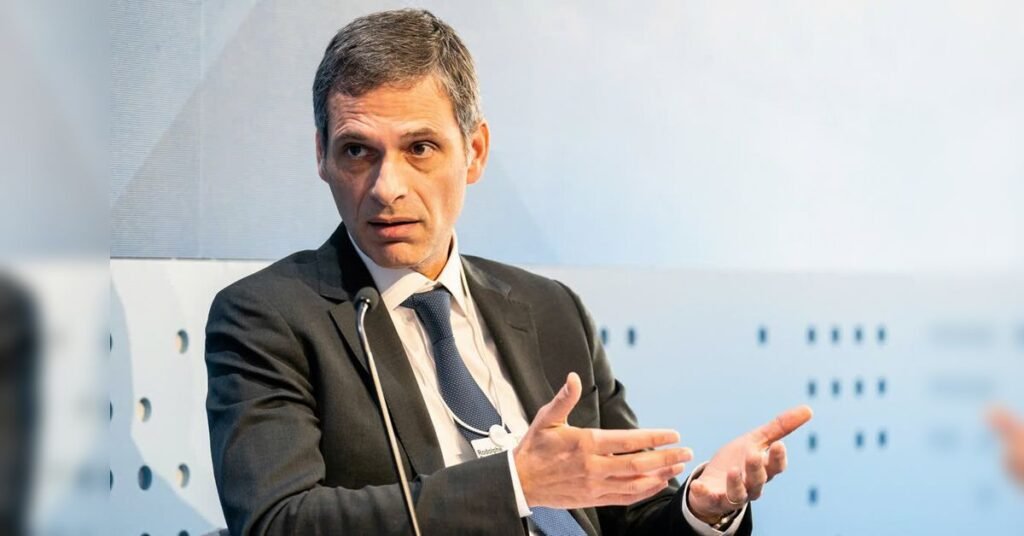
CMA CGM chairman and chief executive Rodolphe Saadé warned on 24 November 2026 that the shipping group would miss its 2050 net-zero target under current conditions. Speaking at the Assises de l’économie de la mer in Montpellier, France, he cited conflict-related shipping diversions, the time needed to develop lower-carbon fuels and the absence of common rules across major economies. Saadé estimated that decarbonising shipping globally would require more than US$1 trillion in investment by 2050. CMA CGM’s published sustainability roadmap continues to list net zero as its 2050 ambition.
How far is CMA CGM from its 2030 emissions target?
CMA CGM reported maritime greenhouse gas emissions of 33.3 million tonnes of carbon dioxide equivalent in 2025, compared with 33.6 million tonnes in its 2008 baseline. The figures are measured on a well-to-wake basis, which covers emissions from producing and supplying fuel through to its use on board. The company aims to reduce those emissions by 30 per cent from the 2008 baseline by 2030 and by 80 per cent by 2040. Meeting the 2030 target would require annual maritime emissions to fall by about 9.8 million tonnes from their 2025 level.
Over the same period, the group reported a 58 per cent decline in emissions per twenty-foot equivalent unit (TEU) carried one kilometre. Annual container volumes rose from about 8.9 million TEUs in 2008 to 24.2 million in 2025. Longer voyages around the Cape of Good Hope have also slowed emissions progress, according to the group’s sustainability reporting.
How is CMA CGM securing fuel for its dual-fuel fleet?
CMA CGM counted 90 dual-fuel vessels in 2025 and says it will operate 208 by 2031. How much the expanded fleet cuts emissions will depend in part on the availability and price of fuels such as biomethane and biomethanol at ports the ships serve.
One supply initiative is a framework agreement with French energy group ENGIE to develop a biomethane plant in the Le Havre industrial and port area. The companies envisage supplying 7,000 tonnes of biomethane annually to CMA CGM’s fleet. The fuel can be used by its liquefied natural gas (LNG) vessels without engine modifications. The project still requires a final investment decision.
What is at stake in the IMO negotiations?
Saadé’s remarks came as the International Maritime Organization (IMO) resumed working-level talks on measures to reduce shipping emissions. Its draft Net-Zero Framework combines a global marine fuel standard with a greenhouse gas pricing mechanism. The IMO approved the draft in April 2025, and formal adoption was deferred in October that year. The Marine Environment Protection Committee is scheduled to consider outstanding issues in London from 30 November to 3 December 2026.
FAQs
Did CMA CGM announce a new deadline for net zero?
Saadé warned that the group was unlikely to meet its 2050 target under current conditions and gave no replacement date.
What is CMA CGM’s next maritime emissions milestone?
The company aims to cut annual maritime greenhouse gas emissions by 30 per cent from its 2008 baseline by 2030, implying a level of about 23.5 million tonnes of carbon dioxide equivalent.
Recent Posts
Power & Propulsion
Wärtsilä 25 engines selected for four new Royal Wagenborg EasyMax 2.0 vessels
Ammonia
Höegh Autoliners receives ammonia fuel tank for ninth Aurora-class car carrier
EV
Gondan to build three battery-electric ferries for Gothenburg’s southern archipelago