
Summary
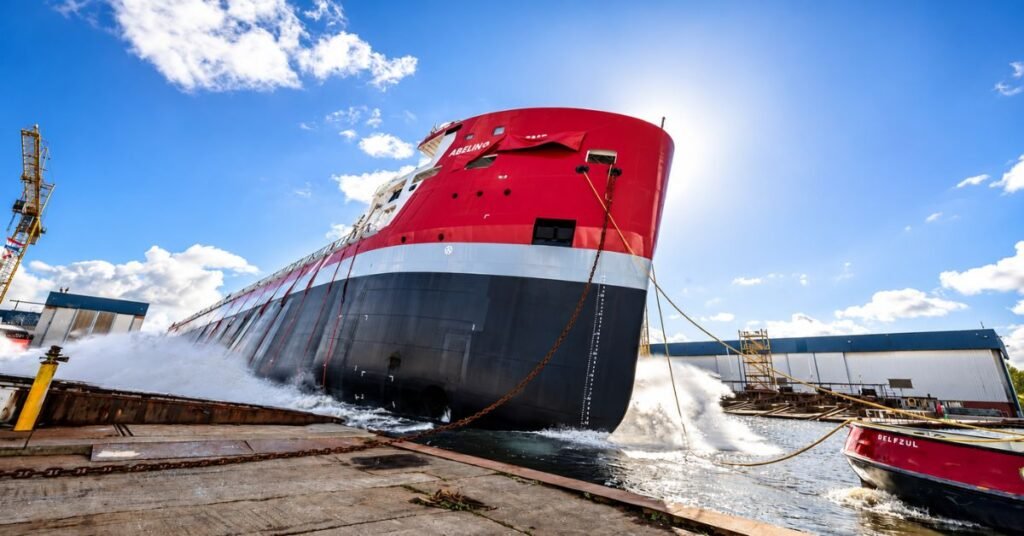
Royal Wagenborg has launched Abelina Wagenborg, the first vessel in its EasyMax 2.0 series, at Royal Niestern Sander in the Netherlands. The general cargo ship combines a focus on efficient cargo transport with preparations for future fuel conversions, including methanol, ammonia and LNG, as Wagenborg advances its fleet renewal programme.
First vessel of a six-ship programme
Abelina Wagenborg was named and launched on 8 October 2026 at Royal Niestern Sander’s shipyard in Delfzijl. It is Wagenborg’s seventh EasyMax vessel and the first built to the second-generation design, which incorporates operating experience from the earlier ships.
The launch brings the company’s next-generation newbuilding programme closer to commercial service. Wagenborg’s latest published schedule places delivery of the first EasyMax 2.0 vessel in the first quarter of 2027. That timetable follows the launch and allows for the remaining work before handover.
Wagenborg has commissioned six vessels of the new design from Niestern Sander. The programme continues a partnership between the shipowner and shipbuilder, with cargo capacity, fuel consumption and operational flexibility central to the development of the series.
Fuel flexibility built into the design
The EasyMax 2.0 vessels are intended to operate on marine gas oil, including bio-MGO, when delivered. Their design also provides for subsequent conversion to LNG, methanol or ammonia without reducing cargo hold capacity.
That distinction is significant: the launch marks the arrival of a vessel prepared for future fuel changes, rather than confirmation that it already operates on all three alternatives. Wagenborg’s approach allows the ships to begin service using established fuel arrangements while retaining options for later adaptation.
Fleet director Theo Klimp has described the design strategy as a way to maintain dependable transport while preserving flexibility over future fuel choices. The company expects conversion decisions to depend on when alternative fuels become technically and economically feasible.
For cargo owners, the commercial relevance lies in maintaining carrying capacity through those potential changes. Preserving hold space is particularly important for a general cargo vessel whose earning capability depends on the volume and weight of freight it can accommodate.
Cargo capacity and energy management
Published specifications for the next-generation series include a length of 149.95 metres, a beam of 15.95 metres and a maximum draught of 8.60 metres. The design has a deadweight of 14,300 tonnes and cargo hold volume of 625,000 cubic feet.
The ships are specified with Finnish-Swedish ice class 1A. Alongside fuel conversion preparations, the design includes enhanced shore power connectivity and improved onboard energy management systems.
These features extend the programme’s efficiency focus beyond propulsion fuel alone. Wagenborg has identified them as part of its effort to reduce greenhouse gas emissions and improve operating efficiency across the new series.
Building on the original EasyMax
The first-generation EasyMax concept combined substantial cargo intake with a hull and propulsion arrangement designed for low fuel consumption. Its two rectangular holds accommodate different cargo types, including timber, paper and heavier freight.
An important feature of the original layout was the positioning of the bridge and accommodation towards the bow. This arrangement created additional space for holds and deck cargo farther aft while improving visibility over cargo carried on deck.
The original concept also used a hull optimised for different draughts and a coordinated engine, gearbox and propeller arrangement. EasyMax 2.0 carries that emphasis on transport efficiency into a design with broader fuel options.
Engine agreement supports fleet renewal
In a related development announced on 2 October, Wagenborg signed an agreement with Wärtsilä for four fuel-flex main engines intended for new EasyMax 2.0 vessels.
The agreement builds on a longstanding relationship between the companies. Approximately 90 Wärtsilä engines are already operating across Wagenborg’s fleet, providing an established base of experience with the manufacturer’s equipment.
The newbuilding programme also draws on the northern Netherlands’ maritime supply chain, bringing together designers, equipment suppliers, installers and shipbuilding specialists.
Abelina Wagenborg’s name links the programme to the company’s origins. Abelina was the wife of founder Egbert Wagenborg, whose name was given to the first EasyMax in 2017. Jacqueline Vuursteen, Jeanette Wagenborg and Aletta Wagenborg served as godmothers at the latest naming ceremony.
FAQs
What is Abelina Wagenborg?
It is Royal Wagenborg’s seventh EasyMax vessel and the first of the new EasyMax 2.0 generation.
Which fuels will the vessel use?
The design provides for operation on marine gas oil, including bio-MGO, with preparations for future conversion to methanol, ammonia or LNG.
When is delivery expected?
Wagenborg’s latest published schedule indicates the first quarter of 2027.
How many EasyMax 2.0 vessels are planned?
Wagenborg has commissioned six vessels from Royal Niestern Sander.
Who is the vessel named after?
Abelina, the wife of company founder Egbert Wagenborg.
Recent Posts
Marine
ABS and US Department of Energy Sign MOU on Maritime Nuclear Technology
Fuels
Repsol Supplies B30 Co-Processed Marine Fuel to NCLH in Barcelona
Ammonia
Viking Energy Set for Ammonia Bunkering Test After Norwegian Safety Approval