
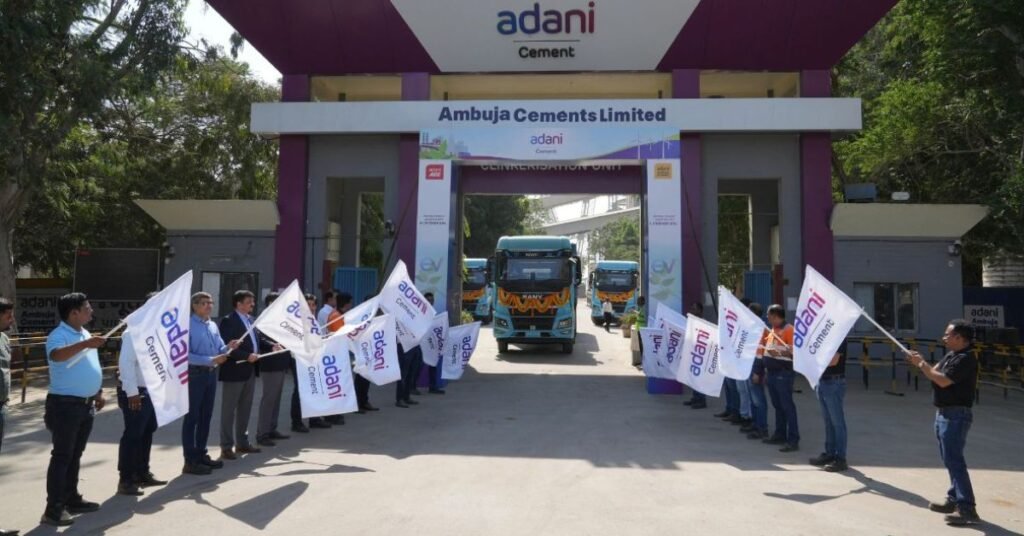
Adani Cement has begun deploying heavy-duty electric trucks at its Sanghi plant in Gujarat as the first stage of a programme to electrify clinker and cement transportation. Announced on 18 November 2026, the initiative targets 410 trucks by March 2027, with further expansion planned across its manufacturing network.
The company’s longer-term objective is to move 10% of its road logistics volume through electric vehicles by 2030, supported by a fleet exceeding 2,000 trucks. The Sanghi launch marks the start of deployment, rather than confirmation that all 410 first-phase vehicles are already operating.
What savings does Adani Cement expect?
Adani Cement estimates that the planned 410-truck fleet could avoid more than 25,000 tonnes of carbon dioxide emissions annually and displace approximately 11 million litres of diesel each year.
Vinod Bahety, Chief Executive Officer of Adani Group’s cement business, said the company had identified additional routes for electric transport. He linked the programme to reducing emissions and limiting exposure to diesel-price fluctuations.
The announcement did not disclose the truck manufacturer, vehicle specifications, procurement cost, charging locations or the number introduced at Sanghi. The emissions and diesel-displacement figures are projections for the planned fleet, rather than measured results from the initial deployment.
Why is Sanghi significant for cement logistics?
The Sanghipuram complex in Gujarat’s Kutch district combines cement manufacturing with its own maritime infrastructure. Sanghi Industries’ 2023–24 annual report recorded clinker capacity of 6.6 million tonnes per annum and cement capacity of 6.1 million tonnes per annum at the site.
The integrated facility also has a captive jetty and power infrastructure. Its location gives the business access to coastal distribution alongside road transport, making logistics an important part of the plant’s operating model.
When announcing the Sanghi acquisition in 2023, Adani outlined plans to strengthen coastal movement of clinker and bulk cement to western and southern Indian markets. The proposal included expanding the captive port to accommodate vessels of 8,000 deadweight tonnes.
That historical plan provides context for Sanghi’s role in the group’s distribution network. The electric-truck announcement does not establish that the new vehicles are assigned specifically to jetty movements or confirm the completion of those earlier port-expansion proposals.
How does the deployment fit India’s electric freight transition?
Cement, steel, ports and logistics were among the sectors identified by the Ministry of Heavy Industries when it introduced electric-truck incentives in July 2025.
Under the PM Electric Drive Revolution in Innovative Vehicle Enhancement, or PM E-DRIVE, framework, eligible trucks can receive incentives of up to ₹9.6 lakh, depending on vehicle weight. Qualification requires the scrapping of an old truck.
The scheme also specifies manufacturer-backed warranties covering batteries for five years or 500,000 kilometres, and vehicles and motors for five years or 250,000 kilometres, whichever comes first. Adani’s announcement does not state whether its fleet will receive these incentives.
What will determine progress towards the fleet target?
The immediate milestone is the deployment of 410 vehicles by March 2027. Achieving the wider 2030 objective will require the programme to expand beyond Sanghi and integrate charging with regular clinker and cement dispatch schedules.
For comparison, Montra Electric’s July 2026 announcement with Wonder Cement paired a proposed deployment of around 250 trucks with 13 charging stations and 39 chargers serving Nimbahera–Dahej and Nimbahera–Tuna port routes. That programme illustrates the supporting infrastructure involved in electrifying industrial freight corridors.
Recent Posts
Power & Propulsion
Everllence 175D Marine Engine Targets 1,500 Hours of Unmanned USV Operation
Tugboats
Zhejiang’s First Fully Electric Tugboat Enters Service at Ningbo-Zhoushan Port
Marine
ABB to acquire Ziehl-Abegg for $2.65 billion, expanding HVAC and industrial cooling portfolio