
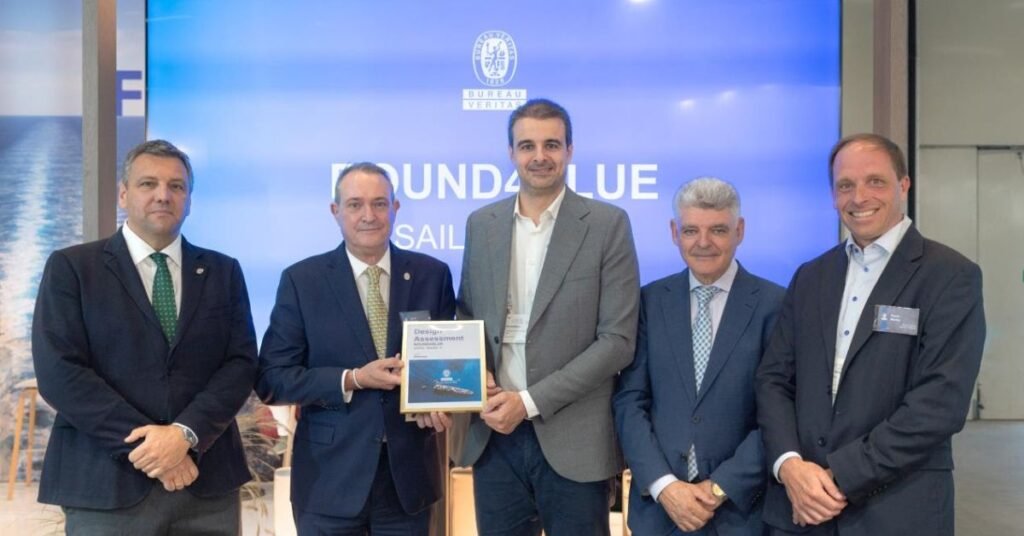
Spanish wind propulsion company bound4blue has received a Design Assessment from Bureau Veritas Marine & Offshore for its Model 3-24 eSAIL suction sail system.
The assessment was presented during a handover ceremony at SMM 2026 in Hamburg. It confirms that the Model 3-24 design has undergone an independent review against Bureau Veritas’ technical requirements.
The assessment comes as bound4blue expands the commercial deployment of its suction sail technology across several shipping segments.
Model 3-24 expands eSAIL technology
The Model 3 range is available in heights ranging from 24 metres to 36 metres. The 3-24 model entered commercial service earlier this year aboard Klaveness Combination Carriers’ newbuild MV Baltazar.
The system features an enlarged surface area and an aerodynamic profile designed to increase the contribution of wind propulsion on larger vessels.
According to bound4blue, more than 50 eSAIL units have now been ordered, with installations completed on 13 operational vessels. A further six vessels are currently included in the company’s orderbook.
Bureau Veritas assesses design
The Design Assessment provides an independent review of the Model 3-24 against Bureau Veritas’ technical requirements.
David Barrow, SVP for Western Europe and Americas at Bureau Veritas Marine & Offshore, said: “Wind propulsion is becoming an increasingly important element of the maritime industry’s decarbonisation journey, and independent technical assessment helps provide confidence as these technologies continue to mature and scale. Through this Design Assessment, Bureau Veritas is pleased to support bound4blue in advancing safe and reliable innovation, helping shipowners reduce emissions while maintaining robust technical standards.“
José Miguel Bermúdez, CEO and co-founder of bound4blue, said: “As the market matures, confidence becomes just as important as innovation”
He added: “So, as wind takes its place within mainstream fleet investment, independent assessments really do play an increasingly important role in differentiating and substantiating technical solutions.
“Here at bound4blue it’s been a focus since day one. We are committed to engaging with leading Class societies to demonstrate the quality and potential of our proprietary technology. By doing so we provide owners, yards and wider industry stakeholders with the reassurance they need to embrace the wind revolution and unlock significant environmental and business benefits. We’re delighted to achieve this latest recognition from Bureau Veritas as we continue to cement our position as a trusted industry partner.”
How does the eSAIL system work?
The Model 3-24 builds on bound4blue’s Model 2 platform and uses boundary-layer suction to draw air across an aerodynamically optimised surface. The company says this generates propulsive force substantially greater than that produced by rigid sails of comparable size.
The system is designed for autonomous operation and installation alongside conventional propulsion systems. It can be deployed on both newbuild vessels and existing ships through retrofit installations.
The technology can also operate alongside alternative marine fuels, including methanol and ammonia, allowing wind propulsion to be combined with other decarbonisation measures.
Wind propulsion and maritime emissions regulations
bound4blue says its eSAIL technology can help reduce fuel consumption and associated CO₂ emissions. The system is also designed without ATEX requirements, according to the company.
Wind-assisted propulsion can contribute to shipowners’ efforts to meet requirements associated with FuelEU Maritime and the EU Emissions Trading System, as well as improve vessel performance under the Carbon Intensity Indicator (CII) and Energy Efficiency Existing Ship Index (EEXI) frameworks.
The company says its eSAIL systems have achieved double-digit fuel savings in commercial operations, with typical payback periods of less than five years.
Adoption across shipping segments
The technology has been adopted by several shipping companies, including Maersk Tankers, Eastern Pacific Shipping, Odfjell and Louis Dreyfus Company.
The systems are designed as plug-and-play units that can be incorporated into both newbuild and existing vessels. Their ability to work alongside conventional propulsion and alternative fuels allows wind assistance to form part of broader vessel decarbonisation strategies.
Recent Posts
Biofuels
WinGD Ethanol-Fuelled Engine Completes First In-Service Voyage on Maersk Vessel
Power & Propulsion
Norsepower Rotor Sails Installed on Airbus Cargo Ship Spirit of Toulouse
EV
Estonia Electric Ferry to Combine Steerprop Propulsion with Battery Power