
Summary
QatarEnergy has signed two agreements to purchase up to four million tonnes of LNG annually from Cheniere’s US Gulf Coast terminals through 2054. Deliveries are expected to begin in 2031, expanding QatarEnergy’s international supply portfolio, while part of the contracted volume depends on investment approval for a Sabine Pass expansion.
Article
Two terminals to supply QatarEnergy
The Cheniere–QatarEnergy LNG deal will provide the Qatari energy company with long-term supplies from Sabine Pass in Louisiana and Corpus Christi in Texas, strengthening its access to production outside its home market.
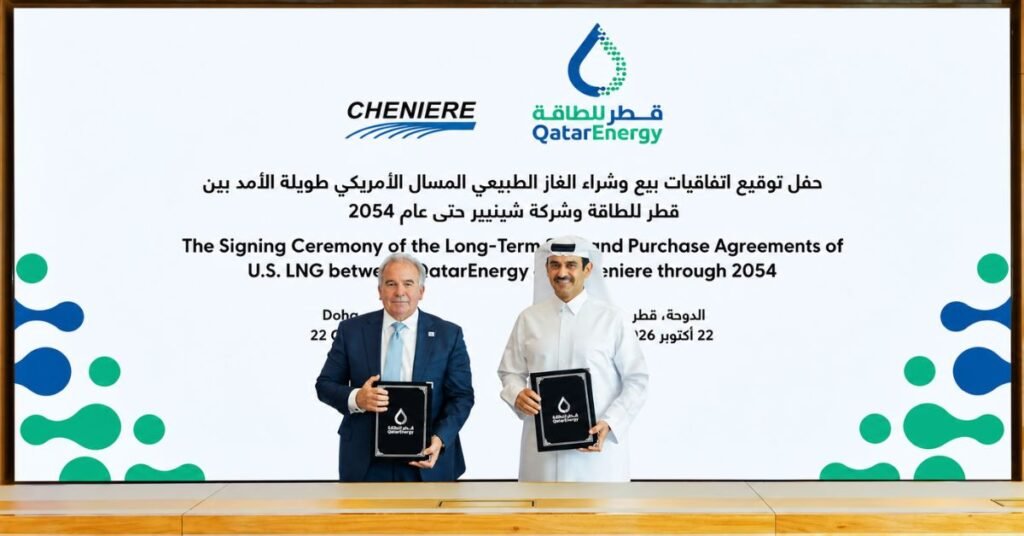
Announced on 22 October 2026, the agreements cover two million tonnes per annum from each facility. Cheniere’s subsidiaries, Sabine Pass Liquefaction and Corpus Christi Liquefaction, entered into separate sale and purchase agreements with QatarEnergy.
Purchases will be made on a free-on-board basis, with prices linked to the US Henry Hub natural gas benchmark plus a fixed fee. Cheniere described deliveries as beginning in the early 2030s and continuing until the end of 2054.
QatarEnergy indicated that shipments are anticipated to commence in 2031. The company positioned the purchases as an addition to its existing supplies, supporting the development of a more diversified and flexible global LNG business.
Portfolio expansion drives the purchase
The agreements were signed by Saad Sherida Al-Kaabi, Qatar’s Minister of State for Energy Affairs and QatarEnergy’s President and Chief Executive Officer, and Jack Fusco, Cheniere’s Chairman, President and Chief Executive Officer.
Al-Kaabi said the additional volumes would strengthen QatarEnergy’s supply and trading portfolio and improve its ability to meet customer requirements internationally.
The commercial significance extends beyond securing additional tonnes. Access to production from two US export locations adds another source of supply to QatarEnergy’s portfolio, creating opportunities to match cargo availability with customers’ delivery requirements.
The announcement concerns purchases for QatarEnergy’s wider business. It does not identify final receiving terminals or allocate the contracted volumes to particular importing countries.
Part of the volume depends on expansion approval
One million tonnes annually under the Sabine Pass agreement is conditional on a positive final investment decision for the first phase of the terminal’s proposed expansion.
This links part of the purchase commitment to additional liquefaction infrastructure. The companies have therefore established a long-term commercial arrangement while retaining an investment condition for that portion of supply.
Cheniere is developing the broader Sabine Pass expansion in phases. The overall proposal could add approximately 20 million tonnes annually, including estimated debottlenecking opportunities, increasing the facility’s production capacity to more than 50 million tonnes a year.
Train 7 preparations provide earlier context
Preparatory work for the expansion advanced in May 2026, when Cheniere awarded Bechtel a lump-sum, turnkey engineering, procurement and construction contract for its first phase.
The planned facilities include Train 7, a boil-off gas reliquefaction unit, supporting infrastructure and connections to the existing terminal. Cheniere expects the phase to add more than six million tonnes of annual production capacity, including debottlenecking opportunities.
A limited notice to proceed authorised early engineering and procurement. In its June project update, Cheniere targeted a final investment decision by early 2027, subject to necessary regulatory approvals and acceptable financing.
The distinction matters for the supply agreement: preparatory engineering and procurement have progressed, but the expansion still requires investment approval.
Established export infrastructure supports future trade
Sabine Pass already has six liquefaction trains, LNG storage tanks and three marine berths. Bechtel delivered the existing trains between 2016 and 2022, creating approximately 30 million tonnes of annual export capacity.
The proposed seventh train builds on that established infrastructure. Its design combines an approximately five-million-tonne liquefaction train with roughly one million tonnes of boil-off gas reliquefaction capacity.
For the maritime sector, the agreements establish a substantial prospective cargo stream extending into the 2050s. However, the announcements do not specify vessel employment, voyage patterns or dedicated charter arrangements.
Their immediate significance is the connection between long-term purchasing commitments and US export capacity development. For QatarEnergy, the contracts broaden supply options; for Cheniere, they add a major international counterparty as it progresses its next expansion phase.
FAQs
How much LNG will QatarEnergy purchase?
The agreements cover up to four million tonnes annually, split equally between Sabine Pass and Corpus Christi.
When are deliveries expected to begin?
QatarEnergy anticipates deliveries from 2031, continuing through 2054.
How will the LNG be priced?
Prices will be indexed to Henry Hub plus a fixed fee.
Is any supply conditional on new infrastructure?
Yes. One million tonnes annually from Sabine Pass depends on a positive final investment decision for the expansion’s first phase.
Have destination markets been announced?
The announcements do not identify specific importing countries or receiving terminals.
Recent Posts
Ports & Harbours
VOC Port’s Tuticorin International Container Terminal Declared Green Terminal After Full Equipment Electrification
Hydrogen
India Could Become Leading Green Hydrogen Producer and Exporter, Says Gadkari
Fuels
Offshore Vessel Fuel Efficiency Offers Immediate Savings, Says Opsealog