
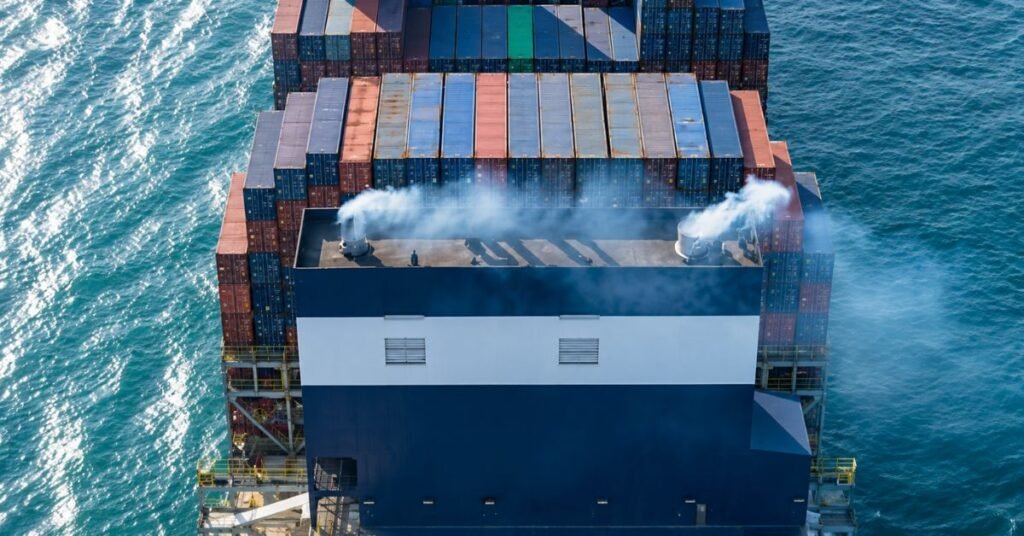
The International Council on Combustion Engines (CIMAC) has called for a single global framework to cut shipping emissions, warning that uncertainty over fuel standards, carbon costs, and compliance could delay investment in cleaner propulsion and marine fuels. The call comes ahead of International Maritime Organization (IMO) talks in late November, when member states are due to revisit draft rules that would set a global marine fuel standard and introduce emissions pricing.
What does CIMAC want from the IMO Net-Zero Framework?
CIMAC’s Greenhouse Gas Strategy Group is seeking clearer rules on how shipping companies would demonstrate compliance, how fuel emissions would be accounted for, and how carbon charges and incentives would apply. Those details affect decisions across the supply chain, from the engines shipowners specify for new builds to whether fuel producers and ports invest in production, storage, and bunkering facilities.
The group warned that separate regional regimes could leave ships trading internationally subject to different certification and compliance requirements. It favours a technology-neutral approach that assesses fuels and propulsion systems on their verified greenhouse gas performance. For marine fuels, the IMO’s lifecycle methodology assesses emissions from production and delivery through to use on board.
Where do the global shipping emissions rules stand?
The IMO’s Marine Environment Protection Committee (MEPC) approved the draft framework in April 2025. It proposed progressively tightening limits on the greenhouse gas intensity of energy used on board and introducing a global emissions pricing mechanism. The measures are intended to support the IMO’s goal of reaching net-zero greenhouse gas emissions from international shipping by or around 2050. Formal adoption was deferred in October 2025, and member states can propose changes to the draft.
The next working group is scheduled for 23 to 27 November 2026, followed by the committee’s 85th session from 30 November to 3 December. The IMO has provisionally scheduled the resumption of its extraordinary session for 4 December, subject to confirmation by the committee.
Why does CIMAC emphasise energy efficiency?
CIMAC says improvements in vessel and propulsion efficiency can lower fuel consumption and emissions while supplies of lower-emission marine fuels are still developing. Using less energy per voyage would also reduce the volume of alternative fuel needed as more ships switch to it. The group sees those savings as a way to ease pressure on fuel supply while producers expand capacity.
FAQs
Has the IMO adopted the Net-Zero Framework?
The committee approved draft measures in April 2025. Formal adoption remains pending, and member states can still propose amendments.
What is a technology-neutral approach to marine fuels?
Under the approach CIMAC supports, different fuels and propulsion technologies would qualify based on their verified greenhouse gas performance. For fuels, a lifecycle assessment takes into account how they are made and delivered, as well as emissions from their use on board.
Recent Posts
Marine
Clean Shipping Alliance seeks risk evidence behind Greenland’s scrubber discharge restrictions
EV
Lloyd’s Register adds FIRE (EV) notation to strengthen vehicle-carrier fire protection
Policy
Hong Kong and Piraeus sign green shipping corridor pact to support Asia–Europe decarbonisation