

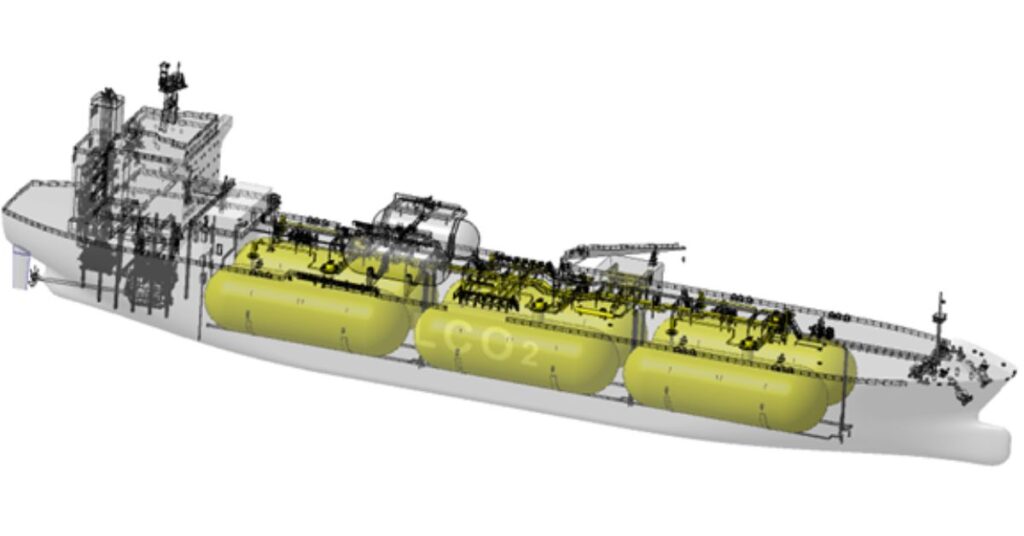
ClassNK has issued a General Design Approval (GDA) for a low-pressure liquefied CO₂ (LCO₂) cargo tank developed by Mitsubishi Shipbuilding Co., Ltd. The approval confirms that the tank design complies with ClassNK rules at the detailed engineering level. It is the first GDA worldwide for an LCO₂ cargo tank constructed using KF460 steel and designed without post-weld heat treatment (PWHT).
ECA-Based Approach Allows Omission of PWHT
The GDA incorporates a safety assessment based on Engineering Critical Assessment (ECA), a fracture mechanics method used to evaluate the structural integrity of welded components. This approach enables the omission of PWHT, a process that can create bottlenecks in tank fabrication.
ClassNK previously issued an Approval in Principle (AiP) for Mitsubishi Shipbuilding’s ECA methodology in September 2024.
Material and Structural Evaluation
The detailed design review drew on assessments conducted by Mitsubishi Shipbuilding and material property evaluations of KF460 steel, developed by Nippon Steel Corporation and compliant with ClassNK standards. Using ECA, the companies verified that the tank maintains structural safety under the required temperature conditions.
ClassNK then reviewed the tank in accordance with Part N of its Rules and Guidance for the Survey and Construction of Steel Ships. The classification society confirmed that the tank satisfies the prescribed criteria even without PWHT, leading to the issuance of the GDA.
This is the first time ClassNK has granted a GDA for an LCO₂ cargo tank.
Ongoing Role in Carbon-Neutral Technologies
ClassNK stated it will continue supporting technologies that advance carbon-neutral shipping through safety assessments and related activities.
Recent Posts
Ammonia
Reliance Industries Limited (RIL) has signed a binding long-term supply and purchase agreement (SPA) with Samsung C&T Corporation for the export of green ammonia over a 15-year period.
Bunkering
Ofiniti Raises $6.8 Million to Scale Digital Bunkering Platform for Global Shipping
Hydrogen
Hefring Marine and Ecomar Propulsion partner to deploy monitoring system on hydrogen-electric vessel