
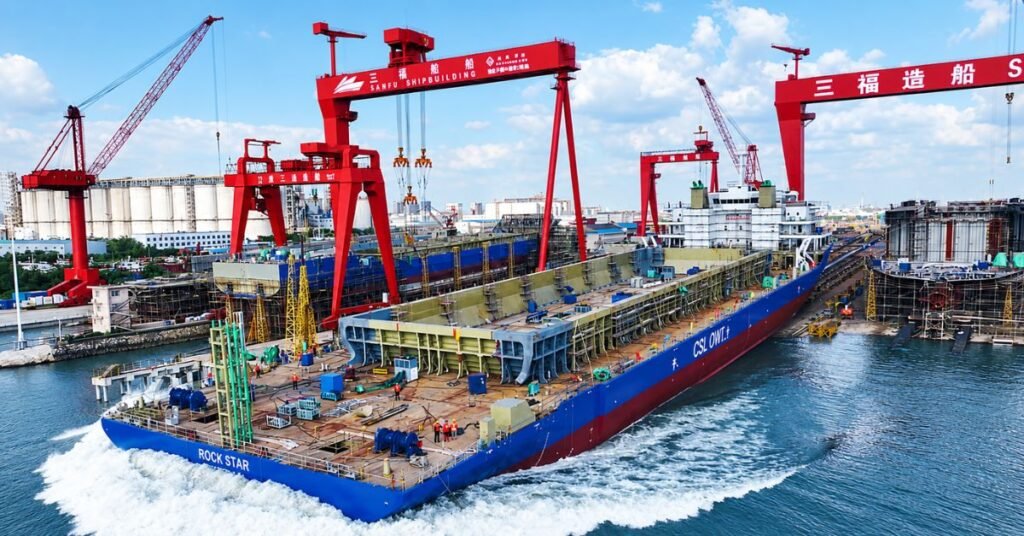
Rotterdam-based CSL OWL Subsea Rock Installation has announced the launch of Rock Star, the first of two purpose-built vessels designed to support offshore wind construction and maintenance. The announcement on September 23, 2026, marks progress in the partnership’s programme to provide specialised rock-placement capacity with marine gas oil and methanol fuel capability.
The partnership between The CSL Group and Offshore Wind Logistics (OWL) is developing the vessels for operations around bottom-fixed wind farms and associated subsea cables. Each vessel is designed to carry 17,500 tonnes of rock and operate in water depths of up to 100 metres.
What offshore work will Rock Star perform?
Rock Star and its sister vessel will undertake scour protection, cable burial and protection, and other subsea rock installation activities supporting offshore wind infrastructure.
The vessels will transport rock to project sites and place it on the seabed. CSL OWL’s services also include maintenance of existing rock berms, extending their role beyond initial wind farm construction.
The company describes its operating focus as providing dedicated installation capacity for renewable energy projects by combining marine transport with controlled seabed placement.
How will the vessel place rock accurately?
The vessel is equipped with dynamic positioning Class 2, commonly known as DP2, and a tremie pipe with active motion compensation for controlled rock placement.
Its installation equipment can handle 60–300 kg rock grading, including individual rocks weighing up to 450 kg. Additional arrangements allow larger armour rock to be handled.
The original construction announcement specified transport belts designed for rocks weighing up to 1,500 kg, along with a side chute for larger armour gradings. Excavators can also be used to handle larger material.
These different handling arrangements provide operational flexibility, allowing equipment to be selected according to the rock specification and installation task.
What is the construction programme’s timeline?
CSL OWL announced the two-vessel programme on November 21, 2024. Construction of the first vessel began with a steel-cutting ceremony on September 12, 2025, when project manager Piet Jan van der Giessen activated the cutter for the first steel plate.
The original schedule envisaged delivery of the first vessel in August 2026 and the second in November 2026. The September launch announcement did not provide a revised delivery date for Rock Star. Its launch therefore represents a construction milestone ahead of entry into service.
What does methanol capability mean for emissions?
CSL OWL says the vessels are designed to operate on marine gas oil (MGO) and methanol, providing flexibility in fuel selection.
The emissions benefit of methanol depends on how it is produced and supplied. The International Maritime Organization’s lifecycle assessment framework considers emissions from fuel production and transport through to onboard consumption. Methanol capability alone, therefore, does not establish a vessel’s lifecycle emissions performance.
How does the project fit CSL’s offshore expansion?
The newbuilds form part of CSL’s expansion into offshore energy logistics. In 2024, the group established CSL Offshore Logistics, focusing on rock sourcing and transport for offshore wind projects.
Its Netherlands-based partnership with OWL added subsea rock installation to that offering. Separately, CSL acquired a 50% stake in Norway’s Peak Group and established Peak CSL Group to provide supply-chain services for European offshore wind projects.
Together, these initiatives extend CSL’s activities across the sourcing, transport and seabed installation of rock used in offshore energy infrastructure.
Recent Posts
Ammonia
Aegis Tristar acquisition to expand Indian group’s global energy logistics reach
Power & Propulsion
Everllence and MITSUI E&S Mark 100 Years of Two-Stroke Engine Partnership
Ammonia
NTPC Targets Japan, South Korea and Germany for Green Ammonia Exports from Andhra Pradesh Hub