
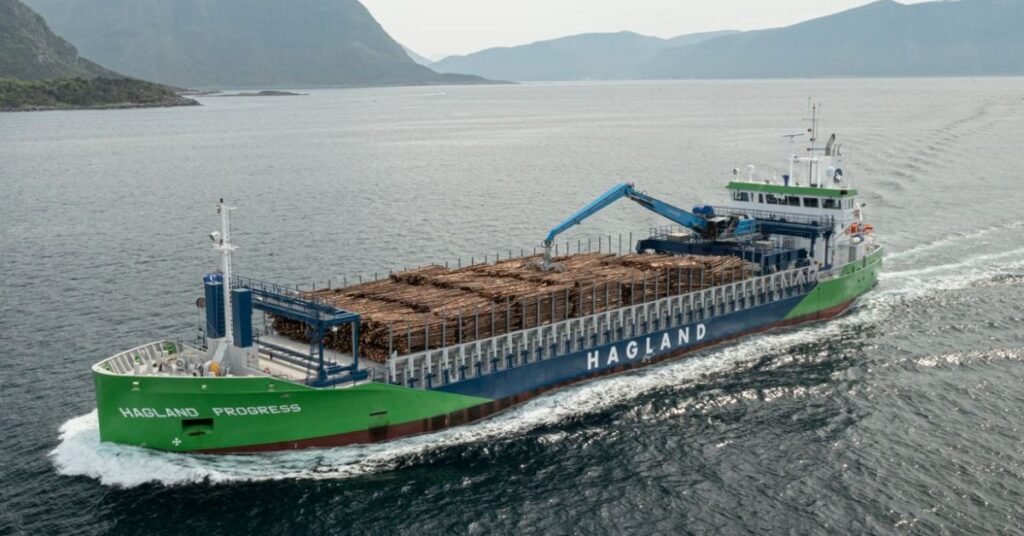
Norway’s Enova has awarded approximately NOK420 million to support 12 battery-powered vessels and two charging facilities, with projects spanning bulk shipping and aquaculture. Announced on 5 November 2026, the funding aims to extend fully electric operations beyond established applications and support an estimated annual reduction of 21,300 tonnes of carbon dioxide emissions.
The package includes vessel conversions, newbuildings and shore infrastructure. Its largest allocation will help Hagland Shipping develop battery-swapping bulk carriers for Norwegian coastal and Northern European services.
How will Hagland’s battery-swapping ships operate?
Hagland Bulk Transport KS will receive NOK235.9 million to convert four bulk carriers, including Hagland Progress. Each vessel is planned to carry 40 megawatt-hours of battery capacity and use fully charged replacement batteries exchanged in port.
Zen will operate the charging and battery-swapping system. The vessels will also receive energy-saving wing sails. Enova describes the project as a prospective first for battery-powered bulk shipping between Norway and other countries.
Kristiansand Havn IKS has separately secured NOK15 million for charging and battery-swapping infrastructure at Gismerøya in Mandal. Operations are targeted towards the end of 2028.
Hagland’s Paal W. Aanensen said the award represented progress towards the battery-swapping concept, while infrastructure, operating arrangements and regulatory questions still required clarification. The funding therefore supports project development rather than marking the start of commercial electric services.
Which other vessels will receive support?
Bulk Loaders AS has been allocated NOK89.2 million for a new battery-powered cargo vessel serving the oil industry, principally between Stavanger and Kristiansund.
The vessel will replace older tonnage and carry both dry cargo and liquid products. Its planned 15-megawatt-hour battery system will primarily charge from shore while cargo is loaded or discharged. The project is also intended to attract freight currently transported by road.
In aquaculture, Grieg New Energy will receive approximately NOK64.5 million for two battery-powered service vessels and a charging facility. Steinarbo Invest, based in Ulsteinvik, will receive NOK15 million for five new battery-powered workboats.
How does this build on Hagland’s fleet renewal?
Hagland has already invested in battery-hybrid vessels as part of its short-sea fleet renewal programme. In April 2026, it took delivery of Hagland Polaris, the first of four vessels in a series built by Royal Bodewes.
That series builds on three ships delivered in 2022 and 2023. Its features include plug-in battery-hybrid propulsion, electrically operated cargo-handling equipment and systems that convert surplus engine heat into electricity.
Hagland has identified shore-power availability as an important factor in achieving further emissions reductions from these vessels. The new battery-swapping proposal would take electrification further by enabling voyages powered entirely by batteries.
Why does shore infrastructure matter?
The supported projects use different approaches to replenishing energy. Hagland’s concept separates battery charging from vessel turnaround by exchanging depleted packs, while Bulk Loaders intends to charge during cargo operations.
Both approaches make port infrastructure part of the vessel’s operating system. Their commercial performance will depend on coordinating energy availability with sailing schedules and cargo-handling requirements.
Enova’s maritime programmes reflect this connection: they support battery-electric vessels and dedicated charging infrastructure, alongside a separate programme for publicly accessible vessel chargers.
How extensive is Norway’s maritime transition funding?
During the first half of 2026, Enova supported 19 maritime transport projects with approximately NOK1.4 billion. These covered electrification, hydrogen and ammonia propulsion, charging infrastructure and emerging maritime technologies.
Enova identifies batteries as the largest project category, while hydrogen and ammonia remain part of its approach for vessel operations where batteries alone are insufficient. The latest awards add further cargo-shipping and aquaculture applications to that programme.
Recent Posts
LNG
EU shipping emissions rules open new market for bio-LNG, says IEA
LNG
AxDo secures 11-year LNG supply deal for planned Bahamas bunkering hub
LNG
LNG bunkering fleet faces major expansion as DNV projects need for up to 208 vessels