
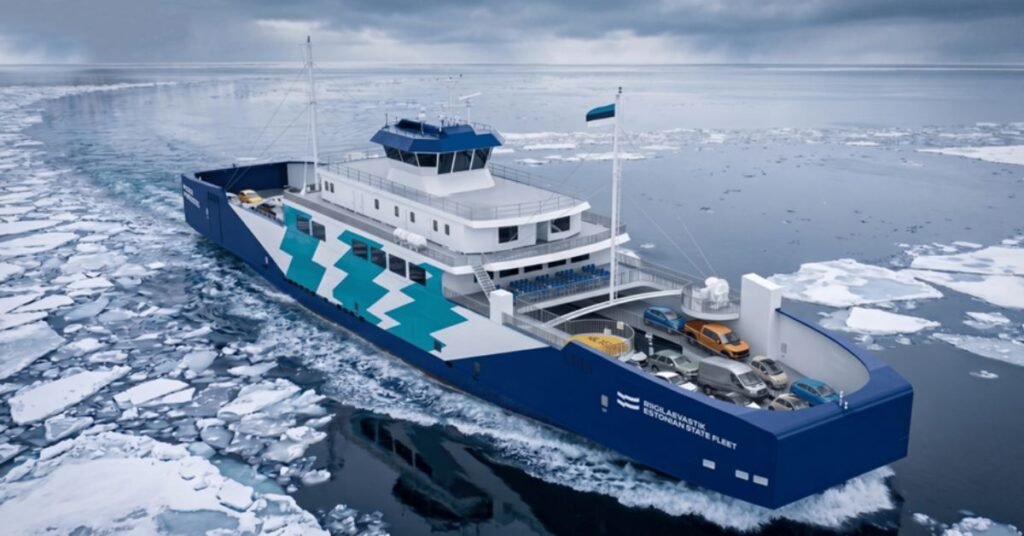
Estonian State Fleet (ESF) has signed a contract with CRIST for the design and construction of Estonia’s first fully electric passenger ferry.
The vessel will be built at CRIST’s shipyard in Gdynia, Poland, following the company’s selection through a public tender process. Delivery is scheduled within 30 months of contract signing, with the ferry expected to enter service by the end of 2028.
The total contract value is approximately €49.93 million ($58.1 million). Funding includes a €28 million grant from the European Union’s Modernisation Fund, with additional financing provided through Estonia’s CO₂ funding mechanisms.
Electric ferry for Baltic island routes
The vessel is intended primarily for operation on the Virtsu–Kuivastu route, which connects mainland Estonia with the country’s largest islands. The ferry will operate mainly using shore-charged green electricity.
Naval architecture and engineering design work will be carried out by LMG Marin, which has previously supported Estonia’s national ferry programme.
Kuldar Leis, Estonia’s Minister of Infrastructure, said:
“Ferry connections are vital for Estonia and especially for our island communities. They support everyday life, local businesses and access to essential services. This new fully electric ferry will make that connection more reliable, modern and environmentally friendly.”
Andres Laasma, Director-General of ESF, said:
“Despite a challenging global economic environment, we are pleased to move forward with a vessel that combines zero-emission operation in daily service with the resilience required for Baltic operating conditions.”
Battery-electric propulsion and ice-class capability
According to ESF, the vessel will be equipped with a 3 MWh battery system enabling fully electric operation on its primary route. Backup biodiesel generators will provide redundancy during severe weather or emergency situations and will also allow operation on the longer Rohuküla–Heltermaa route if required.
An ESF spokesperson said:
“The new ferry will mainly operate on the Virtsu–Kuivastu route, connecting Estonia’s largest islands to the mainland. The vessel will be equipped with a 3 MWh battery bank, enabling fully electric operation on the route.”
The spokesperson added:
“In harsher sea conditions and emergency situations, back-up biodiesel generators ensure continued service operations. The biodiesel generators also make it possible to use the vessel on an alternative and longer Rohuküla–Heltermaa route in Estonia, should the need arise. The vessel’s range without refuelling is at least 1,000 nautical miles.”
The ferry will be built to Ice Class 1B standards, enabling operation in Baltic winter conditions with ice thicknesses of up to 60 centimetres.
Vessel specifications
The double-ended ferry will feature azimuth thrusters at both ends to improve manoeuvrability and operational efficiency. Installed propulsion power will exceed minimum Ice Class 1B requirements to maintain performance in packed ice conditions.
The vessel will measure approximately 100 metres in length overall and will accommodate up to 110 passenger vehicles or eight freight trucks, along with up to 380 passengers.
ESF said the newbuild is expected to deliver up to a 64% improvement in energy efficiency compared with the existing diesel-powered ferry Regula.
Recent Posts
HYBRID
GRSE Signs ₹1,032-Crore ONGC Contract for Four Hybrid Offshore Supply Vessels
EV
Energy In Motion Opens ₹500-Crore Electric Truck Plant in Pune
Fuels
Aegis Logistics Commissions 35,000-Tonne LPG Bottling Plant at JNPA