
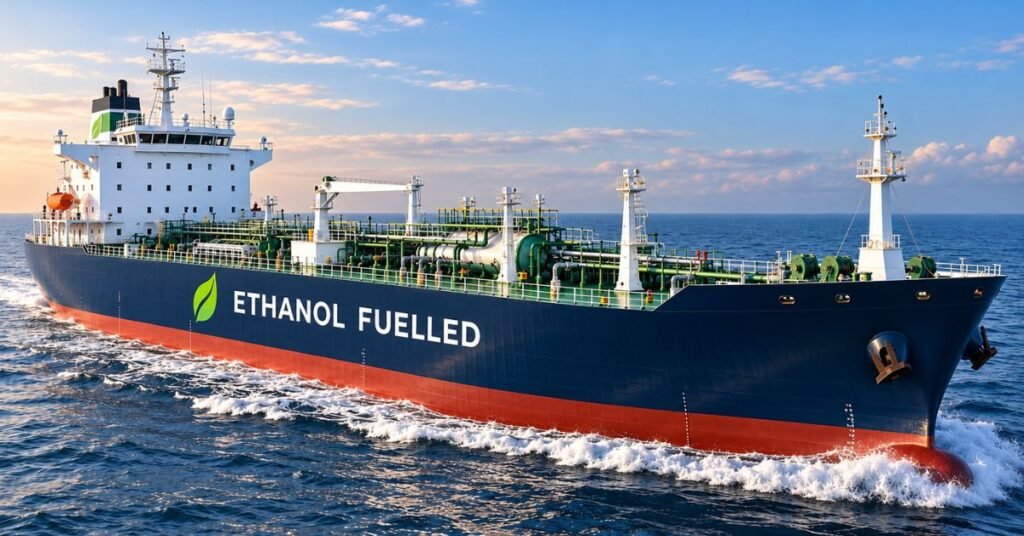
Nineteen methanol- and ethanol-capable vessels were on the global dry bulk orderbook by September 2026, as shipowners committed to alternative-fuel capability backed by long-term cargo contracts. Research published by Drewry on 30 October links these orders to Brazilian miner Vale’s programme for fuel-flexible ore carriers, while highlighting continued uncertainty over fuel costs and availability.
Vale’s wider programme covers up to 30 large ore carriers capable of using methanol or ethanol. The orders reflect growing interest in retaining fuel choices over a vessel’s operating life, although investment decisions across the dry bulk sector remain divided.
Vale-backed orders advance ethanol propulsion
A specific development came on 19 May 2026, when Swiss engine designer WinGD announced ethanol-engine orders for two 325,000-deadweight-tonne ore carriers for Shandong Shipping Corporation.
The vessels will be built at Beihai Shipbuilding in China and operate under long-term charters to Vale, transporting Brazilian iron ore to China. Each will have a six-cylinder 6X82DF-M/E engine designed primarily for ethanol operation.
WinGD is adapting its established methanol engine concept, modifying fuel supply and injection pressure to accommodate ethanol’s different energy density. Engine deliveries are scheduled for early 2029, depending on shipyard requirements, and the contract includes options for additional units.
Brazil’s established ethanol supply is relevant to the planned trade. WinGD cited Vale’s assessment that ethanol could reduce greenhouse gas emissions by around 90% compared with heavy fuel oil, depending on the fuel pathway and lifecycle assumptions. The figure is therefore conditional, rather than a universal emissions benefit.
Why are some owners choosing conventional ships?
Pacific Basin has taken a different approach to near-term fleet renewal. It replaced four planned methanol dual-fuel Ultramax vessels with conventionally fuelled newbuildings, reducing the programme’s reported cost from US$186 million to US$156.8 million.
In an April stock exchange filing covering part of the programme, the company cited uncertainty over the timing and final structure of the International Maritime Organization’s Net-Zero Framework.
Pacific Basin said the absence of a global regulatory mechanism weakened the economics of higher-cost vessels and fuels, particularly in a competitive market where cargo customers were generally unwilling or unable to share additional expenditure.
The company retained options for two methanol dual-fuel Ultramaxes, priced at US$45.5 million each, with potential delivery between April 2030 and March 2031. This preserves an opportunity to invest later as fuel availability, regulation and vessel pricing become clearer.
Singapore bunkering provides operational experience
Ethanol’s development as a marine fuel is also progressing outside dry bulk shipping.
On 19 October 2026, Maersk announced that its retrofitted dual-fuel containership Maersk Halifax had received approximately 5,000 tonnes of certified bioethanol in Singapore. Bunkering took place alongside cargo operations, in collaboration with the Maritime and Port Authority of Singapore and other partners.
The fuel carried International Sustainability and Carbon Certification. Maersk said the operation provided experience in fuel sourcing, supply-chain readiness, infrastructure and shipboard use.
Earlier ethanol trials involved Laura Maersk, Antonia Maersk and Tangier Maersk. The company identifies established production and distribution networks as advantages, while stressing that emissions reductions depend on certified fuel sourced through low-carbon production pathways.
Fuel availability remains central to deployment
Drewry cautions that ordering capable vessels does not guarantee sustained alternative-fuel consumption. Bulk carriers’ changing trading patterns make dependable bunkering access particularly important.
Its assessment identifies fuel prices, infrastructure, regulation and charterer requirements as the factors determining whether owners use alternative fuels commercially. The emerging orderbook demonstrates investment in flexibility, while the commercial case for routine ethanol use remains dependent on those conditions.
Recent Posts
Marine
KONGSBERG Reports 50% Revenue Growth in Q3 2026 as Order Backlog Reaches NOK 174.2 Billion
Marine
Sarbananda Sonowal visits Hanwha Ocean shipyard in South Korea to explore shipbuilding capabilities
Policy
Denmark Explores Maharashtra Cooperation in Green Shipping, Energy and Technology