
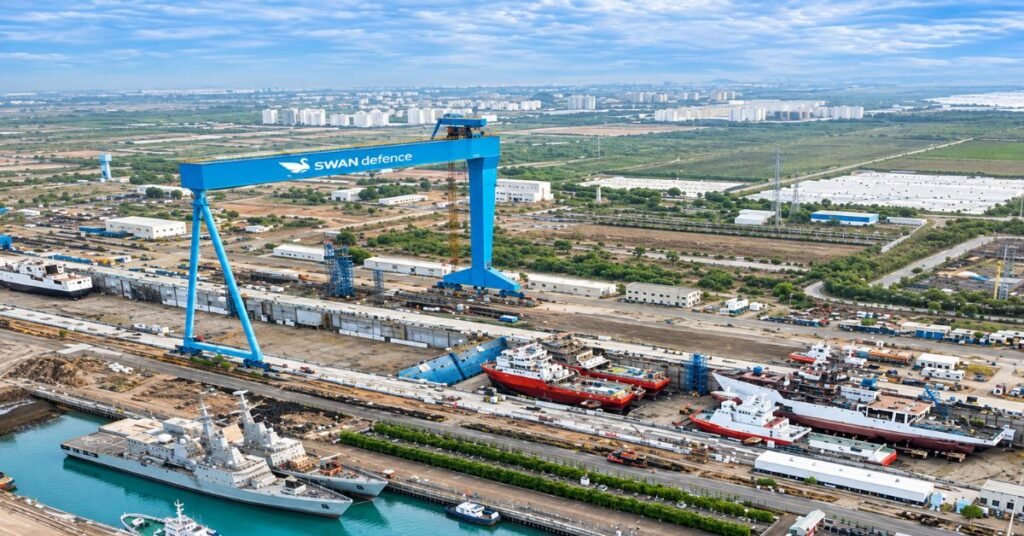
Everllence has secured an order for its two-stroke, dual-fuel engine technology to power six 18,000-deadweight-tonne chemical tankers under construction at Swan Defence and Heavy Industries Limited’s (SDHI) Pipavav shipyard in Gujarat. Announced on 11 November 2026, the contract extends the company’s propulsion technology into a new Indian commercial shipbuilding programme.
Everllence licensee MITSUI E&S will manufacture the engines. The project brings together the propulsion developer, its Japanese manufacturing partner and an Indian shipyard building vessels for European shipowner Rederiet Stenersen AS.
What propulsion technology will Everllence supply?
The first vessel will be powered by an Everllence B&W 6S50ME-C9.7-GI-EGRBP two-stroke engine. The specification includes exhaust-gas recirculation (EGR) technology for International Maritime Organization (IMO) Tier III compliance and a controllable-pitch propeller arrangement.
The tankers will be classed by DNV and built to Ice Class 1A requirements for North European operations.
Bjarne Foldager, head of Everllence’s two-stroke business, said the project combines an Indian newbuilding programme, an experienced European tanker operator and one of the company’s longest-standing licensees. Everllence has not disclosed the engine order’s value or a separate engine delivery schedule.
How does the ME-GI platform provide fuel flexibility?
Everllence’s ME-GI technology supports operation on fuel oil or methane, including liquefied natural gas (LNG). The engine uses a high-pressure gas supply system and the diesel combustion principle.
According to Everllence, the platform combines fuel flexibility with high thermal efficiency and low methane slip, the release of unburned methane during engine operation. These characteristics are relevant to operators evaluating fuel costs and emissions performance over a vessel’s working life.
The engine family is also compatible with biomethane and synthetic natural gas. This provides a technical pathway for using alternative methane-based fuels without changing to a different engine platform.
However, the tanker announcement does not identify fuel supply agreements or provide project-specific greenhouse gas reduction estimates. Compatibility with renewable fuels therefore represents an operational option rather than a confirmed fuel-use commitment for the six vessels.
What is the scale of the tanker programme?
The propulsion selection supports SDHI’s US$227 million construction contract with Rederiet Stenersen, announced in January 2026. The agreement covers six IMO Type II chemical tankers and includes options for six additional sister vessels.
At the original announcement, delivery of the first tanker was scheduled within 33 months, with subsequent vessels following at regular intervals. Marinform AS and StoGda Ship Design & Engineering are responsible for the vessel designs.
The contract marked the first newbuilding order at Pipavav following the shipyard’s revitalisation under Swan Corp. SDHI described it as the first chemical tanker order awarded to an Indian shipyard.
Rederiet Stenersen said the yard was selected following a technical and commercial assessment, including its engineering capability, infrastructure and ability to deliver specialised vessels competitively.
How does MITSUI E&S support Everllence’s delivery model?
MITSUI E&S will manufacture the propulsion equipment through a licensing relationship that reached its centenary in October 2026. The first agreement was signed in 1926 and has been renewed continuously.
During that period, MITSUI E&S has produced more than 7,500 B&W engines, representing cumulative output exceeding 120 million horsepower. The companies marked the anniversary at an event in Okayama, Japan.
For the Pipavav programme, this arrangement connects Everllence’s engine design and technology with MITSUI E&S’s manufacturing capabilities. The resulting equipment will be integrated into vessels built in India for European trading requirements, adding a new project to the partners’ established international supply network.
Recent Posts
Policy
Green port investment needs long-term finance and stable policies, Ningbo dialogue hears
Marine
Alpha Trading acquires Trieste fuel terminal, plans €20 million upgrade
Hydrogen
Hanwha Aerospace gains Korean Register approval for 200 kW marine hydrogen fuel cell