

The Global Centre for Maritime Decarbonisation (GCMD) has published a life cycle assessment (LCA) evaluating greenhouse gas (GHG) emissions from Project CAPTURED, a pilot completed in June 2025 that demonstrated ship-to-ship offloading of onboard captured and liquefied carbon dioxide (LCO₂) with downstream utilisation.
According to GCMD, the study is the first to quantify GHG impacts across the full carbon value chain for a project involving onboard carbon capture and storage (OCCS), covering CO₂ capture and liquefaction onboard an ocean-going container vessel, ship-to-ship and ship-to-truck transfers, overland transport, and final industrial utilisation. The LCA was independently verified by DNV.
How the captured CO₂ was used
At the utilisation site, the captured CO₂ was used as an industrial feedstock to recycle steel slag into post-carbonated slag (PCS) and to produce precipitated calcium carbonate (PCC). Both outputs were generated through carbon mineralisation, a process that chemically converts CO₂ into stable carbonates, fixing carbon over long periods.
Why life cycle assessment matters for OCCS
OCCS is increasingly being considered as a mid-term emissions reduction option for vessels that continue to operate on conventional fuels. While the technology can reduce tank-to-wake emissions by capturing CO₂ from exhaust gases, GCMD noted that its overall climate impact depends on emissions generated across the entire value chain, including transport and final utilisation or storage.
An LCA enables these full-chain impacts to be assessed systematically, ensuring that emissions savings achieved onboard are not offset by downstream activities.
Scenarios assessed in the study
The LCA evaluated the actual operational configuration used in Project CAPTURED and modelled two additional scenarios:
- An optimised utilisation scenario in which inefficiencies associated with a first-of-its-kind pilot are addressed.
- A permanent storage scenario in which captured CO₂ is sequestered in an offshore geological reservoir.
In the utilisation cases, the production of PCC displaced conventional, carbon-intensive PCC manufacturing, while PCS replaced standard sintering materials used in steelmaking. These substitutions resulted in “avoided emissions” that would otherwise have occurred.
Emissions savings demonstrated
With OCCS operating at a 10.7% capture rate, Project CAPTURED achieved 7.9% GHG emissions savings across the full carbon value chain. This equates to 0.84 tonnes of CO₂ savings for every tonne of CO₂ captured and offloaded from the vessel.
GCMD noted that these results were achieved despite several constraints, including the absence of waste heat recovery onboard, long-distance truck transport, and CO₂ venting during offloading and handling.
When these inefficiencies were removed in the optimised scenario, total GHG emissions savings increased to 17.8%, or approximately two tonnes of CO₂ avoided per tonne of CO₂ captured and offloaded.
Utilisation compared with permanent storage
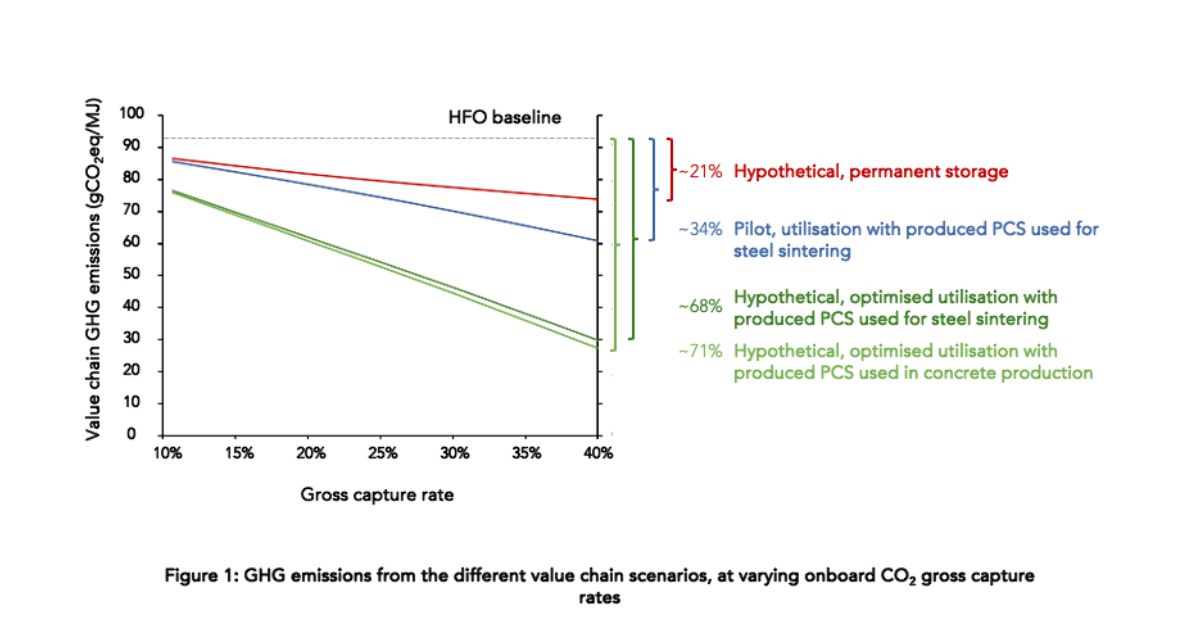
The study found that, at comparable CO₂ capture rates of 40%, carbon mineralisation delivered higher emissions reductions than permanent offshore storage. Mineralisation achieved 34% GHG emissions savings, compared with 21% for geological sequestration.
Under optimised conditions, total savings from mineralisation rose to between 68% and 71%, depending on whether PCS was used in steel sintering or concrete production. GCMD stated that these outcomes are linked to the long-term fixation of carbon, which meets durability thresholds defined under the EU Emissions Trading System (EU ETS) for storage periods of 100 years or more.
Gaps in current GHG accounting frameworks
GCMD highlighted that current GHG accounting frameworks under the International Maritime Organization—including the Data Collection System, Carbon Intensity Indicator and LCA guidelines—do not account for avoided emissions achieved when captured CO₂-derived products displace more carbon-intensive alternatives.
As a result, the study argues that the emissions reduction potential of CO₂ utilisation pathways may be understated in formal regulatory reporting.
Professor Lynn Loo, CEO of GCMD, said, “Project CAPTURED shows that onboard carbon capture, when thoughtfully integrated with utilisation pathways, can deliver real emissions reductions today while we continue to scale up low- and zero-carbon fuels. It also highlights how we measure and account for those reductions matter. If our frameworks continue to ignore avoided emissions and displaced carbon, we risk disincentivising investments in solutions that can meaningfully bend the emissions curve.”
Recent Posts
Ammonia
Reliance Industries Limited (RIL) has signed a binding long-term supply and purchase agreement (SPA) with Samsung C&T Corporation for the export of green ammonia over a 15-year period.
Bunkering
Ofiniti Raises $6.8 Million to Scale Digital Bunkering Platform for Global Shipping
Hydrogen
Hefring Marine and Ecomar Propulsion partner to deploy monitoring system on hydrogen-electric vessel