
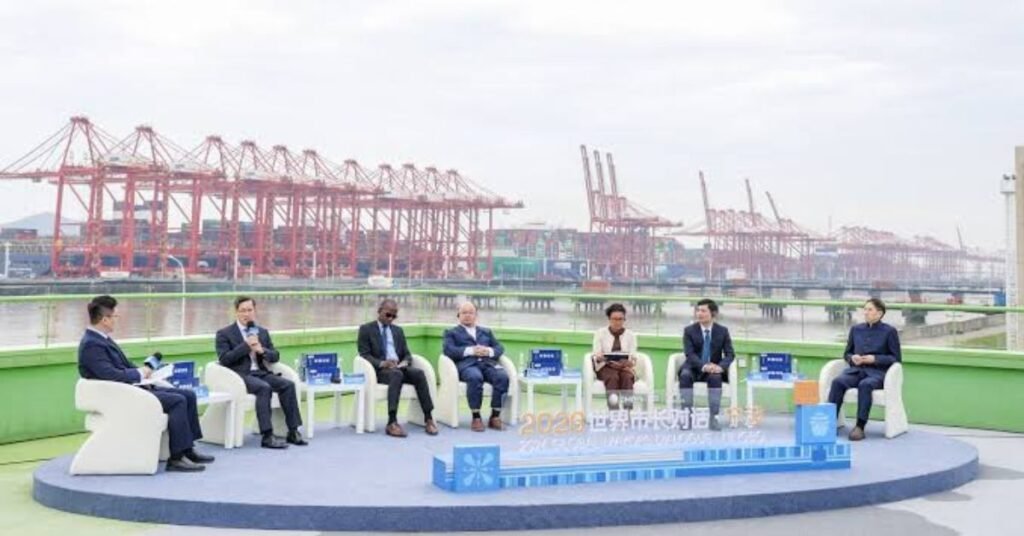
Ports in developing economies need affordable long-term funding, predictable policies and closer regional cooperation to accelerate decarbonisation, former New Development Bank vice-president and chief administrative officer Zhou Qiangwu said at a port-city development dialogue at Ningbo-Zhoushan Port in eastern China on 3 November.
Zhou identified multilateral development finance as a means of sharing investment risks and attracting private capital. He also called for greater certainty over shore-power pricing, concessions and land use, alongside cooperation on equipment procurement, maintenance, common standards and green shipping corridors.
Ningbo vice-mayor Yu Fengqing said the port had developed an integrated wind, solar, energy-storage and hydrogen project, as well as Zhejiang Province’s first green-power port. Its clean-energy utilisation rate had exceeded 70%, he said.
The discussion highlighted the challenge of extending such investment to smaller ports, where limited cargo volumes and uncertain returns can make infrastructure upgrades harder to finance. The proposals concerned ways to improve access to capital, rather than the announcement of a new funding commitment.
What financing options can support greener ports?
The Asian Development Bank (ADB) examined these constraints in its August 2025 brief, Advancing Green Ports: Funding and Financing for Maritime Decarbonization. It outlined a proposed US$1 billion Sustainable and Resilient Maritime Fund, intended to combine loans, grants and equity to support ports across Asia and the Pacific.
The proposed mechanism would help reduce project risks, support public policy and narrow the financing gap for maritime decarbonisation. Its scope extends beyond emissions reduction to climate resilience and the environmental performance of port infrastructure throughout its life cycle.
ADB’s approach links adequate financing with clean energy, waste management and nature-based solutions. This places investment in lower-carbon operations within a broader programme of infrastructure planning and environmental management, rather than treating individual equipment purchases as isolated projects.
How can ports attract private investment?
The World Bank’s Port Reform Toolkit identifies risk allocation as a central requirement for sustainable, investable port projects, particularly those involving public-private partnerships. Its financing guidance covers the identification and management of both financial and non-financial risks.
The toolkit also stresses that the structure of private participation should reflect each port’s priorities, investment requirements, competitive environment and regulatory capabilities. Options range from outsourcing services and awarding terminal concessions to broader ownership changes.
For port authorities, this means selecting arrangements that reconcile commercial objectives with public accountability. The World Bank separately highlights the need for economic regulation that protects users, supports fair pricing and maintains incentives for private investment. These considerations become especially relevant when new environmental infrastructure must be incorporated into existing port businesses.
What must ports demonstrate to secure sustainable finance?
ADB’s Green Ports Toolkit identifies several complementary funding routes: green bonds, sustainability-linked loans, blended finance, development funding, public grants and technical assistance.
It also includes investment screening against sustainable-finance classifications and the use of internal carbon pricing in capital decisions. Together, these practices provide a framework for connecting investment choices with environmental objectives.
Access to these instruments requires governance and operational preparation. The toolkit assigns boards responsibility for financing strategies and oversight, while operational performance data supports reporting against key performance indicators.
For port operators, the financing task therefore extends beyond identifying a lender. It includes establishing a credible investment framework, monitoring environmental performance and maintaining the information needed to demonstrate results. The toolkit treats these capabilities as supporting conditions for investment in decarbonisation, climate adaptation and resilient infrastructure.
Recent Posts
Policy
Green port investment needs long-term finance and stable policies, Ningbo dialogue hears
Marine
Alpha Trading acquires Trieste fuel terminal, plans €20 million upgrade
Hydrogen
Hanwha Aerospace gains Korean Register approval for 200 kW marine hydrogen fuel cell