
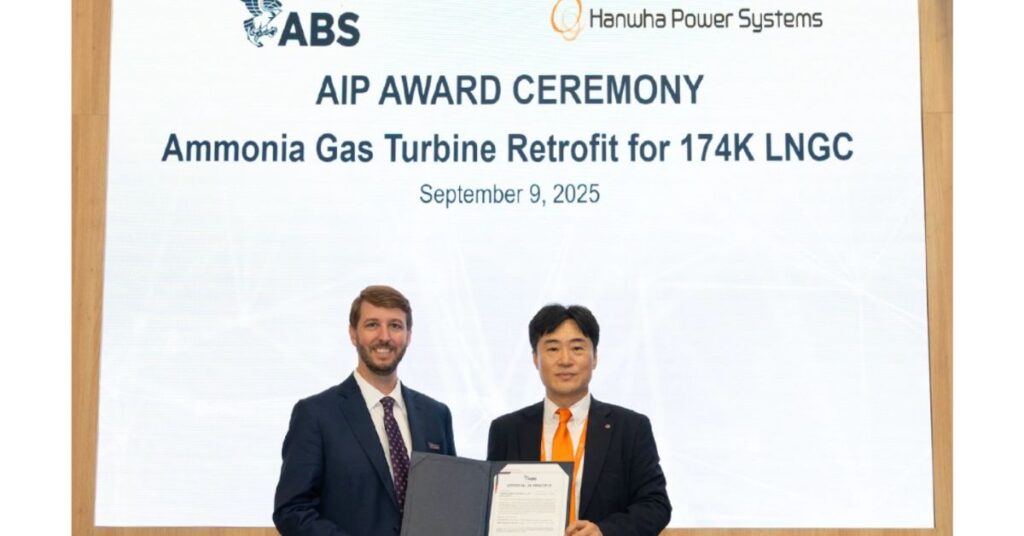
Hanwha Power Systems, part of South Korea’s Hanwha Group, has received an approval in principle from the American Bureau of Shipping (ABS) for its ammonia fuel gas turbine conversion design for 174,000 cbm LNG carriers.
The approval followed ABS’s review of core engineering documentation, including the process flow diagram, operation and control philosophy, equipment list, general arrangement and machinery arrangement, toxic area detection, emergency shutdown system, fire safety drawings, and the hazard identification report. The certification provides Hanwha with a foundation to propose retrofit packages for ammonia fuel conversions across vessel types, including existing LNG carriers.
“This AiP achievement demonstrates the technical and commercial viability of gas turbine propulsion systems utilizing ammonia fuel. We will continue to expand cooperation with shipowners, shipyards, and classification societies to progress toward practical application and commercial operation of this technology,” said Hyoung-seok Kim, Head of Maritime Solutions Business Division at Hanwha Power Systems.
Ammonia, composed of nitrogen and hydrogen, is being studied as an alternative fuel to support shipping’s carbon neutrality goals. The International Maritime Organization has set a target for the global maritime sector to reach carbon neutrality by 2050, with regulatory measures being introduced to support this transition.
In related developments, ABS this week approved additional designs and initiatives, including Japan-based MODEC’s floating storage and injection unit for liquefied CO2, a 16,000 TEU containership with electric propulsion developed by HD Hyundai affiliates, and a memorandum of understanding with the University of Michigan, Singapore Institute of Technology, and Sea Forrest Technologies to explore battery and electrification solutions in shipping.
Recent Posts
Marine
Singapore Unveils Ammonia Bunkering Standard, First Ethanol Bunkering and LNG Storage Plans
Ammonia
Singapore Launches TR 148 Ammonia Bunkering Standard and Model Contract to Prepare for Ammonia-Fuelled Ships
Policy
China Targets Doubling New Energy Inland Vessels by 2028 Under 2026-2030 Action Plan