
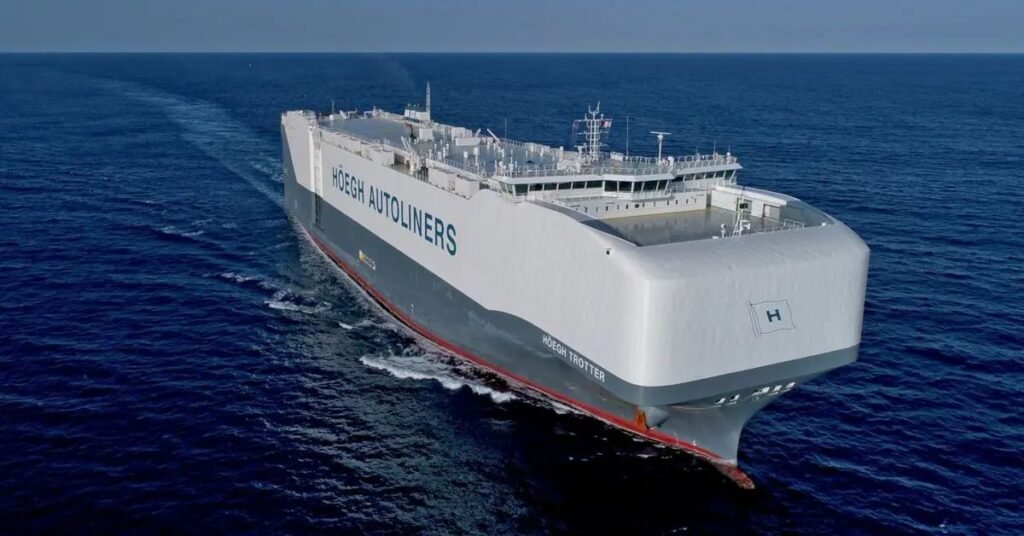
Norwegian shipping major Höegh Autoliners has placed a firm order for six additional LNG dual fuel car carriers, pushing its Aurora class newbuild programme to a total of 18 vessels. The pure car and truck carriers (PCTCs), built for future fuel flexibility, will be constructed by China Merchants Heavy Industry (Jiangsu) and delivered between 2029 and 2031.
Why is this order significant for future fuels shipping?
The new PCTCs are designed to run on LNG dual fuel engines from day one, while carrying DNV notations that keep the door open for ammonia and methanol conversion later. This positions the Aurora class as a genuine future fuel ready platform rather than a single fuel bet, letting Höegh adapt as alternative fuel infrastructure matures across global bunkering hubs.
Each vessel can carry up to 9,100 cars and is expected to cut carbon emissions per car transported by as much as 58 percent compared to conventional PCTCs, according to the company.

How large could the Aurora programme eventually grow?
Beyond the firm order, Höegh Autoliners has secured options for four more vessels on identical terms, exercisable within six months, along with slot reservations for another four ships at the same yard, with notice due by end of 2027. Taken together, these could expand the Aurora series to as many as 26 vessels.
What technology powers the new PCTCs?
Everllence will supply the main engines and Kongsberg Maritime will provide bridge systems for the newbuilds. The ships measure roughly 199.9 metres in length with a service speed of about 18 knots, continuing the specifications established by the Aurora class since its 2024 debut.
What did Höegh Autoliners say about the order?
CEO Andreas Enger said the Aurora class newbuilds have shown strong earnings potential, solid carbon performance, cargo flexibility, and proven conversion capability, reinforcing the company’s confidence in repeat orders at the Jiangsu yard. The company noted it secured attractive terms on the back of its established shipyard relationship and the economics of scale from building repeat vessels.
What does this mean for the green fleet renewal race?
The order underscores accelerating momentum in dual fuel and future fuel ready newbuilding across the PCTC segment, as operators race to meet tightening decarbonisation targets ahead of 2030 emissions milestones. Höegh Autoliners has also raised fresh capital from shareholders to help fund the expansion, signalling continued investor appetite for green fleet renewal in ocean shipping.
Recent Posts
Marine
Singapore Unveils Ammonia Bunkering Standard, First Ethanol Bunkering and LNG Storage Plans
Ammonia
Singapore Launches TR 148 Ammonia Bunkering Standard and Model Contract to Prepare for Ammonia-Fuelled Ships
Policy
China Targets Doubling New Energy Inland Vessels by 2028 Under 2026-2030 Action Plan