
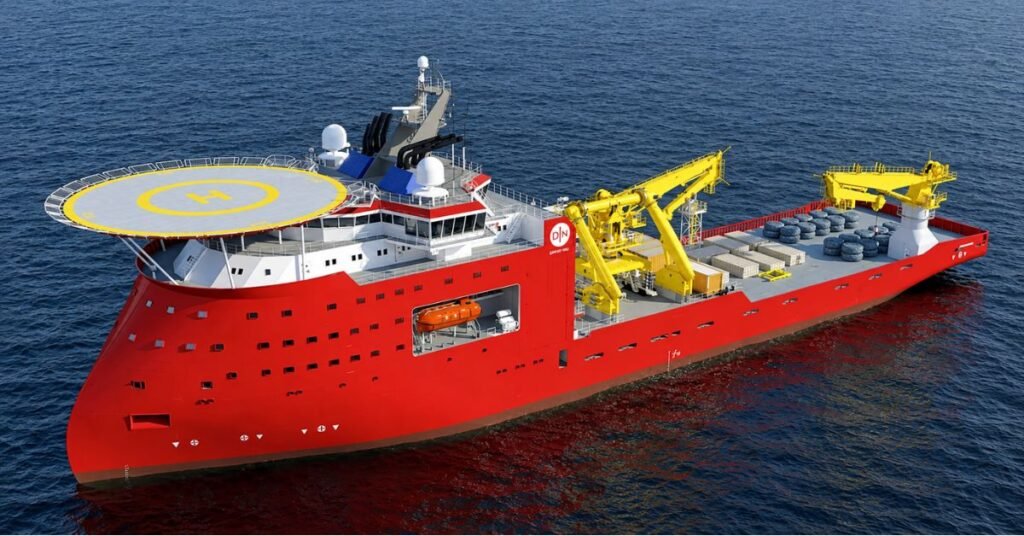
Jan De Nul is expanding its subsea cable installation fleet with an order for a new trenching support vessel that will be an exact sister ship to the Isambard K. Brunel, announced in March.
The latest order takes the company’s number of vessels under construction for subsea cable installation and protection to five. The programme includes two XL cable-laying vessels (CLVs), an XL rock installation vessel and two trenching support vessels designed for cable burial.
Sister vessels designed for cable burial
The new vessel and the Isambard K. Brunel are based on an Ulstein design and will be built at the China Merchants Heavy Industry (CMHI) shipyard.
Both vessels will be capable of burying subsea cables up to five metres below the seabed. They will incorporate ultra-low emission (ULEv) technology and be capable of operating on biofuel. The vessels will also be prepared for future operation on methanol.
Wouter Vermeersch, Director Subsea Cables Offshore Energy at Jan De Nul, said the company’s two new cable-laying vessels will soon enter the market. The Fleeming Jenkin has completed its first sea trials and is in the final construction phase, while the William Thomson is expected to follow shortly.
Fleet expansion for subsea cable protection
Jan De Nul said the expansion of its cable-protection fleet follows its investment in new cable-laying capacity.
Vermeersch said the company sees vessels capable of protecting subsea cables as a logical next step. Jan De Nul announced the George W. Goethals, an XL rock installation vessel, last year. The vessel is designed to protect subsea cables and other energy infrastructure by placing a layer of rock over them.
With the Isambard K. Brunel and its new sister vessel, Jan De Nul will add two specialised vessels for burying cables in the seabed. The company’s fleet for subsea cable installation and protection will subsequently comprise 14 vessels.
Henry Darcy to be converted for trenching support
Alongside the newbuild programme, Jan De Nul is converting the existing Henry Darcy from a water injection dredger into a trenching support vessel.
Following the conversion, the vessel will carry the Crayfish subsea robot, which is designed to bury cables in shallow-water environments.
The combination of newbuild vessels and the Henry Darcy conversion will expand Jan De Nul’s capabilities across cable installation, burial and protection as demand for subsea cable infrastructure grows.
Recent Posts
Ammonia
Aegis Tristar acquisition to expand Indian group’s global energy logistics reach
Power & Propulsion
Everllence and MITSUI E&S Mark 100 Years of Two-Stroke Engine Partnership
Ammonia
NTPC Targets Japan, South Korea and Germany for Green Ammonia Exports from Andhra Pradesh Hub