
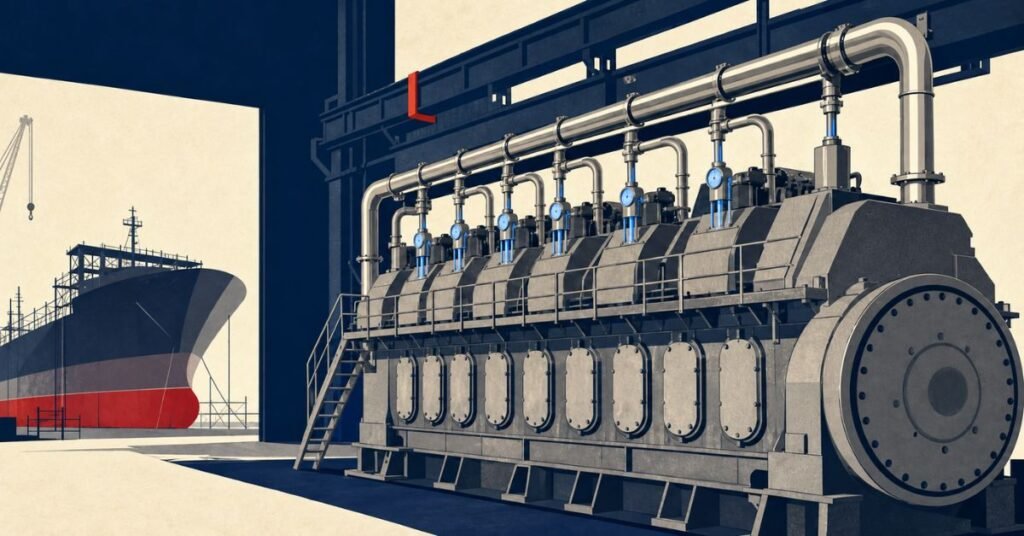
Japan Engine Corporation has completed land-based tests of its 6UEC35LSGH hydrogen-fuelled engine, developed for large merchant vessels, recording a hydrogen co-firing ratio above 95% and a greenhouse gas emissions reduction of more than 95% compared with a conventional heavy-fuel-oil engine.
The results, announced by Japan’s New Energy and Industrial Technology Development Organization (NEDO) on September 8, 2026, mark a significant testing milestone for hydrogen combustion technology intended for commercial shipping. The engine was unveiled by Japan Engine at its head-office plant a day earlier.
Hydrogen combustion technology
Japan Engine achieved the hydrogen co-firing ratio using high-pressure direct injection, which introduces hydrogen directly into the engine cylinder under pressure rather than premixing it with air.
The engine also incorporates a leak-prevention structure and double-walled hydrogen supply piping designed to address safety requirements associated with handling hydrogen.
ClassNK, Japan’s ship classification society, witnessed the approval tests, which were completed without reported issues. The classification society will continue to assess the engine’s safety through the vessel’s design, construction and operational stages.
Development under Japan’s Green Innovation Fund
The engine is being developed under NEDO’s Green Innovation Fund programme for next-generation ships.
Japan Engine is working on the project with Kawasaki Heavy Industries and Yanmar Power Solutions. Kawasaki is separately developing the Marine Hydrogen Fuel System, which will provide the onboard hydrogen storage and supply infrastructure for the engine.
Kawasaki is also developing liquefied-hydrogen bunkering equipment intended to support the future supply of hydrogen to vessels.
The project follows Japan Engine’s development of an ammonia-fuelled two-stroke marine engine, which the company completed in August 2025.
Hydrogen engine yet to undergo sea trials
Despite the factory test results, the hydrogen engine has not yet been operated at sea.
Under the Blue Harmony project, the 6UEC35LSGH is scheduled to be installed on a 17,500-deadweight-tonne multipurpose vessel being constructed at a shipyard in Onomichi, Hiroshima Prefecture, for Mitsui O.S.K. Lines (MOL) and its subsidiary MOL Drybulk.
Installation is planned for January 2027.
Following installation, the vessel is expected to conduct sea trials using hydrogen supplied through Kawasaki’s onboard Marine Hydrogen Fuel System. Demonstration voyages are scheduled to begin in April 2028.
Recent Posts
Biofuels
WinGD Ethanol-Fuelled Engine Completes First In-Service Voyage on Maersk Vessel
Power & Propulsion
Norsepower Rotor Sails Installed on Airbus Cargo Ship Spirit of Toulouse
EV
Estonia Electric Ferry to Combine Steerprop Propulsion with Battery Power