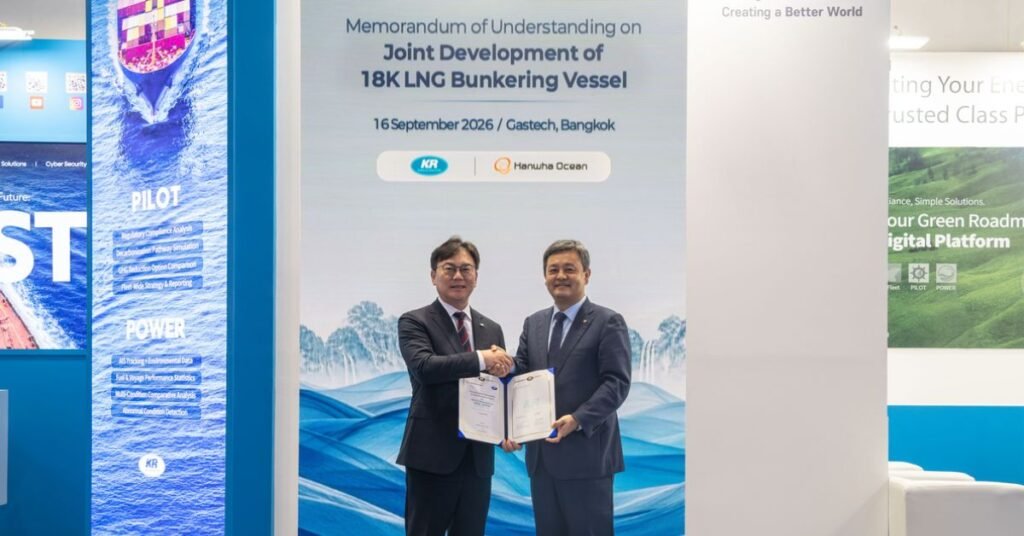
Korean Register (KR) has signed a Memorandum of Understanding with Hanwha Ocean to jointly develop two design concepts for an 18,000 cubic metre LNG bunkering vessel, signed on September 16 at Gastech 2026 in Bangkok.
Why is demand for LNG bunkering vessels growing?
As international regulations on greenhouse gas emissions continue to tighten and the number of LNG-fuelled vessels increases, the need for stable LNG fuel supply infrastructure is also rising. This is driving demand for LNG bunkering vessels capable of ship-to-ship LNG fuel transfer at sea, positioning the segment as an increasingly important part of the alternative fuel supply chain.
What do the two design concepts involve?
Under the agreement, KR and Hanwha Ocean will develop two design concepts for the 18,000 cubic metre vessel, each featuring a different cargo containment solution to address varying bunkering and operational requirements. The two concepts will incorporate Hanwha Ocean’s own LNG cargo tank solution, known as MCTIB (High Manganese Steel Cargo Tank Independent Type-B), alongside independent Type-C tanks, giving shipowners a choice between containment systems depending on their specific operational needs.
What is the objective behind offering two different containment solutions?
The project aims to develop LNG bunkering vessel designs that combine reliable cargo operations with economic efficiency, reflecting the industry’s broader push to balance operational safety with commercial viability as LNG bunkering infrastructure scales up globally.
How will responsibilities be divided between the two partners?
Hanwha Ocean will lead the basic design and vessel performance assessment, overseeing development of the cargo tank arrangement, the LNG bunkering system and the overall operational concept. KR will conduct a comprehensive review from the early design stage, assessing safety, regulatory compliance and operational efficiency in line with applicable international conventions and classification rules. Based on this technical review, KR will also carry out an Approval in Principle (AiP) assessment, supporting the technical reliability and future commercialisation of the LNG bunkering vessel concepts.
What did Hanwha Ocean say about the partnership?
Sangdon Kang, Executive Vice President of Hanwha Ocean, said the tightening of global environmental regulations and the growing number of LNG-fuelled vessels continue to expand the LNG bunkering market’s growth potential. He said the joint development with KR aims to build LNG bunkering vessel design capabilities that combine safety and economic efficiency, strengthening Hanwha Ocean’s competitiveness in the marine fuel supply market.
What did Korean Register say about the significance of this collaboration?
Kyujin Yeon, Executive Vice President of KR, said that as the adoption of alternative-fuelled vessels expands, the marine fuel supply infrastructure needed to support them will become increasingly important. He said KR will continue working closely with shipyards and the wider maritime industry to support the commercialisation of next-generation marine fuel supply technologies.
What does this mean for the LNG bunkering vessel market?
The agreement adds to a growing body of design and classification work around LNG bunkering vessels, reflecting sustained industry investment in ship-to-ship fuel transfer infrastructure as shipowners increasingly adopt LNG and other alternative fuels to meet tightening international emissions standards.
Recent Posts
Ammonia
Aegis Tristar acquisition to expand Indian group’s global energy logistics reach
Power & Propulsion
Everllence and MITSUI E&S Mark 100 Years of Two-Stroke Engine Partnership
Ammonia
NTPC Targets Japan, South Korea and Germany for Green Ammonia Exports from Andhra Pradesh Hub