

A new report from the Lloyd’s Register Maritime Decarbonisation Hub has identified key ports, trade corridors and production regions that could accelerate the early deployment of sustainable maritime fuels.
The report, Building the sustainable maritime fuel supply chain, examines where alternative fuels such as e-fuels and sustainable biofuels are most likely to be produced, exported and bunkered during the initial phase of the shipping industry’s energy transition.
Fuel demand concentrated in limited number of ports
According to the study, global marine fuel demand remains heavily concentrated, with just 19 ports currently supplying around half of the world’s bunkering volumes. The report suggests that focusing infrastructure investment on a relatively small number of strategically located hubs could help accelerate the availability and adoption of low-carbon fuels.
At the same time, the analysis highlights a geographic disconnect between emerging fuel production projects and existing bunkering demand centres. Many planned sustainable fuel production facilities are located outside traditional bunkering hubs, creating a need for new trade routes and fuel distribution infrastructure.
The report found that more than 60% of identified e-fuel projects are being developed alongside existing industrial infrastructure such as refineries, petrochemical facilities and energy clusters. According to the study, this approach could reduce development risk by leveraging existing utilities, storage systems, logistics networks and permitting frameworks.
Regional fuel supply patterns emerging
The assessment outlines three broad regional trends expected to shape the early sustainable fuel market:
- Asian bunkering hubs are expected to rely heavily on imported fuels
- Europe is likely to combine domestic production with imported supply
- Parts of the Americas, Africa and Asia may emerge as export-oriented production regions
The report concludes that barriers to scaling sustainable maritime fuels are increasingly linked to financing, regulation and coordination rather than technology readiness.
It states that coordinated investment across fuel production, bunkering infrastructure, shipping demand and port facilities will be necessary to move projects from announcement stages into commercial operation.
New Port Explorer Tool introduced
As part of the research, the Decarb Hub also introduced a Port Explorer Tool designed to help ports, policymakers and investors identify locations with strong potential for future fuel export and bunkering activities beyond existing major hubs.
Dr Carlo Raucci, Director of Sustainable Fuels and Strategy at the Decarb Hub, said:
“This transition is about more than new fuels, it’s about building a resilient maritime energy system. As supply chains diversify and new trade routes emerge, ports will become the critical interface between production and global shipping demand. Our analysis helps identify the priority locations where investment and partnerships can accelerate early market formation.”
Vassia Sourtzi, Fuel Transition Lead at the Decarb Hub, added:
“The biggest barrier to scaling alternative fuels is no longer identifying projects, it is enabling the full supply chain. That means aligning production, port infrastructure, shipping demand and finance. Without that coordination, projects will continue to struggle to reach final investment decision.”
Focus on maritime energy transition
The publication is the first report in the Decarb Hub’s “Maritime System in Transition” series, which will examine broader issues including infrastructure, finance, fleet development and policy frameworks linked to shipping decarbonisation. The report reflects increasing industry focus on the practical challenges associated with scaling alternative marine fuels, including infrastructure investment, trade route development and supply chain integration.
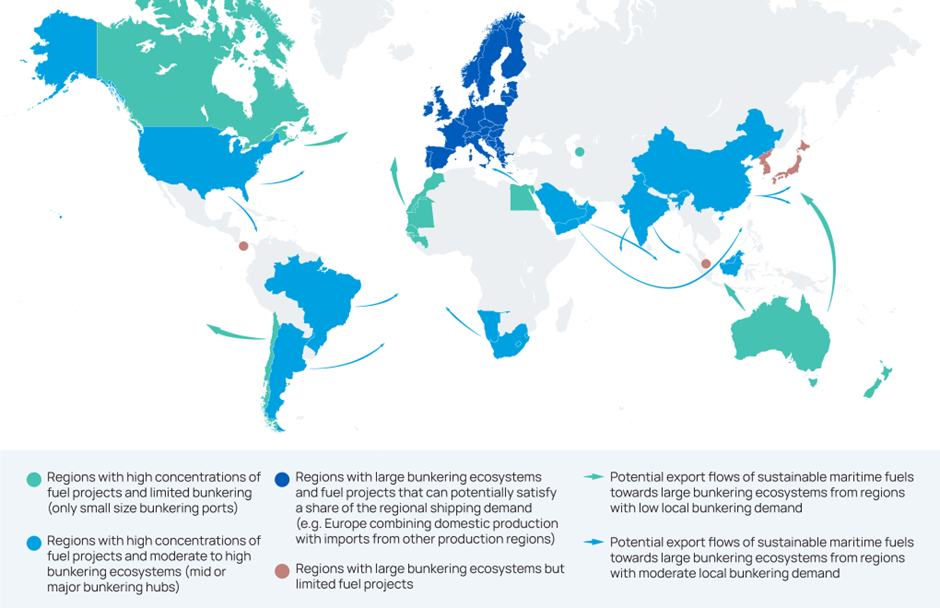
Figure 1: Global map showing potential regional patterns and early trade for sustainable maritime fuels.
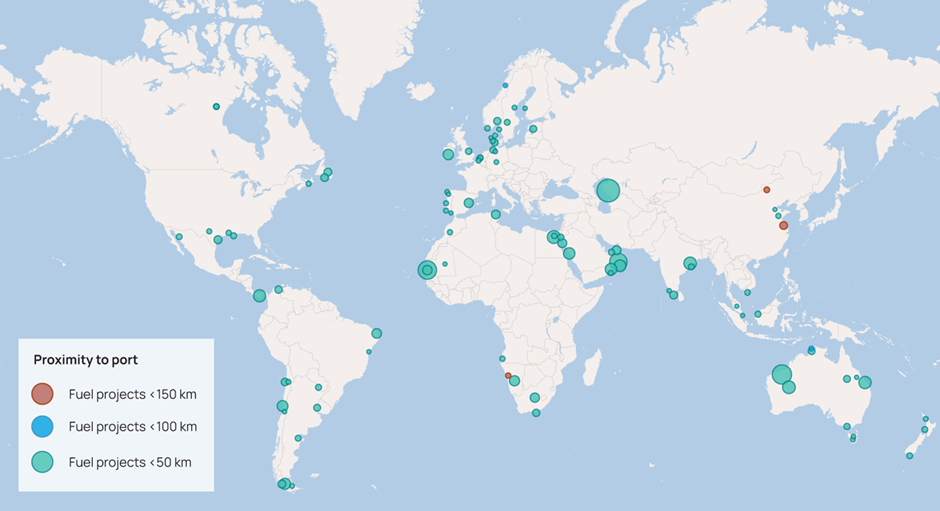
Figure 4: A screening of e-fuel projects based on proximity to ports and capacity (size of the bubble).
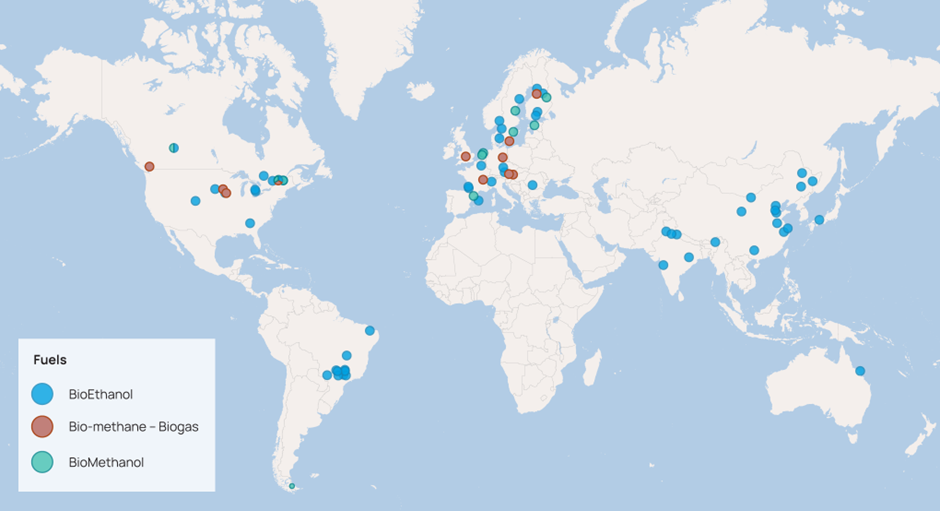
Figure 5: A screening of selected sustainable biofuel projects by fuel type.
Recent Posts
Biofuels
WinGD Ethanol-Fuelled Engine Completes First In-Service Voyage on Maersk Vessel
Power & Propulsion
Norsepower Rotor Sails Installed on Airbus Cargo Ship Spirit of Toulouse
EV
Estonia Electric Ferry to Combine Steerprop Propulsion with Battery Power