
Summary
The LNG shipping market could face a surplus of 110–200 vessels despite expanding US exports, according to Maritime OIC modelling. The outlook highlights a potential mismatch between fleet investment and cargo growth, with future ordering and the retirement of older ships critical to restoring balance.
Fleet expansion could outstrip cargo requirements
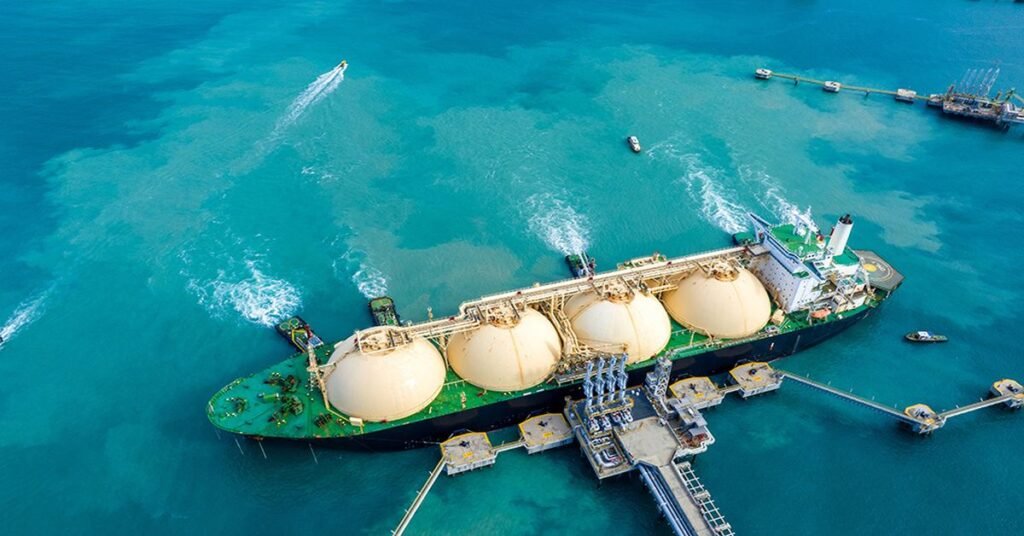
An LNG carrier surplus could persist as new vessels enter service faster than expanding liquefaction projects generate shipping demand, research by maritime investment and advisory platform Maritime OIC suggests.
Its model projects fleet growth from 678 vessels at the end of 2024 to almost 1,170 by 2031, while median shipping requirements increase from 595 to 940 ship-equivalents.
The projection includes 348 firm deliveries and assumes another 340 ships will be ordered. It also accounts for vessel phase-outs and ageing steam-powered carriers.
The outcome is therefore conditional: fewer additional orders or accelerated withdrawals could bring the market into balance by 2030. The findings underline the importance of distinguishing the existing orderbook from assumptions about future investment.
US export growth is already generating cargo
Actual export figures demonstrate why owners continue to anticipate substantial employment opportunities.
US LNG exports averaged 17.4 billion cubic feet per day in January–June 2026, an increase of 23% compared with the corresponding period a year earlier.
Additional production at Plaquemines LNG and Corpus Christi Stage 3 supported that expansion. Golden Pass LNG began exporting in April, adding another source of cargo as its facilities ramp up.
The changing destination mix also matters for shipping. US shipments to Asia increased by 108% in the first half, while exports to Europe rose by 1%.
For shipowners, cargo volume and voyage distance work together to determine vessel requirements. A shipment travelling farther occupies a carrier for longer, meaning changes in trading patterns can affect fleet demand even without an equivalent increase in exported tonnes.
Investment decisions sustain the longer-term pipeline
The export expansion has a substantial investment base behind it.
The International Energy Agency’s LNG capacity tracker records more than 430 billion cubic metres a year of export capacity reaching final investment decision between 2019 and October 2026.
Four investment decisions announced during January–October 2026 represented nearly 46 billion cubic metres a year of combined capacity. These covered CP2 LNG Phase 2, Commonwealth LNG and Delfin LNG in the United States, alongside LNG Canada Phase 2.
Such commitments provide a foundation for future trade, but investment approval, construction completion and sustained production are separate milestones. For shipping investors, their timing determines when anticipated cargoes become available to employ vessels.
That sequencing is central to the emerging market challenge: ships and export plants have different construction schedules, and their delivery dates may not align.
Supply disruptions complicate fleet planning
Geopolitical developments add another layer of uncertainty.
The IEA’s third-quarter gas outlook estimated cumulative LNG supply losses of around 140 billion cubic metres over 2026–2030, reflecting near-term disruptions and damage to infrastructure, including Qatar’s Ras Laffan complex.
The agency indicated that the effects on supply growth would be concentrated in 2026 and 2027, keeping gas markets tighter than previously expected.
For shipping, this creates competing effects. Lost production can remove cargoes from the market, while replacement supplies from more distant exporters can increase transport requirements.
Consequently, a tight gas market does not automatically mean a shortage of LNG carriers. Vessel availability depends on where cargoes originate, their destinations and the time required to complete each trading cycle.
Owners face a timing and deployment test
Earlier IEA analysis had already identified persistent LNG tanker oversupply in 2026, with more sustained rebalancing expected after additional liquefaction capacity enters operation, most likely beyond 2027.
Taken together, the forecasts suggest that growing LNG consumption alone is insufficient justification for additional ship orders. Owners must assess delivery timing, charter coverage, competing fleet additions and the prospects for older vessels.
For charterers, surplus capacity could strengthen negotiating options. For owners, the commercial distinction will be between vessels secured against dependable employment and ships entering an already competitive market without committed cargo support.
FAQs
How large is the projected surplus?
Maritime OIC estimates 110–200 vessels under its modelled scenarios.
Is the projected fleet entirely based on confirmed orders?
No. The model includes both firm deliveries and assumed future orders.
Why do voyage distances matter?
Longer voyages occupy vessels for more time, increasing the fleet needed to transport a given cargo volume.
Can strong LNG demand coexist with surplus ships?
Yes. Fleet capacity can expand faster than cargo volumes and transport requirements.
What could improve the balance?
Slower ordering, vessel retirements and additional operating export capacity could help absorb available shipping capacity.
Recent Posts
Power & Propulsion
WinGD Signs First Engine Licensing Agreement with HD Hyundai Marine Engine
LNG
LNG Carrier Surplus Forecast Raises Questions Over New Ship Orders
Policy
UK ETS Site Visits: DNV Urges Early Action Before First Reporting Deadline