
Summary
PETRONAS, TotalEnergies and Mitsui have signed a joint venture agreement to develop offshore carbon dioxide storage in Malaysia. The first phase targets injection capacity of up to five million tonnes annually, potentially starting in 2031, although technical and commercial work must progress before a final investment decision.
Article
Agreement establishes development framework
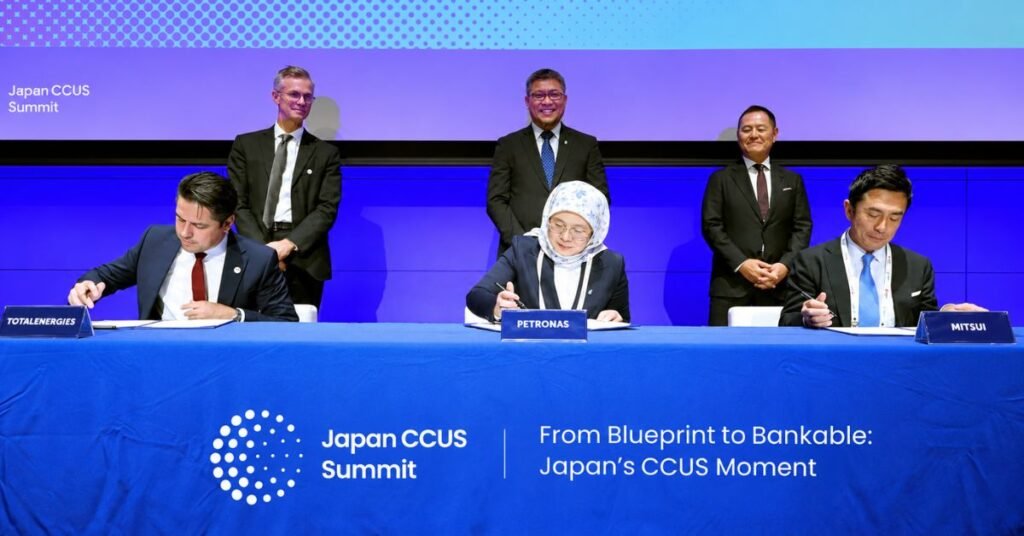
The Malaysia Southern CCS Hub has moved forward with an agreement between PETRONAS CCS Ventures, TotalEnergies EP CCS Malaysia and Mitsui & Co. to develop carbon dioxide storage areas offshore Peninsular Malaysia.
Announced in Tokyo on 23 October 2026, the agreement establishes a framework for incorporating a dedicated company responsible for developing, commercialising and operating the storage area. PETRONAS CCS Ventures is wholly owned by Malaysia’s national energy company.
The partners will now advance the initial project’s technical and commercial preparation ahead of a final investment decision. The signing therefore represents a development milestone, with investment approval still to follow.
Initial phase targets depleted gas field
The first phase centres on a depleted offshore gas field, with expected injection capacity of up to five million tonnes of CO₂ a year.
Initial injection is targeted as early as 2031, subject to industry readiness. The capacity figure describes the proposed annual injection rate, rather than the field’s total storage potential or an existing volume of contracted emissions.
The Southern Hub is intended to accommodate carbon dioxide from Malaysian and regional industries, potentially including cross-border shipments. Its proposed role is to provide long-term storage for emissions from sectors where reducing emissions remains particularly difficult.
Partnership began with broader storage studies
The latest agreement follows a collaboration launched in June 2023, when the three companies agreed to assess potential storage locations in the Malay Basin.
That earlier programme considered both depleted offshore fields and saline aquifers. It also examined how carbon dioxide could reach Malaysia from industrial clusters elsewhere in Asia and how a commercial storage service could be structured.
The original concept consequently extended beyond identifying a suitable underground reservoir. It included transport options and the business arrangements needed to connect industrial customers with storage infrastructure.
A Key Principles Agreement followed in 2025, establishing the basis for front-end engineering and design activities and the proposed joint venture structure. The partners agreed to enter that arrangement in July 2025, marking an intermediate step between initial studies and the latest corporate framework.
Japanese industrial links provide background
Earlier customer studies illustrate the industrial market being explored alongside offshore storage development.
In April 2024, Mitsui announced separate memorandums of understanding with Mitsubishi UBE Cement and Resonac to investigate CCS value chains linking Japan and Malaysia.
Those studies covered carbon capture, transportation and storage at the Malaysian offshore site being developed with PETRONAS and TotalEnergies. They were exploratory arrangements, rather than confirmation that either company had committed a particular volume to the storage project.
For Mitsubishi UBE Cement, the work supported its ambition to reach carbon neutrality by 2050 and reduce CO₂ emissions by 40% by 2030 against a 2013 baseline. This provides an example of how industrial decarbonisation plans could create demand for overseas storage services.
Shipping forms part of the commercial opportunity
Japan’s advanced CCS programme has also identified the Southern Offshore Peninsular Malaysia project as a potential destination for emissions captured from multiple industrial clusters in western Japan.
The proposed chain involves overseas transportation followed by permanent offshore storage. Separately, Mitsui has identified Malaysia’s maritime access to Asian industrial emitters, particularly those in Japan, as an advantage for developing a regional hub.
For maritime businesses, the potential opportunity extends to transporting captured CO₂ and coordinating its movement between industrial facilities and storage sites. However, translating that opportunity into regular cargo movements requires the capture, transport and injection elements to develop together.
Commercially, this makes customer participation important alongside reservoir development. Industrial users need dependable storage access, while infrastructure investors need sufficient confidence in the volumes that may eventually move through the system.
The agreement provides a clearer organisational basis for pursuing that work. The next decisive milestone will be whether the partners can bring the technical design and commercial arrangements to the point required for investment approval.
FAQs
What have the three companies agreed?
They have signed a joint venture agreement providing a framework for a dedicated company to develop and operate offshore CO₂ storage.
What is the proposed injection capacity?
The initial phase targets up to five million tonnes annually.
When could injection begin?
As early as 2031, depending on industry readiness and further project development.
Has a final investment decision been taken?
The partners are still progressing technical and commercial work ahead of that decision.
Could the hub receive CO₂ from overseas?
Yes. Its development concept includes potential cross-border shipments alongside Malaysian emissions.
Recent Posts
Ports & Harbours
VOC Port’s Tuticorin International Container Terminal Declared Green Terminal After Full Equipment Electrification
Hydrogen
India Could Become Leading Green Hydrogen Producer and Exporter, Says Gadkari
Fuels
Offshore Vessel Fuel Efficiency Offers Immediate Savings, Says Opsealog