
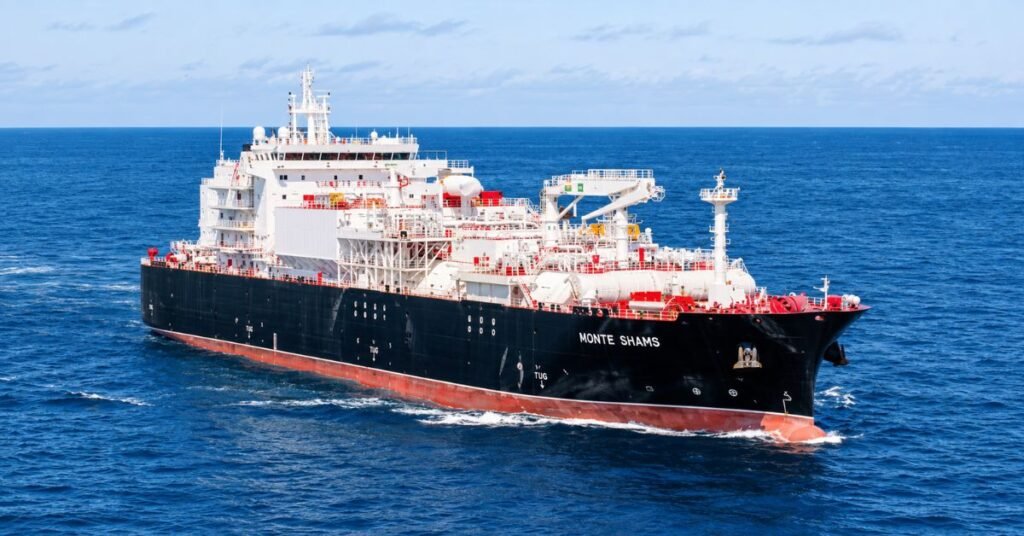
The 18,600-cubic-metre liquefied natural gas (LNG) bunkering vessel Monte Shams has been named at Hudong-Zhonghua Shipbuilding in China, marking a construction milestone ahead of its planned deployment in Oman. Owned by Spain’s Ibaizabal Group and chartered for TotalEnergies’ bunkering operations, the vessel is intended to support marine fuel supplies at Sohar.
The naming ceremony took place on 3 November 2026. Delivery is scheduled for later this year, while TotalEnergies has previously stated that the vessel will be stationed in Sohar from 2028, alongside the start-up of the Marsa LNG project.
What are the vessel’s main specifications?
Monte Shams measures 135.9 metres in length, 24.5 metres in breadth and 16 metres in depth. It is classed by Bureau Veritas and represents an updated version of Hudong-Zhonghua’s 18,600-cubic-metre LNG bunker vessel design.
The ship is equipped with GTT’s Mark III Flex cargo-containment system. Its planned role is to deliver LNG to receiving vessels, providing the marine distribution link between shoreside supply infrastructure and ships using the fuel.
TotalEnergies announced its charter agreement with Ibaizabal in October 2024. The original announcement identified container ships, tankers, large cruise ships and ferries among the vessel types it could serve.
How does Monte Shams connect with Marsa LNG?
Marsa LNG is being developed at Sohar in northern Oman by a joint venture owned 80% by TotalEnergies and 20% by OQ Exploration and Production.
The liquefaction plant has a planned capacity of one million tonnes annually, with production expected to begin in the first quarter of 2028. Its principal market will be LNG bunkering in the Gulf.
The partners celebrated the project’s groundbreaking in May 2025, following the final investment decision announced in April 2024. Monte Shams takes its name from Oman’s Jabal Shams, or “Mountain of the Sun”.
The vessel’s delivery and its Sohar deployment are separate milestones. The naming announcement does not indicate that the Marsa plant has started production or that regular bunkering services have commenced.
What infrastructure is being built at Sohar?
The integrated project combines upstream gas production, liquefaction and renewable electricity generation. Feedstock will come from the Mabrouk North-East field in Oman’s onshore Block 10.
Technip Energies holds the engineering, procurement and construction contract for the liquefaction plant, while CB&I is responsible for a 165,000-cubic-metre LNG storage tank. Quantities not sold into the bunker market are intended to be taken by the project partners in proportion to their ownership.
Port-related works include dredging and jetty construction, coordinated with Sohar Industrial Port Company. Together, these facilities will provide the production, storage and marine-access infrastructure needed to support the proposed supply operation.
How will the project power LNG production?
Marsa LNG is designed to use electrically driven equipment rather than conventional gas turbines. A planned 300-megawatt-peak solar installation will generate electricity equivalent to the plant’s annual consumption.
This annual energy balance is the basis of the project’s renewable-power design. It should not be interpreted as a claim that solar generation will continuously meet the plant’s electricity demand at every hour.
Where does Oman fit in TotalEnergies’ bunkering network?
When announcing the charter in 2024, TotalEnergies identified three deployed LNG bunker vessels: Gas Agility in Rotterdam, Gas Vitality in Marseille and Brassavola in Singapore.
The planned Sohar operation would extend that geographical coverage to the Gulf region, combining local LNG production with a dedicated delivery vessel. Its operational launch remains tied to completion and commissioning of the associated infrastructure.
Recent Posts
LNG
EU shipping emissions rules open new market for bio-LNG, says IEA
LNG
AxDo secures 11-year LNG supply deal for planned Bahamas bunkering hub
LNG
LNG bunkering fleet faces major expansion as DNV projects need for up to 208 vessels