
Summary
NatPower Marine has joined ZEBOX’s international innovation network to advance energy infrastructure for ports and shipping. The partnership will examine shore power, vessel charging, battery storage and grid connections, combining technology development with financing and project-delivery capabilities to help selected solutions progress beyond pilot demonstrations.
Partnership connects innovation with infrastructure delivery
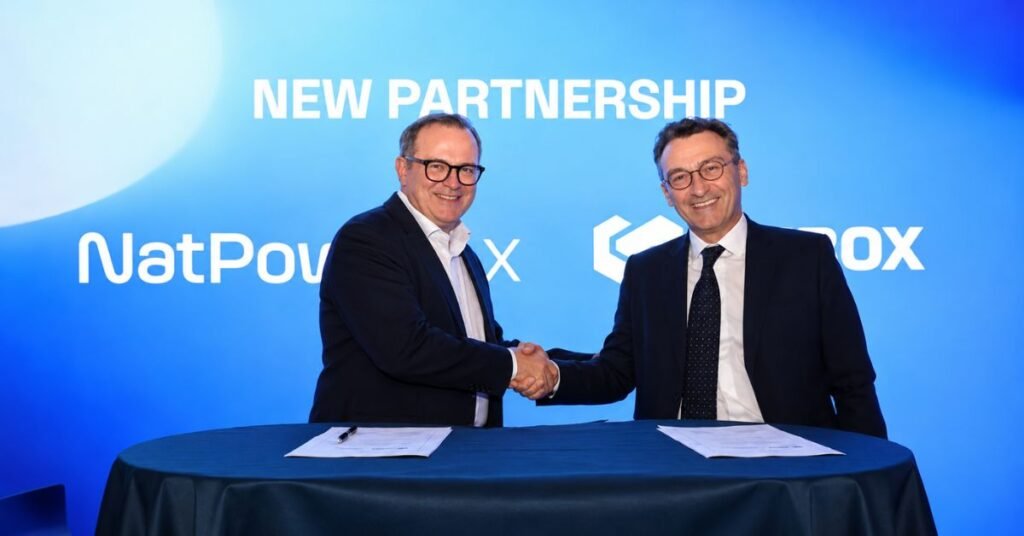
The NatPower Marine–ZEBOX partnership, announced in Marseille on 29 October 2026, brings together an energy-infrastructure developer and an accelerator established by the CMA CGM Group.
The partners will assess technologies against maritime operating requirements and identify opportunities for deployment. NatPower Marine contributes development, financing, construction and operating capabilities, while ZEBOX provides access to start-ups, corporate partners and industry stakeholders.
Founded in 2018 by CMA CGM Chairman and Chief Executive Rodolphe Saadé, ZEBOX connects emerging technologies with established businesses. Its activities encompass environmental performance, technological competitiveness and workplace safety.
The agreement establishes a collaboration framework. It does not identify a specific port installation, construction award or committed investment amount.
Shore power and propulsion charging present different needs
The proposed areas of cooperation span both electricity supplied to ships at berth and charging for electrically propelled vessels.
Shore power allows a connected vessel to meet onboard electrical demand without running its auxiliary engines. Propulsion charging replenishes batteries used to move the vessel, creating different requirements for connection capacity, charging speed and scheduling.
For a ferry making frequent calls, available charging time may determine the power required at the berth. For a larger ship staying longer in port, the priority may be a dependable electricity supply matched to hotel and cargo-service loads.
These differences make operational demand central to infrastructure selection. A technically successful charging system still needs a suitable grid connection, compatible vessel equipment and sufficient use to support its commercial model.
Financing model extends beyond equipment supply
NatPower Marine’s existing port offering combines energy supply, grid access and delivery infrastructure. The company markets an infrastructure-as-a-service approach under which it develops, finances and operates facilities.
Its published services also include the potential acquisition or leasing of existing shore-power infrastructure, allowing ports to consider different ownership and operating arrangements.
The company identifies permitting, electricity access, capital and infrastructure coordination as interconnected requirements for project execution.
That background helps explain the partnership’s emphasis on implementation. For technology providers, access to an infrastructure developer can help connect a proposed solution with site assessment, financing and construction planning.
For ports, the relevant commercial questions include who funds the installation, who purchases electricity, how operating risks are allocated and what level of vessel demand supports the investment.
Asian joint venture provides wider context
NatPower Marine is separately developing its Asian activities through WK NatPower, its joint venture with shipping group Wah Kwong.
Established in August 2025 and headquartered in Hong Kong, the venture focuses on shore power, electric-vessel charging, battery-swapping infrastructure and integrated energy systems.
Its stated approach prioritises ferry, short-sea and frequent port operations, where coordinated infrastructure along a route can support vessel electrification. Hong Kong provides the initial regional base, with the venture seeking opportunities across Asian maritime markets.
The venture is distinct from the ZEBOX agreement, but illustrates NatPower’s broader strategy of combining energy expertise with maritime relationships.
It also demonstrates why charging development can require a network perspective. An electric vessel’s operating flexibility may depend on facilities at several ports rather than a single berth installation.
Deployment will depend on defined customer demand
The partnership’s practical test will be whether selected technologies can be matched with customers, suitable locations and workable investment structures.
Battery storage and energy management may form part of those solutions, but their role will vary by site. Some projects may need to manage short periods of high charging demand; others may face constraints in grid availability or the timing of electricity supply.
The agreement creates a route for evaluating such requirements with technology providers and maritime users. Progress into construction will require project-specific engineering, approvals and commercial commitments.
For ports and shipping companies, the opportunity is access to a wider combination of innovation, capital and delivery expertise. The next meaningful milestones will be identified sites, agreed operating models and infrastructure projects moving into execution.
FAQs
What does the partnership cover?
Shore power, electric-vessel charging, battery storage, grid connections, clean energy and energy management.
What is ZEBOX?
An international innovation accelerator initiated by the CMA CGM Group.
What will NatPower Marine contribute?
Infrastructure development, financing, construction and operating expertise.
Have specific construction projects been announced?
The partnership announcement does not identify individual installations or construction awards.
How does shore power differ from vessel charging?
Shore power supplies onboard electrical needs at berth; propulsion charging replenishes batteries used to move a vessel.
Recent Posts
Fuels
ONE Symphony Joins 14,000-TEU Fleet as ONE Expands Alternative-Fuel-Ready Newbuildings
Dual-Fuel
COSCO Ethylene Carrier Investment Adds LNG Dual-Fuel Capacity to Fleet Plans
Ammonia
MOL Ammonia-Fuelled Bulkers Named as 2027 Delivery Programme Advances