
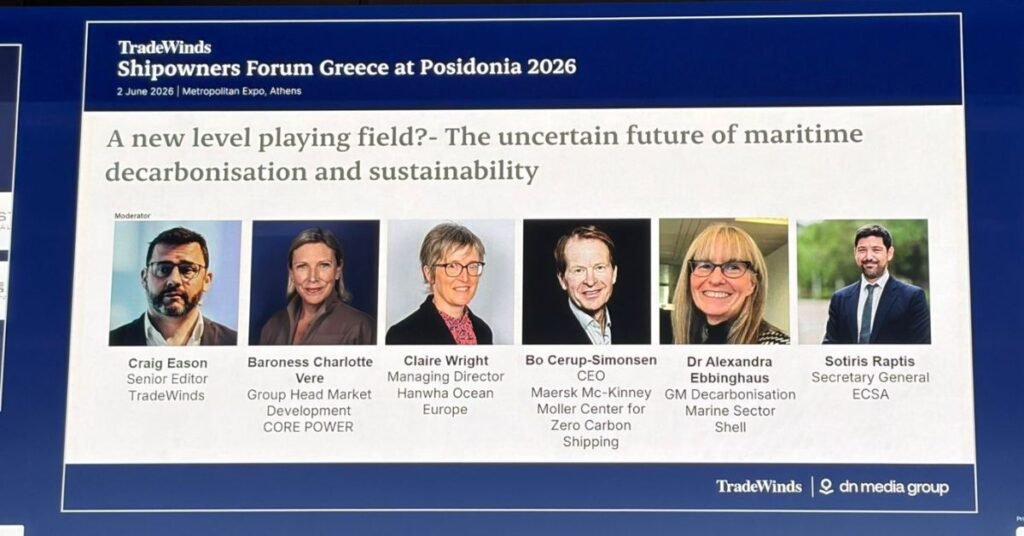
The road to zero-emission shipping is neither straight nor short — but it is being built, plank by plank, fuel by fuel, regulation by regulation. That was the broad consensus emerging from one of Posidonia 2026’s most wide-ranging panel discussions, which brought together voices from energy majors, shipbuilders, research institutions, industry associations and the rapidly advancing world of nuclear marine propulsion.
The LNG Question
Dr Alexandra Ebbinghaus, GM Decarbonisation, Marine Sector, Shell opened the debate by framing the central commercial dilemma facing ship owners who are weighing the merits of dual-fuel LNG newbuilds against conventional vessels. The economics, she acknowledged, are genuinely difficult to navigate. “LNG has the only advantage of all other options in that the fossil version can be competitive just on an energy basis,” she said, “but you take a risk and you have a higher cost.” She noted that Greek tanker and bulker owners face a particular structural challenge, given their asset-trading model, where a vessel’s resale value matters as much as its operational profile. “Is there safety in being conventional and being the same as everyone? That’s one of the challenges we see, especially in the tanker sector.”
Yet Dr Alexandra was careful not to dismiss the longer-term logic of the LNG pathway. She pointed to bio-LNG as an easier-to-produce bridging fuel compared with synthetic alternatives and outlined a trajectory that could eventually lead through synthetic methane toward net zero. “You have high energy. You have synthetic. To actually get to net zero, you need that pathway,” she argued. The challenge, she suggested, is not the destination but the business case for each step of the journey, particularly for owners whose planning horizons are measured in market cycles rather than decades.
From Fuel Transition to Operational Resilience
Claire Wright, Managing Director, Hanwha Ocean, Europe offered a perspective shaped by daily conversations with ship owners across segments. she suggested that the nature of those conversations has quietly but meaningfully shifted. “The talk has moved from energy transition to resilience and flexibility in operation — but fundamentally it was saving fuel,” she said. Energy efficiency technologies, where the return on investment is clear and the installation pathway is established, continue to attract strong owner interest. The more complex picture, she noted, lies in how multiple technologies interact once deployed together on a single vessel. “When you have turbine optimisation, air lubrication and wind you can run a storm model. The crew needs training to optimise performance with all those technologies in the operational conditions they face.”
Digital solutions onboard, she added, are increasingly seen as the integrating layer that makes efficiency investments actually deliver. On alternative fuels, she acknowledged that ammonia development continues at Hanwha but conceded that commercial timelines had extended, particularly outside car carriers and a small number of pioneering segments. For a company straddling many markets, the R&D challenge is one of prioritisation. “The challenge is timing — what do we accelerate, what do we decelerate?”
Five Years of Progress, and a Re-Strategy
Bo Cerup-Simonsen, CEO of Maersk Mc-Kinney Moller Centre for Zero Carbon Shipping, offered a longer view, reflecting on what five or six years of focused research and collaboration have actually produced. The scale of change is striking when viewed against what was possible at the Centre’s founding. “At that time, we were hoping that ammonia would one day be enabled as a fuel for shipping. Now here we are in 2026,, and we have engine builders putting big two-stroke engines in commercial ships,” he observed.
The Centre, he explained, has recently undergone a re-strategizing process to reflect the changed landscape — one where technologies have matured, regulatory frameworks have firmed up and owner appetite for action has grown. He pushed back gently against the more pessimistic commentary that had surfaced elsewhere at Posidonia, where some Greek owners had questioned whether the decarbonisation drive had produced anything beyond glossy publications. “Our industry wants to decarbonise. There’s questioning about the net zero framework, the availability of fuels, the risks — but a lot of work going on shows it is possible.” He pointed to EU ETS as already driving real behavioural change, and to the Catalyst book-and-claim platform as a practical mechanism enabling cargo owners to access green transportation certificates even where direct fuel access is limited. “It provides real flexibility, particularly at the beginning of the transition, before global fuel supply infrastructure is in place.”
Where Is the Nine Billion Going?
European Community Shipowners’ Association (ECSA) Secretary General Sotiris Raptis struck the most impatient note of the session, directing his frustration squarely at the pace and clarity of EU policy. Despite a message from the European Commissioner earlier in the week that the industry would not be made to “pay twice” under both the ETS and FuelEU Maritime, Sotiris was unequivocal that this fell well short of what is needed. “Not paying twice is not the same as withdrawing,” he said flatly. “We need a clear commitment that when we have an IMO agreement, the European measures will be withdrawn. This message hasn’t been delivered yet.”
The numbers he cited underlined the stakes. European shipping currently contributes nine billion euros annually under the ETS — a figure that dwarfs most sectoral climate funds — yet the majority of that revenue flows into national government budgets rather than back into clean fuel infrastructure or technology deployment. “We need to go from resolutions to urgent action,” he said. He called for a mandatory requirement on fuel suppliers to make sustainable fuels available in European markets, pointing out that shipping remains the only major European economic sector without such an obligation. “Aviation has it. The power sector has it. Shipping does not.”
The Nuclear Wild Card
The session’s final and perhaps most forward-looking thread concerned nuclear propulsion, a topic that has moved from the fringes of maritime conversation to something approaching mainstream discussion with notable speed. Core Power’s Group Head, Market Development, Baroness Charlotte Vere attributed much of this momentum to the global energy security environment, arguing that national-level investment in nuclear technology was creating conditions that would ultimately benefit marine applications. “It is national security and it is energy security,” she said. “And there are lots of nations out there who want to get involved in nuclear — they will need technology.”
She outlined a staged pathway, beginning with floating nuclear power plants — essentially small modular reactors on barges generating electricity — using already-proven technology, before progressing to propulsion applications. The timeline she put forward was ambitious but not fanciful. “I think we could see reactors on ships within five years,” she said, echoing assessments from Norwegian research institutions. The broader ecosystem — regulations, marinization standards, licensing frameworks, yard capability — remains the critical constraint, she acknowledged, but insisted that work on all those elements is advancing in parallel. The IAEA’s Atlas initiative and the UK’s nuclear regulator consultation on maritime nuclear were among the concrete milestones she cited as evidence of genuine institutional momentum.
The panel left no illusions about the complexity ahead. Fuel availability, regulatory coherence, financing structures and technology maturity all remain live and contested questions. But it also left no serious doubt about the industry’s direction of travel — or about the fact that the decisions being made today, in shipyards and boardrooms and negotiating chambers, will define what global shipping looks like for the next half century.
Recent Posts
HYBRID
GRSE Signs ₹1,032-Crore ONGC Contract for Four Hybrid Offshore Supply Vessels
EV
Energy In Motion Opens ₹500-Crore Electric Truck Plant in Pune
Fuels
Aegis Logistics Commissions 35,000-Tonne LPG Bottling Plant at JNPA