
Summary
The Port of Oakland has marked the start of infrastructure works that will enable Matson Terminal to transition to a fully zero-emission cargo-handling equipment fleet. Completion is expected in 2028. The project forms part of wider seaport improvements supported by $119 million in California funding for freight infrastructure.
Charging infrastructure supports fleet transition
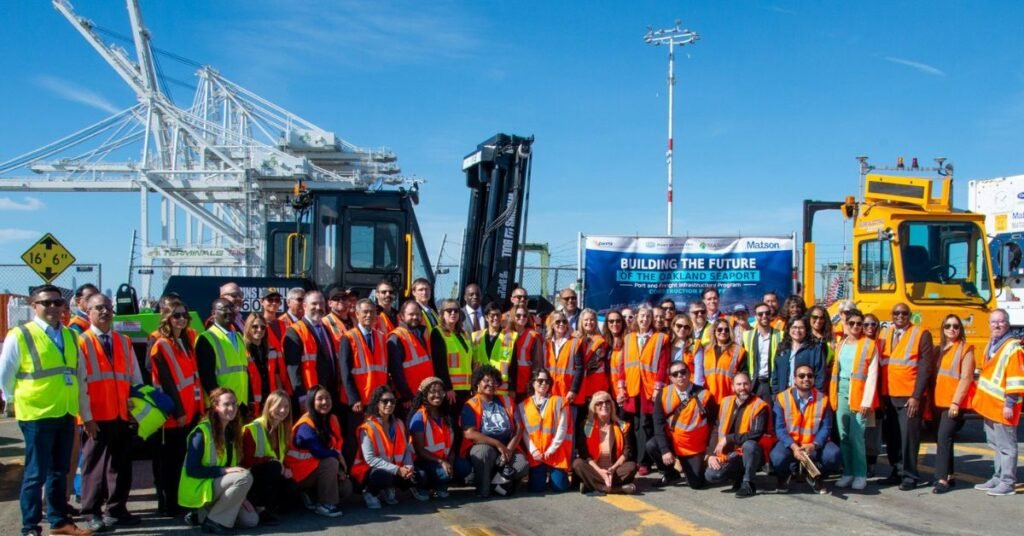
Oakland terminal electrification has advanced with a construction launch for infrastructure upgrades designed to support zero-emission cargo handling at Matson Terminal.
The port marked the milestone on 27 October 2026 alongside California Transportation Secretary Toks Omishakin and project partners. New charging and electrical infrastructure will enable the terminal’s equipment transition.
Once completed, Matson is expected to become Oakland’s first marine terminal with an entirely zero-emission cargo-handling equipment fleet.
The terminal is operated by SSA Terminals, a joint venture between SSA Marine and Matson. The project is scheduled for completion in 2028.
The milestone concerns the terminal’s cargo-handling fleet. It should be distinguished from eliminating emissions from every activity associated with the terminal, including visiting vessels and external transport.
State funding covers broader port improvements
The California State Transportation Agency is supporting the investment through $119 million from its Port and Freight Infrastructure Program.
That funding supports improvements across Oakland Seaport, rather than representing a disclosed standalone price for the Matson equipment transition.
The port originally announced the state award in July 2023. Its published programme includes converting diesel cargo-handling equipment at Matson, wharf electrical improvements, mobile shore-power outlets, bollard and fender replacement, and other terminal modernisation works.
The latest construction announcement therefore moves an earlier funding commitment towards physical delivery.
For port users, the operational requirement is to introduce new infrastructure while maintaining dependable cargo movement. Construction sequencing, equipment availability and the readiness of electricity connections will influence how smoothly the transition progresses.
Electrification requires more than equipment replacement
Moving a terminal fleet away from diesel requires coordination between mobile equipment and fixed infrastructure.
Charging locations must fit working patterns, while electrical connections need to support the demand created by equipment returning for energy between assignments. Maintenance teams and operators also need familiarity with the new systems.
For terminal management, the commercial test is whether the replacement fleet can sustain required productivity and availability. Equipment that performs well individually must also function effectively within the terminal’s wider handling sequence.
Oakland’s project addresses the supporting infrastructure that makes such deployment possible. The charging and electrical works are therefore central to achieving the fleet objective, rather than ancillary additions.
Separate federal programme widens the transition
The Matson works sit alongside a separate, broader zero-emission investment programme.
In October 2024, the US Environmental Protection Agency awarded Oakland approximately $322 million through its Clean Ports Program.
The port said that award would support 663 pieces of zero-emission equipment, comprising 475 drayage trucks and 188 cargo-handling machines, together with supporting infrastructure.
These figures describe the federal programme’s planned deployment. They are not the equipment count for the newly announced Matson project.
The distinction is important because terminal equipment and drayage trucks serve different parts of the cargo journey. Improving one source of emissions does not automatically resolve the infrastructure or operating requirements of the other.
Community and workforce measures accompany investment
The wider Clean Ports programme also includes community engagement, workforce development and air-quality monitoring, alongside equipment and energy infrastructure.
These activities provide a way to connect investment with local outcomes and the skills needed to operate and maintain new technology.
For nearby communities, the relevant measure will be actual reductions in pollution as replacement equipment enters service. For the workforce, implementation creates requirements for training and safe working procedures around new electrical systems.
Completion will establish an operational benchmark
The 2028 target gives Oakland and its terminal partners a defined implementation horizon.
Progress will depend on completing electrical works, installing charging systems and integrating the replacement equipment into regular operations.
If delivered as planned, Matson Terminal would provide a practical operating example for further transitions elsewhere at Oakland. Its experience could help identify infrastructure needs, maintenance requirements and scheduling changes before similar deployments expand across the seaport.
FAQs
What is changing at Matson Terminal?
New charging and electrical infrastructure will support a fully zero-emission cargo-handling equipment fleet.
When is completion expected?
In 2028.
Who operates the terminal?
SSA Terminals, a joint venture between SSA Marine and Matson.
Is $119 million the Matson project’s standalone cost?
No. It is state funding supporting a broader package of Oakland Seaport infrastructure improvements.
Does this make the entire terminal zero-emission?
The stated objective covers cargo-handling equipment, rather than all emissions associated with terminal activity.
Recent Posts
Power & Propulsion
WinGD Signs First Engine Licensing Agreement with HD Hyundai Marine Engine
LNG
LNG Carrier Surplus Forecast Raises Questions Over New Ship Orders
Policy
UK ETS Site Visits: DNV Urges Early Action Before First Reporting Deadline