
Global maritime leaders gather in Greece as geopolitical tensions and energy security dominate shipping agenda
Posidonia 2026 opened in Athens this week against a backdrop of heightened geopolitical tensions, supply chain disruptions and growing pressure on the shipping industry to accelerate decarbonisation and digital transformation.
The exhibition, regarded as one of the maritime sector’s largest international gatherings, comes at a time when the continued closure of the Strait of Hormuz to commercial traffic has intensified concerns around global energy flows and maritime security.
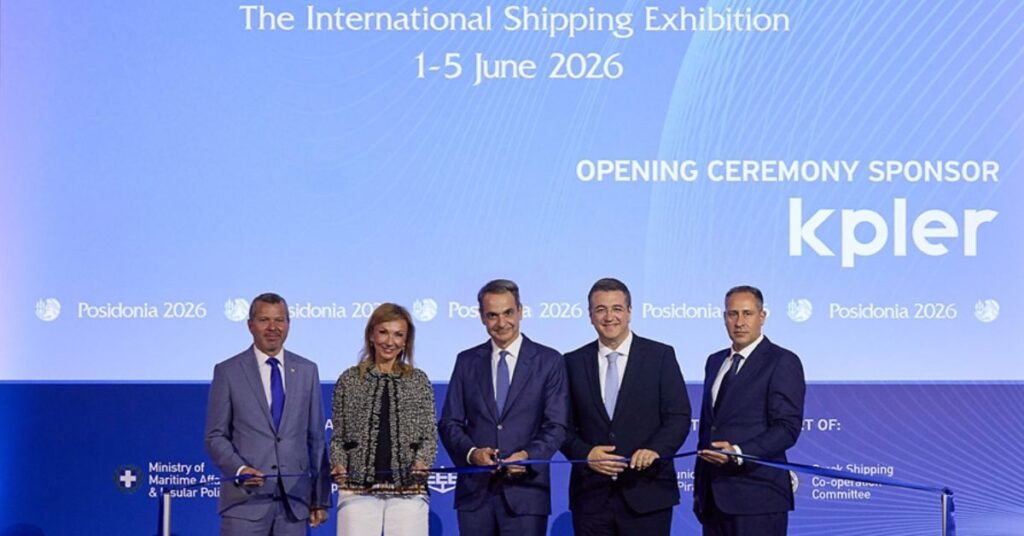
The official opening ceremony took place at the Athens Metropolitan Expo in the presence of Greek Prime Minister Kyriakos Mitsotakis, IMO Secretary-General Arsenio Dominguez, European Commissioner for Sustainable Transport and Tourism Apostolos Tzitzikostas, Union of Greek Shipowners President Melina Travlos, and Panama President José Raúl Mullino.
Largest Posidonia edition on record
According to organisers, Posidonia 2026 is the biggest edition in the exhibition’s nearly six-decade history, featuring 2,227 exhibitors from 83 countries and territories across 45,000 square metres of exhibition space.
The event also includes 24 national pavilions, with Germany and Italy returning officially after extended absences.
More than 40,000 participants are expected to attend the exhibition and related events through 5 June 2026, while organisers estimate the exhibition could generate over €100 million for the Greek economy through hospitality, transport, catering and event-related services.
The conference programme includes approximately 70 shipping forums, seminars and industry conferences, many hosted outside the exhibition venue for the first time due to increased demand.
Geopolitical tensions dominate discussions
Addressing attendees during the opening ceremony, Greek Prime Minister Kyriakos Mitsotakis highlighted the strategic role of shipping in global trade and regional stability.
He said:
“Greek shipping constitutes a national and European asset that must be safeguarded, especially at a time when the strategic and geopolitical importance of shipping is being highlighted more strongly than ever in recent years.”
Mitsotakis added:
“The foresight, realism, and courage that brought Greek shipping to the top will continue to be its greatest strengths in facing the challenges ahead.”
IMO Secretary-General Arsenio Dominguez pointed to the growing impact of geopolitical instability on maritime trade and energy supply chains.
He stated:
“Today’s situation in the Middle East — including tensions in the Red Sea and the Strait of Hormuz — presents serious challenges for global shipping, energy security and supply chains.”
Dominguez also highlighted the importance of the Strait of Hormuz, noting that the region typically handles around 20 million barrels of oil per day, nearly 20% of global LNG trade and approximately one-third of global fertiliser trade.
EU highlights strategic role of shipping and ports
European Commissioner Apostolos Tzitzikostas stressed the importance of maritime transport to Europe’s economic competitiveness and supply chain resilience.
He said:
“Without ships, without ports, there is no competitive Europe.”
Tzitzikostas noted that shipping accounts for 76% of European Union imports and 73% of exports, while maritime imports alone are valued at approximately €1.3 trillion annually.
He also referenced recently introduced EU initiatives focused on shipping and port competitiveness, including the European Industrial Strategy for Shipping and the Strategy for European Ports.
Decarbonisation and technology central to Posidonia agenda
Environmental compliance, digitalisation and alternative fuels are among the major themes at this year’s exhibition.
According to organisers, more than 100 exhibitors are showcasing environmental technologies aimed at supporting shipping’s transition toward lower-emission operations, while over 30 companies are presenting artificial intelligence applications tailored for maritime use cases.
Nuclear energy is also emerging as a key discussion topic, with dedicated sessions examining the role of advanced nuclear technologies in commercial shipping and near-shore power generation.
Melina Travlos, President of the Union of Greek Shipowners, emphasised the importance of balancing decarbonisation goals with operational realities.
She said:
“Without freedom of navigation, there can be no global prosperity.”
Travlos added:
“Without realism, there can be no sustainable green transition.”
Shipping resilience highlighted amid global uncertainty
Theodore Vokos, Managing Director of Posidonia Exhibitions S.A., said recent disruptions to critical maritime corridors had once again demonstrated shipping’s importance to the global economy.
He stated:
“Recent developments have highlighted a simple but powerful truth: without shipping, the world stops.”
Vokos added:
“Shipping has once again proven that it is the backbone of global trade and a cornerstone of stability in an ever-changing world.”
Sustainability initiatives and expanded events
The Posidonia Games sporting programme has also expanded for 2026, including the introduction of the Posidonia Tour cycling race. Proceeds from the sporting events will continue supporting charities and non-governmental organisations.
Organisers confirmed that Posidonia 2026 has received ISO certification as a sustainable event for the third consecutive edition, remaining the first exhibition in Greece to achieve the distinction.
The exhibition is being held under the auspices of Greece’s Ministry of Maritime Affairs and Insular Policy, the Hellenic Chamber of Shipping and the Union of Greek Shipowners.
Recent Posts
HYBRID
GRSE Signs ₹1,032-Crore ONGC Contract for Four Hybrid Offshore Supply Vessels
EV
Energy In Motion Opens ₹500-Crore Electric Truck Plant in Pune
Fuels
Aegis Logistics Commissions 35,000-Tonne LPG Bottling Plant at JNPA