
Summary
The Freeport of Riga Authority has signed a cooperation memorandum with South Korea’s ECOMETHANOL and Latvia’s AE Risinājumi to explore green methanol production and bunkering. The agreement establishes a three-year project preparation framework, with site selection, infrastructure requirements and commercial arrangements still to be developed.
Article
Partners explore an integrated fuel hub
The Riga green methanol bunkering initiative aims to connect local fuel production, exports and vessel supply within one port-based development.
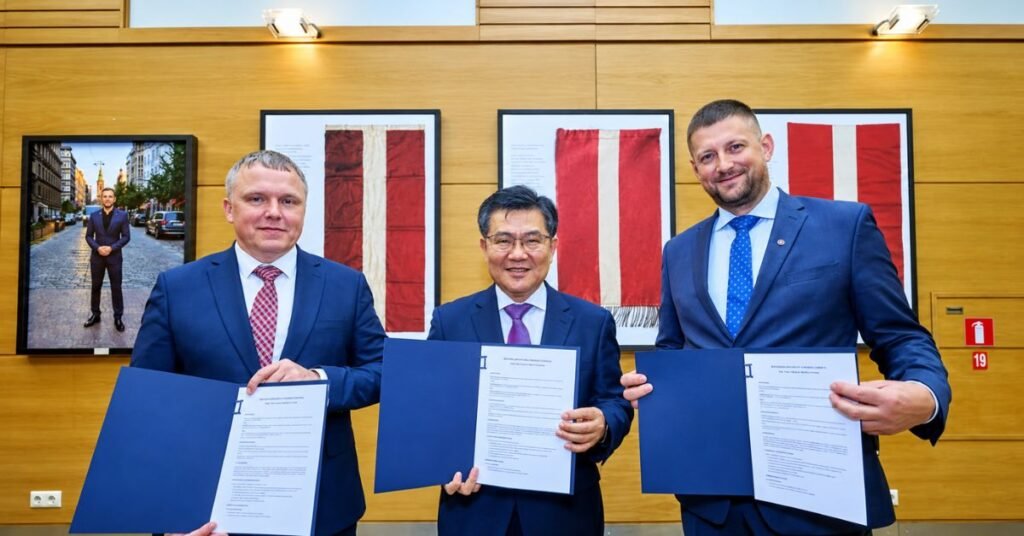
The Freeport of Riga Authority, ECOMETHANOL and AE Risinājumi signed the memorandum at Riga City Council on 20 October 2026.
The proposed plant would produce methanol for export and use as an alternative marine fuel. The partners will also assess facilities for supplying that fuel to ships.
The agreement marks a project-development step. It does not establish an operating bunkering service, a final investment decision or an approved construction programme for the Latvian plant.
Preparation covers land and infrastructure
The cooperation framework runs for three years and includes selecting a suitable site, examining land-lease conditions and planning infrastructure connections.
The work will consider utilities, transport links and access to port terminals. Environmental requirements, potential support mechanisms and methanol bunkering infrastructure will also be evaluated.
Specific land and implementation terms will require separate agreements between the partners.
This structure leaves several commercial decisions open. The announcement does not specify the Riga plant’s production capacity, investment requirement or commissioning date.
Those details will be necessary to assess the scale of fuel supply the project could eventually offer.
Baltic demand forms part of the proposition
The partners intend to address the marine-fuel market in the Baltic Sea region and beyond.
They have also identified vessels operating between Europe and Asia through the Northern Sea Route as a potential customer group. That is a stated market ambition rather than evidence of committed vessel calls or fuel-purchase contracts.
For Riga, the proposed combination of production and bunkering could create activity across manufacturing, storage, terminal handling and fuel distribution.
The commercial proposition would depend on matching production with customers’ requirements, including delivery locations, volumes and the timing of vessel operations.
Korean project provides a parallel development
ECOMETHANOL is also developing a green methanol facility at Taebaek in South Korea, with planned annual capacity of 15,000 tonnes.
Construction there is scheduled to begin in December 2026, with output intended to supply ports on Korea’s east coast.
That capacity and construction schedule apply to the Korean project. They should not be attributed to the proposed Riga facility.
The partners present the Latvian initiative within a wider ambition to establish fuel-supply points serving Europe–Asia shipping. However, the two locations have distinct development requirements, and progress at one does not establish readiness at the other.
Production pathway determines the fuel’s credentials
The term green methanol covers production routes that differ from conventional methanol manufactured from fossil feedstocks.
IRENA’s earlier technical work identifies two principal renewable pathways: biomethanol derived from biomass and e-methanol synthesised using renewable hydrogen and an appropriate carbon-dioxide source.
These distinctions matter because using methanol in a ship does not, by itself, establish a low-emission supply chain. The production inputs and energy sources determine its environmental characteristics.
The Riga announcement identifies green methanol as the intended product, but does not disclose a final feedstock configuration or quantified lifecycle emissions performance.
Further engineering and commercial disclosures will therefore be important when assessing both the project’s production costs and the fuel it could supply.
Commercial commitments remain the next test
IRENA and the Methanol Institute’s 2021 renewable methanol outlook identified production scale and cost as central challenges for developing the market.
That historical assessment provides context for projects seeking to connect new production with identifiable industrial or transport customers. It should not be treated as a current price quotation for Riga.
For the Latvian partners, the immediate task is to turn the memorandum into a defined project. Land arrangements, infrastructure planning and environmental assessment will establish whether the proposed hub can progress towards investment.
For shipowners, the meaningful commercial milestone will be dependable fuel availability on agreed terms. The memorandum begins that development process; it does not yet add purchasable bunker supply.
FAQs
Who signed the memorandum?
The Freeport of Riga Authority, South Korea’s ECOMETHANOL and Latvia’s AE Risinājumi.
Is methanol bunkering already available under this project?
No. The agreement establishes a framework for project preparation.
How long does the preparation framework run?
Three years.
Has the Riga plant’s capacity been announced?
No. The cited 15,000-tonne annual capacity belongs to ECOMETHANOL’s separate Korean project.
What happens next?
The partners will assess the site, land terms, infrastructure, environmental requirements and implementation arrangements.
Recent Posts
Ports & Harbours
VOC Port’s Tuticorin International Container Terminal Declared Green Terminal After Full Equipment Electrification
Hydrogen
India Could Become Leading Green Hydrogen Producer and Exporter, Says Gadkari
Fuels
Offshore Vessel Fuel Efficiency Offers Immediate Savings, Says Opsealog