
Summary
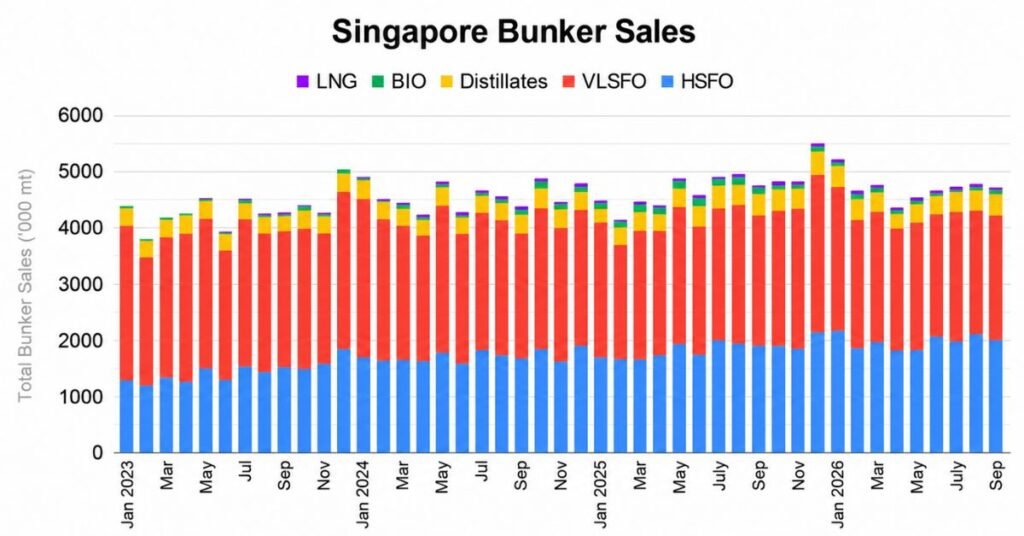
Singapore’s conventional and biofuel bunker sales reached 41.97 million tonnes in January–September 2026, exceeding the previous year’s nine-month record despite a September decline. High-sulphur fuel oil drove the increase, while LNG expanded from a smaller base and biofuel blends recorded a substantial contraction, revealing diverging demand across fuel categories.
Nine-month growth withstands September decline
Singapore bunker sales of conventional fuels and biofuels increased 1.8% year on year during the first nine months of 2026.
September volumes, however, slipped to 4.67 million tonnes, down 0.8% from August and 0.9% from a year earlier.
High-sulphur fuel oil sales rose 10.4% to 17.58 million tonnes over January–September, while very-low-sulphur fuel oil declined 2% to 20.63 million tonnes.
Biofuel blend sales fell 48% to 598,300 tonnes. LNG, counted separately from the conventional and biofuel total, increased 21.4% to 487,100 tonnes.
The figures show that growth in the overall market has been accompanied by a significant change in product demand.
HSFO retains a role under sulphur rules
The strength of HSFO demand needs to be understood within the industry’s emissions compliance framework.
Since January 2020, IMO rules have limited sulphur content in marine fuel used outside designated emission control areas to 0.50% by mass.
Ships can meet the requirements through compliant fuels or approved equivalent arrangements, including exhaust gas cleaning systems, commonly known as scrubbers.
Scrubber-equipped ships can consequently continue using higher-sulphur fuel while meeting the applicable sulphur oxide emissions requirements.
This explains why HSFO remains commercially relevant. Its continued use does not indicate that the global sulphur limit has been relaxed. Nor does sulphur compliance alone establish a vessel’s greenhouse-gas performance: the two address different environmental measures.
Growth follows a record annual performance
The latest nine-month result follows another strong year for Singapore’s marine fuel industry.
Total marine fuel sales reached a record 56.77 million tonnes in 2025, increasing 3.4% from 2024. Alternative marine fuels accounted for 1.95 million tonnes, compared with 1.35 million tonnes the previous year.
The port also recorded 44.66 million TEUs of container throughput and 3.22 billion gross tonnes of vessel arrivals in 2025.
These measures provide context for Singapore’s refuelling business, although they describe different activities. Container throughput measures terminal handling, vessel arrival tonnage reflects calling ships’ size, and bunker sales measure fuel supplied.
Strong performance in one category does not necessarily produce equivalent growth in another.
LNG infrastructure programme advances
Singapore is preparing additional infrastructure arrangements alongside the increase in LNG demand.
At SIBCON on October 14, the Maritime and Port Authority of Singapore announced plans to invite applications for licences to operate LNG floating storage units at its anchorages by the end of 2026, subject to regulatory approvals.
The initiative follows the award of eight new LNG bunker supplier licences in July.
Additional storage is intended to strengthen supply resilience as the market develops. MPA, CMA CGM and Singapore LNG Corporation also signed an agreement to explore liquefied biomethane as a marine fuel, including opportunities to use existing gas infrastructure.
These initiatives concern future capability. They should be distinguished from fuel already delivered to ships.
Standards support a wider fuel offering
Singapore’s preparations extend beyond LNG.
A new ammonia bunkering technical reference covers safety, operating procedures, custody transfer and personnel competencies.
MPA also announced an ethanol bunkering operation intended to assess how existing methanol procedures could be adapted and how mass flow meters would perform with ethanol.
Together, these developments demonstrate investment in several fuel pathways rather than dependence on a single alternative.
However, introducing standards and conducting trials are different from establishing sustained commercial demand. Actual uptake will depend on compatible ships, fuel availability, pricing and customers’ operating requirements.
Suppliers face a changing product mix
For bunker suppliers, the commercial challenge is to serve today’s large conventional-fuel market while preparing for smaller, evolving alternatives.
Storage allocation, delivery-vessel capability and fuel-quality controls must reflect the products customers actually purchase. Investment decisions also require an assessment of how quickly demand could change.
The September decline underlines the need to examine monthly movements alongside cumulative performance. A nine-month record indicates resilience, while the differing fuel trends provide a more useful guide to where suppliers may need additional capacity or greater flexibility.
FAQs
How much fuel did Singapore sell during January–September 2026?
Conventional and biofuel sales totalled 41.97 million tonnes. LNG was reported separately.
Which fuel drove growth?
HSFO, with nine-month sales increasing 10.4%.
Did September sales increase?
No. Conventional and biofuel volumes declined both month on month and year on year.
How did alternative fuels perform?
LNG grew, while biofuel blend sales fell substantially.
Why can ships still use HSFO?
Approved scrubbers can provide an equivalent means of meeting sulphur oxide emissions requirements.
Recent Posts
HYBRID
GRSE Signs ₹1,032-Crore ONGC Contract for Four Hybrid Offshore Supply Vessels
EV
Energy In Motion Opens ₹500-Crore Electric Truck Plant in Pune
Fuels
Aegis Logistics Commissions 35,000-Tonne LPG Bottling Plant at JNPA