
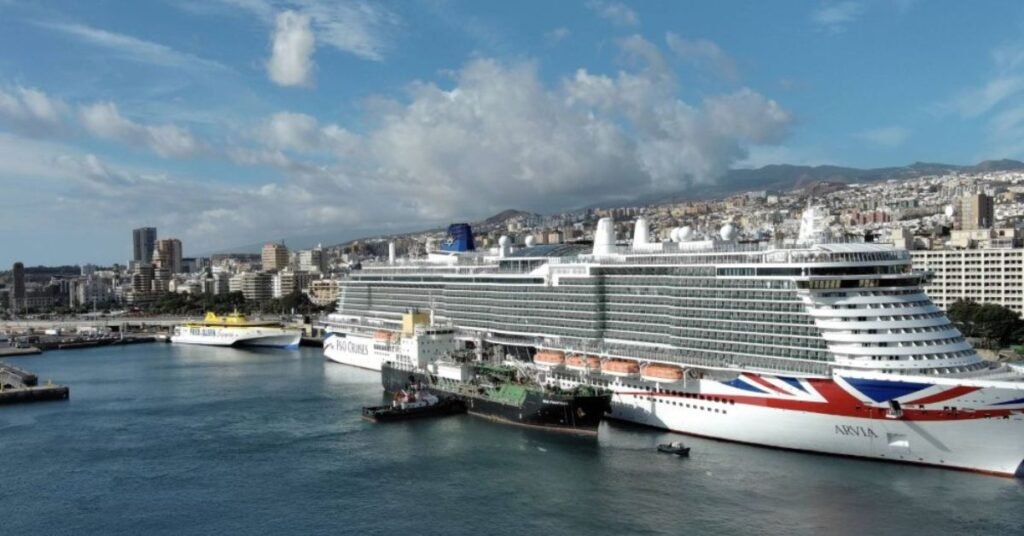
The Port Authority of Santa Cruz de Tenerife has joined SEA-LNG, becoming the coalition’s first member based in the Mid-Atlantic as it expands liquefied natural gas (LNG) bunkering services for cruise ships and ferries. Announced on 19 November 2026, the membership extends the industry group’s presence along shipping routes connecting Europe, Africa and the Americas.
The authority manages six ports across Spain’s Canary Islands. Its membership brings experience in both ship-to-ship and truck-to-ship fuel deliveries to the coalition, which promotes LNG and renewable methane-based marine fuels.
Why has Tenerife joined SEA-LNG?
Airam Díaz Pastor, the port authority’s Deputy Director, said participation would strengthen collaboration with the international maritime industry and support cleaner marine energy solutions. He described LNG as a transitional fuel that could support subsequent adoption of liquefied biomethane.
SEA-LNG Chief Operating Officer Steve Esau highlighted the potential for Tenerife’s infrastructure to supply bio-LNG and synthetic methane in future. The membership announcement also identified Granadilla as a location with opportunities for further bunkering, storage and LNG infrastructure development.
These opportunities were presented as areas for development, without a specific investment commitment or construction timetable.
How quickly is cruise bunkering demand growing?
The port authority expects 33 LNG bunkering operations during the 2026–27 cruise season, compared with 18 in the previous season, an increase of 83.3%. Carnival Corporation, Royal Caribbean International and TUI Cruises are among the companies expected to use the service.
The season’s first operation took place on 27 October, when P&O Cruises’ Arvia received 1,000 tonnes of LNG from New Frontier 1, with Shell supplying the fuel. Erhardt Shipping Services acted as the bunker vessel’s local agent.
Arvia called at Tenerife from Southampton before continuing towards Philipsburg in Sint Maarten. The operation illustrates the port’s role as a refuelling point for cruise vessels operating across the Atlantic.
The projected increase relates to the number of bunkering operations, rather than a disclosed forecast for total fuel volumes.
How has Tenerife expanded ferry fuel supply?
On 10 September, Santa Cruz de Tenerife introduced multi-truck-to-ship LNG bunkering for Baleària’s fast ferry Mercedes Pinto. The arrangement allows several road tankers to supply a vessel simultaneously, adding a shore-based option to the port’s existing ship-to-ship capability.
ESK carried out the operation at the Anaga basin jetty. Two tankers delivered fuel equivalent to 600 megawatt-hours, with a combined pumping rate of 700 litres per minute.
The service followed coordination between the port authority, Baleària, ESK and other participants. Preparations included risk assessment, emergency procedures and operating arrangements suited to the jetty and receiving vessel.
The 123-metre Mercedes Pinto can accommodate 1,200 passengers and 425 vehicles. Its dual-fuel engines are designed to use natural gas and biogas, according to the port authority.
What experience supports further development?
Tenerife’s LNG bunkering activity predates the latest expansion. The port authority records supplying AIDAnova in December 2018 and subsequently extending the service to additional cruise vessels.
During 2024, Santa Cruz de Tenerife supplied 12,234 tonnes of LNG to AIDAcosma, Arvia, Costa Toscana, Iona and Sun Princess.
Its operational footprint has also widened within the harbour. Mein Schiff Relax became the first cruise ship to receive LNG at the Muelle Sur, using New Frontier 1 in a Shell-chartered operation. Together, these developments provide an established operating base for the increased cruise demand and broader ferry bunkering services now planned.
Recent Posts
Marine
Lloyd’s Register approves nuclear classification framework for ships and offshore units
Marine
IGFA forms three committees to support Hong Kong’s green marine fuel market
Methanol
Fratelli Cosulich lays keel for final tanker in four-vessel methanol-ready programme