
Australian developer NH3 Clean Energy has shifted the targeted final investment decision for its WAH2 low-emissions ammonia project in Western Australia to 2027, as it incorporates additional customer requirements into engineering and commercial planning.
The company disclosed the revised timetable in its September-quarter activities report, released on 26 October 2026. Commercial operations remain targeted for 2030, despite the investment decision moving beyond the previously indicated late-2026 milestone.
The development is relevant to proposed ammonia bunkering services along the Pilbara–Asia iron ore shipping corridor, where WAH2 is intended to provide a potential source of lower-emissions marine fuel.
Why has the WAH2 investment decision moved?
NH3 Clean Energy said discussions with prospective industrial ammonia customers had broadened the project’s potential market beyond power generation and marine fuel.
However, accommodating those opportunities requires further work across engineering, approvals, commercial negotiations and financing. Management therefore considers additional time necessary to refine the project before committing to investment.
The revised schedule separates two milestones: authorisation to proceed with the investment and the targeted commencement of commercial operations. The latest filing retains 2030 for operations but does not specify a quarter for the 2027 final investment decision (FID).
What type of ammonia will WAH2 produce?
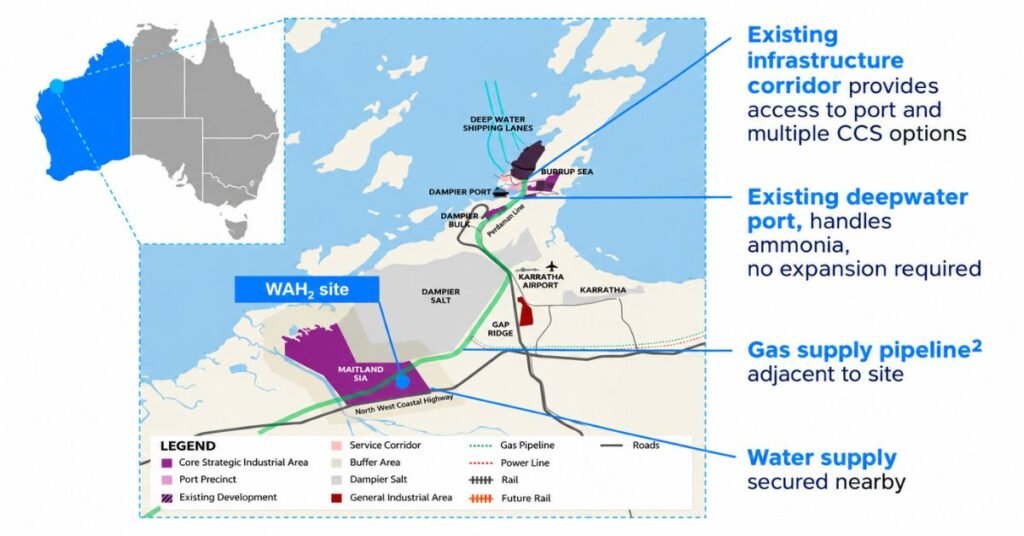
WAH2 is planned for the Maitland Strategic Industrial Area in Western Australia, with access to existing gas pipelines and export infrastructure.
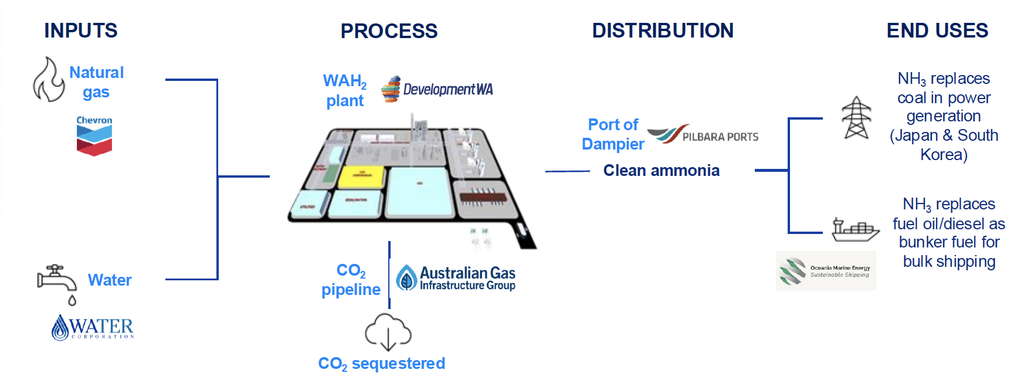
The project is based on gas reforming combined with carbon capture and storage (CCS). Its proposed low-emissions ammonia production pathway therefore differs from ammonia made using hydrogen produced entirely through renewable-powered electrolysis.
NH3 Clean Energy identifies Japan, South Korea and the maritime sector among its intended markets. The project’s commercial proposition combines ammonia supply for established industrial applications with emerging demand from energy users and shipping.
How does WAH2 connect with ammonia bunkering?
In June 2025, NH3 Clean Energy, Pilbara Ports and Oceania Marine Energy announced a non-binding joint development agreement to establish low-emissions ammonia bunkering at the Port of Dampier by 2030.
The arrangement envisaged NH3 supplying ammonia from WAH2, Oceania owning or operating bunker vessels, and Pilbara Ports managing port operations and bunkering licences.
The proposed service would transfer ammonia from Dampier’s bulk liquids berth to vessels at anchorage, supporting bulk carriers transporting iron ore from the Pilbara to Asia.
That agreement originally outlined coordinated work intended to support investment decisions for ammonia production, bunker vessels and associated port infrastructure by the end of 2026. WAH2’s revised production-project timetable is therefore a material update to the earlier planning assumptions. It does not, by itself, establish that the proposed bunkering service has been delayed.
What engineering and commercial work remains?
Front-end engineering and design (FEED) continues with Linde Engineering. The company is also pursuing discussions with industrial customers alongside prospective buyers in power generation and marine fuels.
The central commercial task is to translate customer interest into agreements that support the project’s technical configuration and financing. A wider customer base offers additional sales opportunities, but differing requirements must be reconciled before the investment decision.
For prospective marine-fuel users, the distinction between a development target and committed supply remains significant. The current announcement confirms a revised investment timetable and a retained operating target, rather than an approved construction programme or operational fuel supply.
The next milestones will be progress towards binding commercial arrangements, financing, completed engineering and the investment decision itself. These will determine whether WAH2 can maintain its stated 2030 commercial operations objective.
Recent Posts
Fuels
ONE Symphony Joins 14,000-TEU Fleet as ONE Expands Alternative-Fuel-Ready Newbuildings
Dual-Fuel
COSCO Ethylene Carrier Investment Adds LNG Dual-Fuel Capacity to Fleet Plans
Ammonia
MOL Ammonia-Fuelled Bulkers Named as 2027 Delivery Programme Advances