
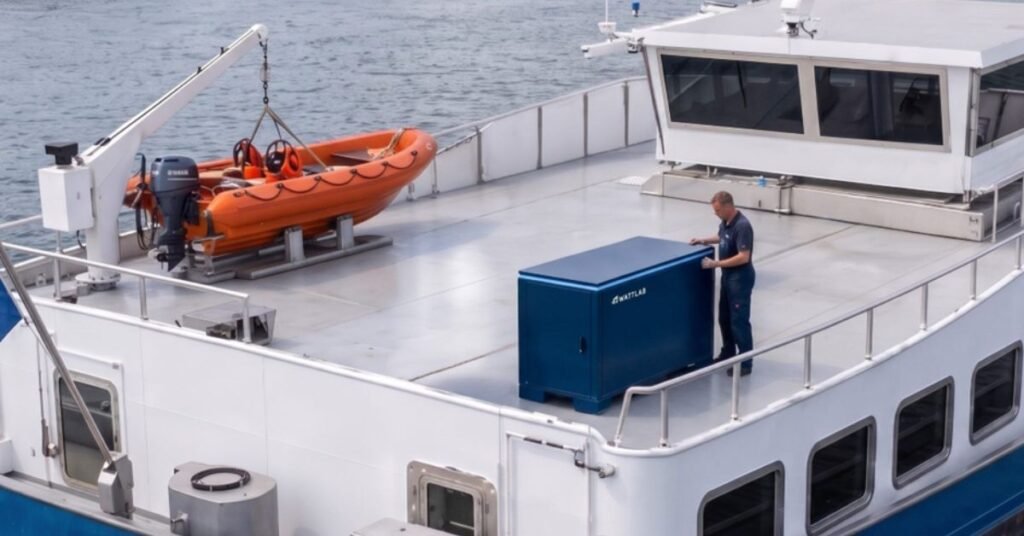
Standardised battery solution aims to reduce fuel use, emissions and installation downtime
Wattlab has introduced a modular battery system for inland vessels designed to be installed within a single day, targeting one of the major barriers slowing battery adoption in inland shipping: high installation costs and extended vessel downtime.
The new system, called WEstack, is intended to improve generator efficiency and reduce fuel consumption across inland and coastal vessels through a pre-assembled battery package that can be rapidly integrated onboard.
Battery retrofit designed to reduce installation complexity
According to Wattlab, conventional marine battery retrofits can require up to two weeks of installation work, keeping vessels out of operation during the process.
The WEstack system is delivered as a fully assembled and pre-tested unit available in four capacities ranging from 100 kWh to 400 kWh. Once onboard, the system only requires final connection to vessel systems.
The modular design is intended to simplify electrification projects for operators that may otherwise avoid battery retrofits due to cost and operational disruption.
Generator optimisation targets fuel savings
Wattlab said the system was developed following years of operational data collection from its solar hatch installations for inland shipping.
The company identified low generator loading as a major source of fuel inefficiency onboard vessels.

Bo Salet: ‘We hear from the market that our battery system is exactly what they want.’
Wattlab founder and CEO Bo Salet said:
“Generators run at only 10 to 15 percent of their capacity for the vast majority of the time. At that load, you consume twice as much fuel as when running at the optimal level.”
The battery system is designed to allow generators to operate closer to optimal load conditions while excess energy charges the battery pack.
Stored electricity can then power onboard systems while generators are switched off, reducing overall running hours.
Fuel savings and reduced onboard emissions
According to the company, the system can reduce generator fuel consumption by between 30% and 50%, depending on vessel type and operating profile.
Wattlab estimates that some inland vessel operators could save approximately 30 cubic metres of fuel annually.
The reduced generator operating hours are also expected to lower maintenance costs, extend equipment lifespan and improve onboard comfort through lower noise, vibration and exhaust emissions.
Salet said:
“Many skippers are surprised by how much fuel they can save by running their generators more efficiently.”
He added:
“But they find the extra comfort on board at least as important: less noise, fewer vibrations, and less odor.”
Leasing model targets faster adoption
The WEstack system will be offered through both purchase and lease models.
Wattlab said the lease structure is designed so operational savings from reduced fuel consumption and maintenance can exceed lease costs from the start of deployment.
After five years, ownership transfers to the vessel operator.
The company said the battery system is suitable for a broad range of inland and coastal vessels, including dry cargo ships, tankers and smaller coastal ships.
Wattlab said efficiency technologies will remain important regardless of whether the maritime sector ultimately transitions toward fuels such as hydrogen, ammonia or methanol.
Salet said:
“The road to affordable alternative fuels is still long.”
He added:
“Energy-saving measures are therefore not temporary. They are permanent.”
Solar and battery integration expands in coastal shipping
In parallel with the WEstack launch, Wattlab said it is also supplying Solar Flatracks for a Norwegian coastal vessel operated by Berge Rederi.
The vessel is expected to become one of the first fully battery-powered coastal ships in its class and will include 194 kWp of installed solar generation capacity.
Recent Posts
HYBRID
GRSE Signs ₹1,032-Crore ONGC Contract for Four Hybrid Offshore Supply Vessels
EV
Energy In Motion Opens ₹500-Crore Electric Truck Plant in Pune
Fuels
Aegis Logistics Commissions 35,000-Tonne LPG Bottling Plant at JNPA