
Summary
Eastern Pacific Shipping’s first two wind-assisted vessels have secured financing through the Fund for Energy Efficiency Technologies. The arrangement links shipowner payments to independently verified savings, testing a financing model intended to reduce upfront investment barriers and make the commercial returns from shipboard efficiency equipment more measurable.
First investments cover two EPS vessels
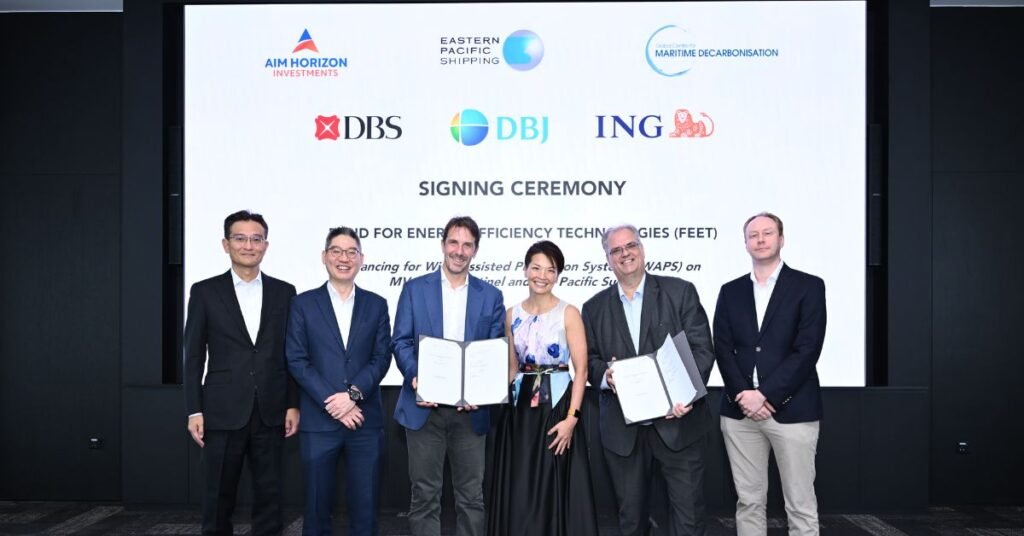
A wind-assisted propulsion financing arrangement announced on 20 October 2026 will support systems installed on Eastern Pacific Shipping’s Pacific Sentinel and Pacific Sunstone, marking the first deployment of the Fund for Energy Efficiency Technologies, or FEET.
Each vessel carries three 22-metre suction sails. The transaction brings together EPS, fund manager AIM Horizon Investments and the Global Centre for Maritime Decarbonisation (GCMD), which acts as the fund’s decarbonisation adviser.
FEET offers up to 100% upfront financing through a blended structure, with payments linked to verified fuel and regulatory savings. The announcement concerns financing for installed equipment, extending the project beyond technology deployment into the measurement and funding of operating benefits.
Operational evidence underpins repayments
The arrangement builds on earlier work by GCMD and EPS to measure wind-assisted propulsion performance aboard Pacific Sentinel.
GCMD collected 276 million data points during four months of spot-market trading in the Americas, from mid-May to mid-September 2025. Researchers screened 203 valid transitions between the system’s operating and non-operating states to assess its contribution separately from changing conditions.
FEET will use the independently reviewed methodology for the wind-assisted projects it finances. Project data will undergo auditing, while calculated savings will be independently verified before determining shipowner payments.
The approach gives financiers a basis for connecting repayments with measured performance, addressing uncertainty over how much equipment saves during commercial service.
Fund structure addresses investment barriers
FEET reached its initial closing in November 2025 with commitments of up to US$35 million. Its structure combines catalytic capital, commercial and preferred equity, and senior debt.
GCMD supplied catalytic equity, while the Development Bank of Japan took a preferred-equity position. DBS and ING were identified as senior-debt providers.
A feature is the use of unsecured equipment leases, separating retrofit financing from the vessel’s existing mortgage. The fund’s published model can cover equipment, installation and additional monitoring equipment, with ownership transferred to the shipowner for a nominal fee when the lease ends.
The model responds to difficulties in predicting investment payback when savings vary with weather, routing and operating conditions. It also addresses the financial complications that arise when owners fund equipment but charterers benefit from lower fuel bills.
At its launch, the partners outlined an ambition to expand FEET to US$500 million by 2030, potentially supporting around 200 ships. That remains a growth target.
Pacific Sentinel established the retrofit pathway
The vessel programme predates the financing announcement. In February 2025, bound4blue completed the installation of three eSAIL units on the 50,000-dwt Pacific Sentinel during scheduled drydocking at Beşiktaş Shipyard in Türkiye.
Preparatory work allowed each sail to be installed in less than a day. The project combined foundations, welding and equipment preparation within one yard visit, illustrating how wind-assist installation can be incorporated into planned maintenance.
The suction-sail technology draws air across an aerodynamic surface to generate lift and supplementary thrust. This contribution can reduce the propulsion demand placed on the vessel’s engine.
The installation also required structural and safety integration appropriate to a tanker, demonstrating that equipment performance is only one consideration in executing a retrofit.
Newbuild installation broadens the experience
EPS subsequently incorporated the technology into Pacific Sunstone during construction at New Times Shipbuilding in Jiangsu, China. Completion was announced in March 2026.
Foundations and electrical connections were included in the newbuilding programme before the Spanish-manufactured sails were shipped to China for installation. This provided a second deployment route alongside Pacific Sentinel’s retrofit.
In that earlier announcement, EPS reported that a six-month study of Pacific Sentinel had recorded average net power reductions of 8% and net fuel savings of 5.5%. Those findings relate to that vessel’s study conditions and should not be treated as guaranteed results across other ships or routes.
The first FEET transaction now tests whether operational evidence can support a repeatable financing mechanism. Its wider significance lies in connecting equipment performance, independent verification and investment repayment within a single commercial arrangement.
FAQs
Which vessels are covered by the financing?
Pacific Sentinel and Pacific Sunstone, both operated by Eastern Pacific Shipping.
What equipment is installed?
Each vessel has three 22-metre bound4blue eSAIL suction sails.
How does the financing work?
FEET provides upfront funding, with shipowner payments linked to independently verified savings.
Who manages FEET?
AIM Horizon Investments manages the fund, with GCMD acting as decarbonisation adviser.
Does the arrangement guarantee a fixed fuel-saving percentage?
No. Savings depend on operating conditions and are measured and verified for the financed projects.
Recent Posts
Ammonia
Maersk Tankers Ammonia Retrofit Project Advances Towards EU Support
Policy
EU Maritime Innovation Projects Advance in €3.4-Billion Funding Selection
Policy
Shanghai–Melbourne Green Shipping Corridor Sets 2035 Vessel Deployment Goal