

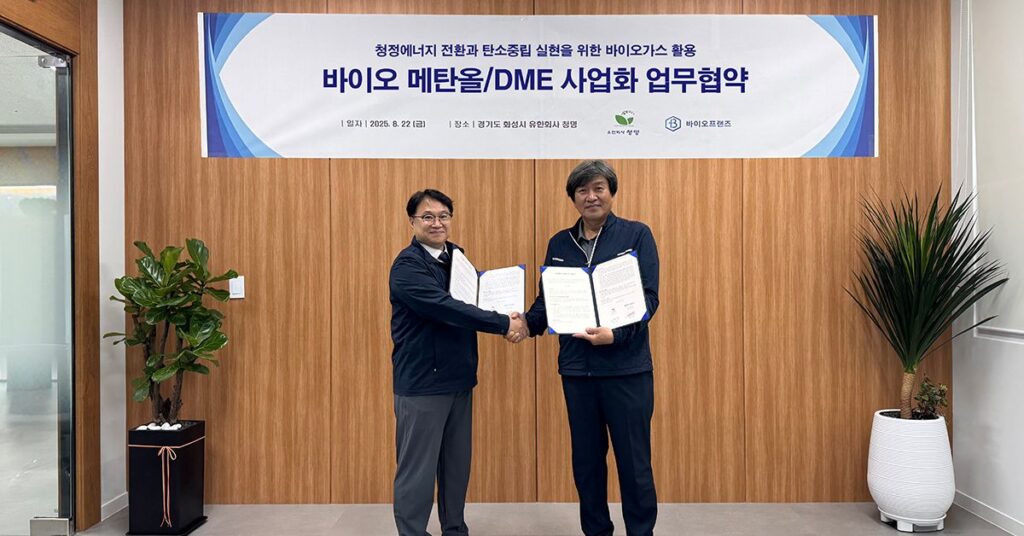
South Korean firms Biofriends and Cheongmyeong have signed a memorandum of understanding to build what is described as the country’s first commercial-scale biogas-to-methanol production facility. The agreement was signed on August 22 and is seen as a step toward full-scale commercialization of clean fuel production from domestically sourced biogas.
The biomethanol produced will initially be supplied to methanol-powered vessels in South Korea. The companies expect this to support the competitiveness of the nation’s shipbuilding sector while contributing to greenhouse gas reduction targets. South Korea is currently the world’s second-largest shipbuilder after China.
According to Biofriends, part of the output will be converted into dimethyl ether (DME) for use as an LPG-DME blended fuel. DME produces almost no sulfur oxides or nitrogen oxides and reduces carbon dioxide emissions. Because its properties are similar to liquefied petroleum gas, DME can be used within existing infrastructure. Biofriends noted that blending DME with LPG could help further lower carbon emissions and support national carbon neutrality goals.
The project follows a feasibility study carried out by Biofriends, which identified production capacity between 45,000 and 100,000 tons per year. Based on this study, the plant is planned to produce between 60,000 and 80,000 tons of biomethanol annually. It will use about 120,000 cubic meters of biogas per day generated from the digester at the Gunsan plant as feedstock.
Biofriends and Cheongmyeong will apply synthesis gas conversion technology to process the biogas. Cho Won-jun, CEO of Biofriends, said: “The core of this project lies in the Carbon Capture & Utilization process, which converts biogas methane (CH₄) and carbon dioxide together to create synthesis gas, which is then converted into methanol. This is a first in Korea to simultaneously utilize greenhouse gases to produce high-value-added clean fuel, and it is a technology that is competitive in the global market.”
Biomethanol is seen as one of the potential fuels for the shipping sector’s decarbonization pathway. Compared with conventional marine fuels, it can lower nitrogen oxide, sulfur oxide and particulate matter emissions. It is also easier to handle and store than other alternative fuels such as hydrogen or ammonia.
Representatives from Biofriends and Cheongmyeong said the project positions biomethanol as an important part of South Korea’s energy transition and supports the International Maritime Organization’s tightening environmental regulations.
Recent Posts
Fuels
Kuehne+Nagel expands SAF access for air cargo through Book & Claim model
Power & Propulsion
Kongsberg Maritime to extend range of Elegance Pods for large cruise vessels
LNG
Qatari, UAE LNG cargoes transferred via ship-to-ship outside Strait of Hormuz