

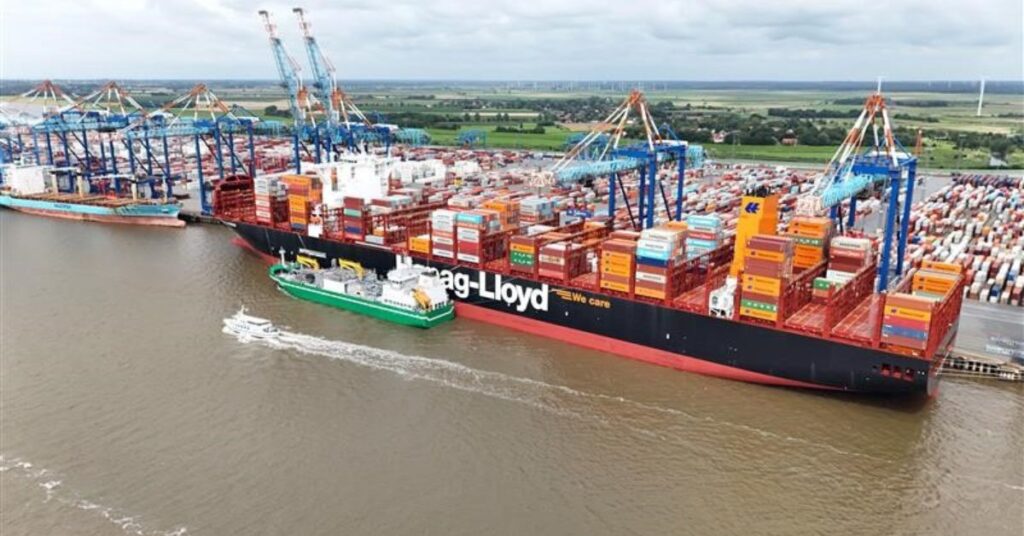
Hapag-Lloyd and Shell Western LNG B.V. (Shell) have signed a multi-year agreement for the supply of liquefied biomethane starting with immediate effect.
The agreement builds on a strategic collaboration established in 2023 to accelerate the decarbonization of alternative marine fuels.
Biomethane, also known as Bio-LNG, plays a significant role in Hapag-Lloyd’s decarbonization strategy, which aims to achieve net-zero fleet operations by 2045, by enabling emissions reductions across its fleet and supporting customers in their efforts to decarbonize their supply chains.
Since 2024, Shell has expanded its offering to include liquefied biomethane, which is now available at 22 strategic locations within its global LNG bunkering network.
“This agreement helps secure the fuel certainty and supply reliability we need to further expand the use of waste-based renewable fuels across our fleet – cutting emissions without compromising the quality and reliability our customers expect. Collaborations like this demonstrate that true leadership in shipping means acting now – using lower-emission fuels already available today and not waiting for future solutions,” said Jan Christensen, Senior Director Global Fuel Purchasing at Hapag-Lloyd AG.
Dexter Belmar, Shell’s Vice President Global Downstream LNG, added: “Bio-LNG is no longer a concept – it’s here, and it’s fueling the next chapter of shipping decarbonization. These long-term deals help build the confidence needed to scale renewable fuels.”
The liquefied biomethane supplied to Hapag-Lloyd is ISCC EU certified, which ensures sustainability of the feedstock production, traceability of sustainable products through the supply chain, and credible, verified reductions of life cycle emissions. Biomethane is a drop-in fuel that enables Hapag-Lloyd’s LNG dual-fuel vessels to transition seamlessly to renewable fuels without any equipment modifications. Derived from the decomposition of organic waste – such as crop residues, livestock manure and food waste – biogas is upgraded to biomethane by removing CO₂ and impurities. The liquefied biomethane is then fed into the local gas grid, liquefied and supplied to ships on a mass-balanced basis.
Recent Posts
Fuels
Kuehne+Nagel expands SAF access for air cargo through Book & Claim model
Power & Propulsion
Kongsberg Maritime to extend range of Elegance Pods for large cruise vessels
LNG
Qatari, UAE LNG cargoes transferred via ship-to-ship outside Strait of Hormuz