
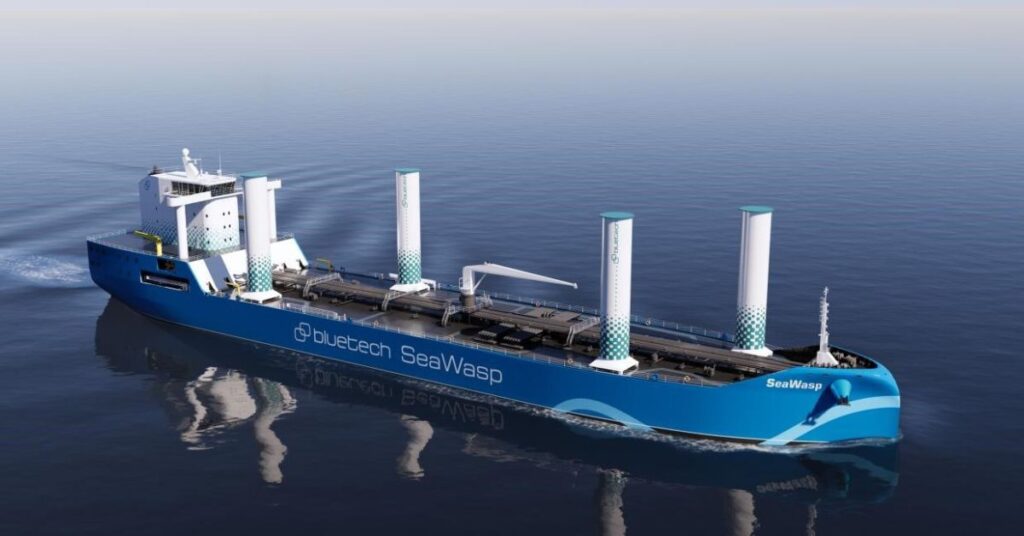
Bluetech and International Seaways, Inc. (INSW) have reported significant propulsion power and fuel savings from advanced simulations of Bluetech’s SeaWasp wind-optimised tanker design. The findings come as part of a joint research project involving the NYSE-listed tanker owner and supported by wind propulsion specialist Norsepower.
The project set out to determine whether purpose-built wind propulsion could provide meaningful power assistance for future ship designs. Results from Bluetech’s simulations confirmed the potential for substantial efficiency improvements, with wind power contributing notably to fuel and emissions reductions.
Purpose-built for Wind Performance
The SeaWasp design modifies Bluetech’s BT50 tanker to maximise thrust from two 35-metre Norsepower Rotor Sails™. On a representative INSW medium-range (MR) tanker route between San Francisco and South Korea, the design achieved total savings of up to 876 kW of propulsion power, equivalent to around 597 metric tonnes of fuel annually.
Of this, design-related modifications alone contributed approximately 104 kW, or 71.5 tonnes of fuel savings, improving vessel performance by around 13.5% in favourable conditions.
Traditionally, wind-assisted ship propulsion (WASP) systems have been retrofitted to existing vessels or added to newbuilds with minimal design adjustments. In contrast, Bluetech’s SeaWasp was developed from the outset to be wind-optimised while maintaining compatibility with MR trade requirements.
Focus on Operational Feasibility
“We set out to develop a ship that is entirely WASP-optimized, but maintains every essential operational feature and meets all trade-specific terminal and port restrictions,” said Sam Robin, Director of Energy Savings Solutions at Bluetech.
Michael LaGrassa, Director of Performance and New Construction at INSW, noted: “We focused on more than just energy savings and emissions reduction — our goal was a concept design that works in the real-world conditions of the MR trade. That meant ensuring reasonable build costs, equivalent cargo capacity and a design fit for purpose.”
The study also analysed the lower range of potential savings. On routes with less favourable wind conditions, such as South Korea to Singapore, the SeaWasp still delivered measurable benefits — around 185.9 metric tonnes of fuel savings per year, or 275 kW of propulsion power, compared to a conventional BT50 design.
Efficiency Above and Below the Waterline
According to Bluetech, the base BT50 design is already around 12% more efficient than typical tanker profiles, with the SeaWasp’s enhancements further improving performance.
One of the notable developments is Bluetech’s new ‘blueSURF’ fin design, which computational fluid dynamics (CFD) analysis shows can deliver significant additional power savings. “We were genuinely surprised to see such pronounced benefits in power demand,” said Juha Hanhinen, Head of Hydrodynamics at Bluetech.
Above the waterline, improvements include a more aerodynamic superstructure, semi-enclosed mooring stations, and an aero-optimised upper deck to reduce drag.
Evaluating Rotor Sail Configurations
The project also compared two configurations: two 35-metre Rotor Sails™ versus four 24-metre units. Severi Sarsila, Sales Engineer at Norsepower, explained that each had unique advantages depending on wind conditions, though the larger pair offered greater savings potential and lower cost.
“The SeaWasp project has generated some truly innovative naval architecture that can meaningfully improve WASP performance on newbuild vessels,” said Robin.
William Nugent, Chief Technical and Sustainability Officer at INSW, added: “The future certainly looks brighter for our next generation of tanker shipping. Creative problem solving following a thorough design process will be one of the keys to success.”
INSW’s latest Sustainability Report is available at www.intlseas.com/sustainability.
Recent Posts
Dual-Fuel
EPS Adds 93,000-cbm LPG Dual-Fuel VLAC Lilac Cove to Fleet
Ammonia
ABS and lomarlabs Launch Collaboration to Test Emerging Maritime Technologies
LNG
LR Study Finds 200,000m³ LNG Carriers Could Expand Fleet Efficiency Without Major Terminal Changes