
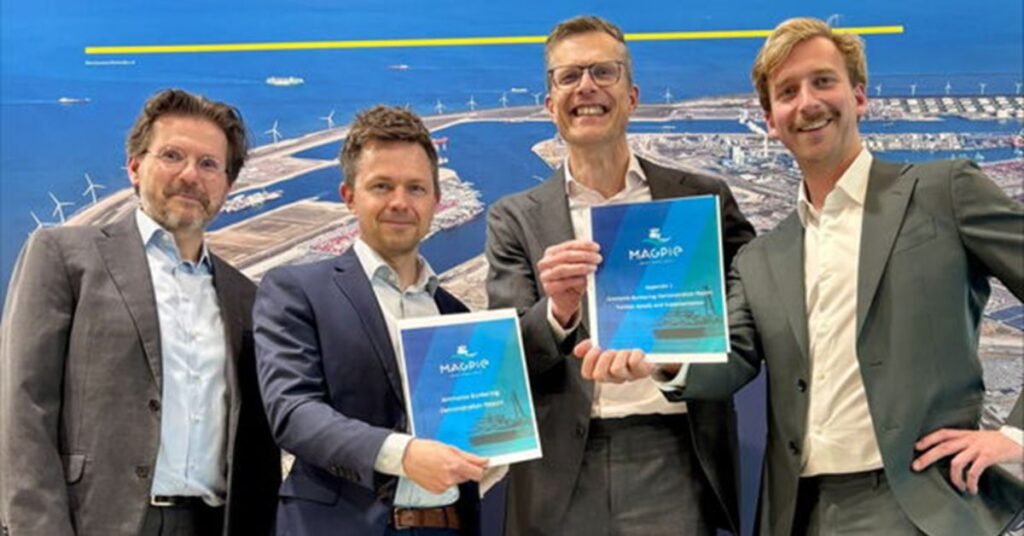
A demonstration project conducted at the Port of Rotterdam has shown that ship-to-ship ammonia bunkering can be carried out safely within an operational port setting, according to findings released under the EU-funded MAGPIE project.
The trial, carried out on 12 April 2025, involved a full-scale simulation of an ammonia bunkering operation and was designed to assess the operational, safety and regulatory requirements associated with ammonia as a marine fuel.
Ammonia is increasingly being considered as a potential low- or zero-carbon fuel for shipping, but its toxicity and handling characteristics have raised concerns around bunkering safety, crew competence and port readiness.
Demonstration validates safety frameworks
The project findings have been compiled into a report by the Mærsk Mc-Kinney Møller Center for Zero Carbon Shipping and project partners. According to the report, the bunkering operation demonstrated that ammonia transfer within port limits is operationally feasible when conducted under established safety procedures and regulatory controls.
The exercise also validated the Port of Rotterdam’s ammonia safety framework and the International Association of Ports and Harbours (IAPH) Port Readiness Tool, both of which are intended to support ports evaluating the introduction of alternative marine fuels.
Bo Cerup-Simonsen, CEO of the Mærsk Mc-Kinney Møller Center for Zero Carbon Shipping, said:
“The project delivers practical learnings, validation sheets and recommendations that can be used by ports globally to build confidence in ammonia bunkering and to inform future port permitting and regulatory processes. The results support the EU’s ambition for green ports and the safe deployment of alternative fuels in the maritime sector.”
Supporting alternative fuel infrastructure
The demonstration forms part of wider efforts to establish infrastructure and operational standards for alternative marine fuels as the shipping industry seeks to reduce greenhouse gas emissions.
The report includes practical lessons, validation procedures and recommendations that ports and regulators can use to support future permitting and safety assessments for ammonia bunkering operations.
Boudewijn Siemons, CEO of the Port of Rotterdam, said:
“The energy transition requires new, integrated value chains. This ammonia bunker pilot is an important step in developing a complete value chain for alternative fuels, from import to application in shipping. Together with our partners, we demonstrate that innovation, safety, and scalability can go hand in hand. Rotterdam plays a connecting role as an energy and logistics hub for Northwest Europe.”
Recent Posts
HYBRID
GRSE Signs ₹1,032-Crore ONGC Contract for Four Hybrid Offshore Supply Vessels
EV
Energy In Motion Opens ₹500-Crore Electric Truck Plant in Pune
Fuels
Aegis Logistics Commissions 35,000-Tonne LPG Bottling Plant at JNPA