
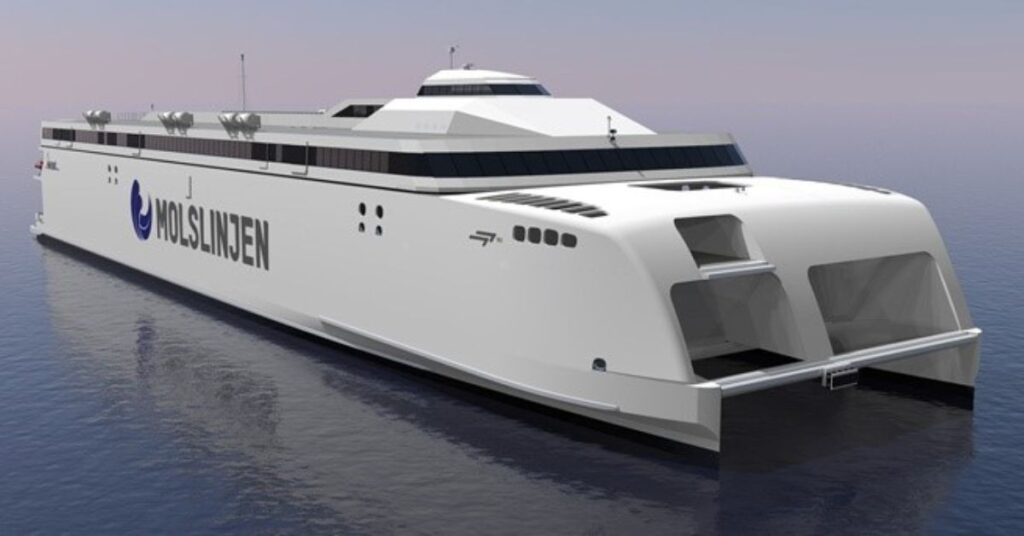
Molslinjen has placed an order for a third battery-powered high-speed catamaran for operation on the Kattegat, expanding what the company describes as the world’s largest maritime electrification project. The vessel will be built by Australian shipbuilder Incat, which is already constructing the first two ferries in the series.
Third Electric Mega-Catamaran to Join the Fleet
The new vessel will operate on Molslinjen’s routes between Jutland and Zealand, forming part of a three-ship programme aimed at fully electrifying the company’s Kattegat services. Construction of the first two ferries is underway at Incat’s Hobart facility, which has also been selected to build the third unit.
Kristian Durhuus, CEO of Molslinjen, said:
“There will be obvious advantages to having the three ferries built in the same place, and there will be valuable learning along the way from the first to the last ferry. And it has been important for us to have a stable and solid supplier.”
Investment and Government Support
The electrification project—including three 129-metre vessels and associated onshore charging infrastructure—represents an investment of DKK 3.5 billion. The initiative recently received DKK 180 million in support from Denmark’s Investment Support Fund 2025.
Durhuus noted the significance of public funding in advancing the project:
“We and our owners are leading the way here and trying to show the way for a green transition with technology that was not present at all very recently. This kind of innovation is expensive, and it has been crucial for us to get the government’s support for this electric adventure.”
Deployment Timeline
The three ferries will enter service sequentially as they arrive in Denmark. The current timeline anticipates:
- First vessel: End of 2027
- Second vessel: Summer 2028
- Third vessel: Spring 2029
The delivery schedule will allow Molslinjen to transition its entire Kattegat operation to battery-electric propulsion over a period of two years.
NFI Perspective
Carsten Jensen, CEO of Nordic Ferry Infrastructure (NFI), the parent company of Molslinjen, said:
“With the order of a third ferry, we are really kicking off the world’s largest electrification project at sea – and we are extremely proud of this project, which shows what is possible when ambition meets innovation.”
Key Vessel Specifications
- Length: 129 metres
- Width: 30.5 metres
- Passenger capacity: 1,483
- Vehicle capacity: 500 cars
- Battery capacity: 45,000 kWh
- Speed: 40+ knots
Recent Posts
Events
Singapore International Bunkering Conference and Exhibition (SIBCON) 2026
Methanol
Deendayal Port to Begin Construction of 150 TPD e-Methanol Plant
Marine
NTNU to Acquire Kongsberg HUGIN 6000 for Ocean Technology Research