
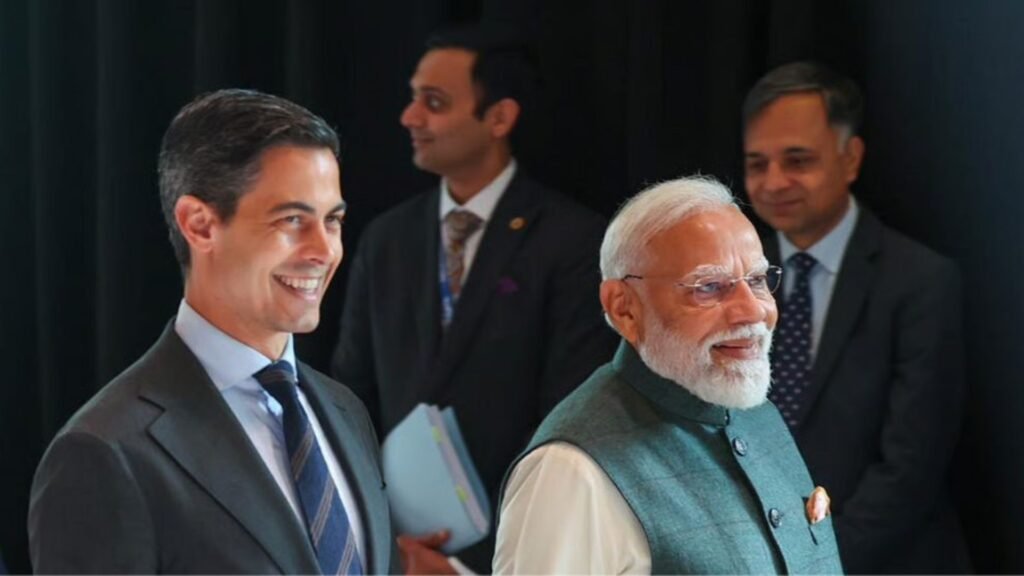
India and the Netherlands have agreed on a series of bilateral initiatives spanning renewable energy, circular economy, and maritime cooperation, announced during Prime Minister Narendra Modi’s official visit to The Hague on 16-17 May 2026. The agreements form part of a broader Strategic Partnership Roadmap adopted by Modi and Dutch Prime Minister Rob Jetten.
The energy and maritime tracks were among the more substantive outcomes of the visit, with both governments setting in motion working groups, joint roadmaps, and academic partnerships in areas central to the global energy transition.
A Roadmap for Green Hydrogen
The two governments launched the India-Netherlands Roadmap on the Development of Green Hydrogen, intended to align Indian production capacity and export ambitions with Dutch demand and technological capabilities. The roadmap is positioned to support production, domestic use, and export of green hydrogen, with both countries treating it as a long-term clean energy vector.
A Joint Working Group has also been established under the existing Memorandum of Understanding on Renewable Energy. Its mandate covers innovative solar technologies, green hydrogen, energy storage, and bilateral investment flows in the renewable sector.
In parallel, the Joint Statement of Intent on Capacity Building for Energy Transition between NITI Aayog and the Netherlands has been renewed, extending the existing framework for institutional cooperation on transition-related policy and technical work.
The Bio-Economy and Biofuels Track
Modi welcomed the Netherlands joining the Global Biofuel Alliance, a grouping launched during India’s G20 presidency in 2023. The two governments also reaffirmed their commitment to bio-economy cooperation, referencing the Mission Innovation Program on Biorefineries, which India and the Netherlands co-chair.
Where Circular Economy Cooperation Goes Next
The 2025 update of the Dutch National Circular Economy Programme 2023-2030, combined with India’s presidency of the World Circular Economy Forum (WCEF) 2026, has opened space for expanded bilateral work on resource efficiency.
Identified areas of cooperation include:
Industrial circularity
Solid and liquid waste management for climate-resilient urban systems
Technology deployment through pilot and scalable projects
B2B partnerships, including under the Resource Efficiency and Circular Economy Industry Coalition (RECEIC)
On sustainable mobility, the two sides flagged scope for deeper cooperation in interoperable charging infrastructure, battery technology, system integration, standardisation, heavy and medium-heavy zero-emission vehicles, smart urban mobility, and alternative fuels.
Academic Tie-Ups on Hydrogen
The University of Groningen (RUG) signed a Memorandum of Understanding with 19 Indian Institutes of Technology to strengthen academic cooperation. A PhD Fellowship Programme on Hydrogen has also been established between India’s Department of Science and Technology and RUG, creating a research talent pipeline tied directly to the bilateral hydrogen agenda.
Building a Green and Digital Sea Corridor
On the maritime front, the two Prime Ministers referenced the recently renewed Memorandum of Understanding on Maritime Cooperation and the Letter of Intent signed in October 2025, which outlined a strategic “Green and Digital Sea Corridor” between India and the Netherlands.
Both governments agreed to explore developing a comprehensive Strategic Roadmap on a Green and Digital Sea Corridor, aimed at establishing what the joint statement described as “an environmentally sustainable, digitally integrated and economically efficient future-ready maritime corridor between India and the Netherlands.”
Priority areas under the maritime partnership include smart and sustainable development of ports and inland waterways, supply chain optimisation, and green ports and shipping.
Maritime Security and Supply Chains
Given shared interests in the Indo-Pacific, both leaders agreed to exchange best practices on protecting critical maritime infrastructure, including cyber resilience in ports and inland waterways. The cooperation will involve government entities, businesses, and knowledge institutions on both sides.
Diversified and resilient supply chains were flagged as a focus area, particularly for critical raw materials, medicines, and food — categories where both countries have identified vulnerabilities in existing trade routes.
Why These Agreements Matter
The hydrogen roadmap is among the more concrete bilateral instruments India has signed with a European partner, and it slots into a broader pattern of European governments seeking long-term green hydrogen offtake arrangements with producer geographies. The Netherlands, with the Port of Rotterdam positioned as a likely European hydrogen import hub, has commercial reasons to engage Indian producers early.
The Green and Digital Sea Corridor concept, meanwhile, aligns with the International Maritime Organization’s tightening emissions targets and the growing commercial focus on green shipping lanes between major trading partners. India and the Netherlands run substantial container traffic between them, with Rotterdam serving as a gateway for Indian exports into the European Union.
Recent Posts
EV
Maharashtra Signs ₹150 Crore MoU to Build Electric Boat Manufacturing Facility for Mumbai Water Metro
Hydrogen
Samskip’s SeaShuttle Joins EU HyShip Project to Advance Hydrogen-Powered Short-Sea Shipping
Methanol
Maritime Technologies Forum Releases Safety Management Guidelines for Methanol-Fuelled Ships