
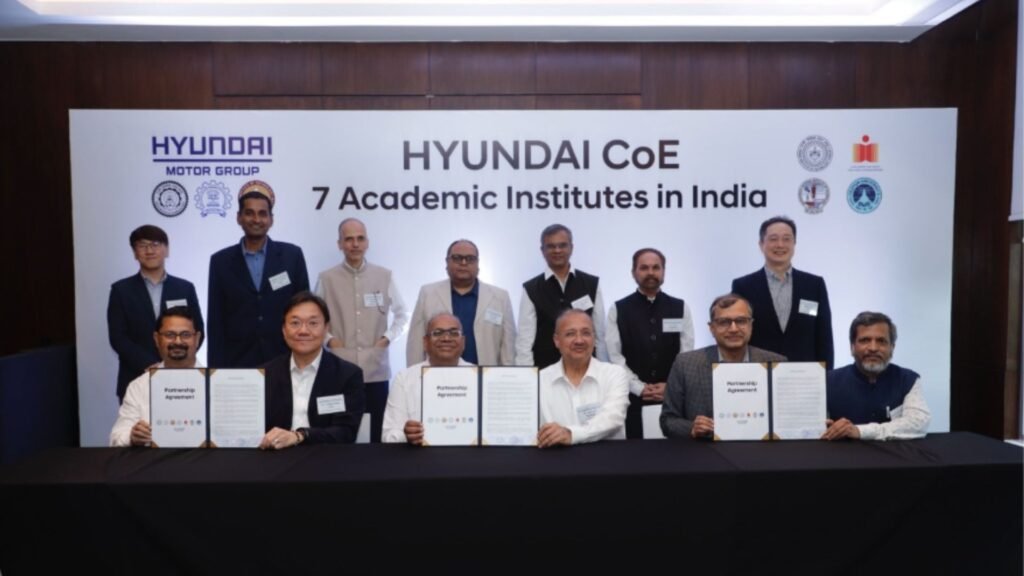
Hyundai Motor Group has expanded its Center of Excellence (Hyundai CoE) initiative in India by adding four new academic institutions to its research and development network focused on battery and electrification technologies.
The new partners include IIT Kanpur, IIT Hyderabad, Visvesvaraya National Institute of Technology (VNIT) Nagpur, and Tezpur University. They join the three founding institutions announced in 2025 — IIT Madras, IIT Delhi, and IIT Bombay — creating a seven-university research consortium.
The initiative is aimed at advancing India-specific electric vehicle (EV) technologies and strengthening collaboration between academia and industry in areas related to electrification, battery systems, and mobility innovation.
A formal agreement ceremony was held in New Delhi and attended by Hyundai Motor Group executives and representatives from participating academic institutions.
According to the company, the Hyundai CoE network is currently managing 39 collaborative research projects across the seven institutions. Research areas include battery cell development, battery management systems (BMS), energy density improvement, safety and durability technologies, and diagnostic systems.
The programme also includes work on battery materials tailored for Indian operating conditions and an AI-enabled Vehicle-to-Grid (V2G) platform.
“By bringing together the distinguished professors and emerging researchers from these seven institutes, we can create powerful synergies that will yield immense value for both Hyundai and India’s sustainable growth. I strongly believe that the Hyundai CoE will grow to become the premier expert network of the Indian academic community,” said Chang Hwan Kim, Head of the Electrification Energy Solutions Tech Unit.
Hyundai Motor Group stated that the initiative will also support knowledge exchange through academic collaboration programmes between Indian and Korean researchers. Planned activities include research exchange visits, technology forums, and global conferences focused on EV and electrification technologies.
The long-term objective of the programme is to expand Hyundai CoE into a broader research hub supporting India’s transition toward electric mobility and related clean transportation technologies.
The development reflects increasing collaboration between automotive manufacturers and academic institutions as companies seek to localise EV technology development and strengthen regional research capabilities.
Key takeaways:
What: Expansion of Hyundai’s EV research consortium in India
Who: Hyundai Motor Group; IITs; VNIT Nagpur; Tezpur University
Focus: EV batteries, BMS, safety, durability, and V2G technologies
Network size: Seven academic institutions
Projects underway: 39 collaborative R&D initiatives
Objective: Develop India-specific EV technologies
Additional initiatives: Research exchange, tech forums, academic collaboration
Long-term goal: Build a broader EV research ecosystem in India
Recent Posts
HYBRID
GRSE Signs ₹1,032-Crore ONGC Contract for Four Hybrid Offshore Supply Vessels
EV
Energy In Motion Opens ₹500-Crore Electric Truck Plant in Pune
Fuels
Aegis Logistics Commissions 35,000-Tonne LPG Bottling Plant at JNPA