
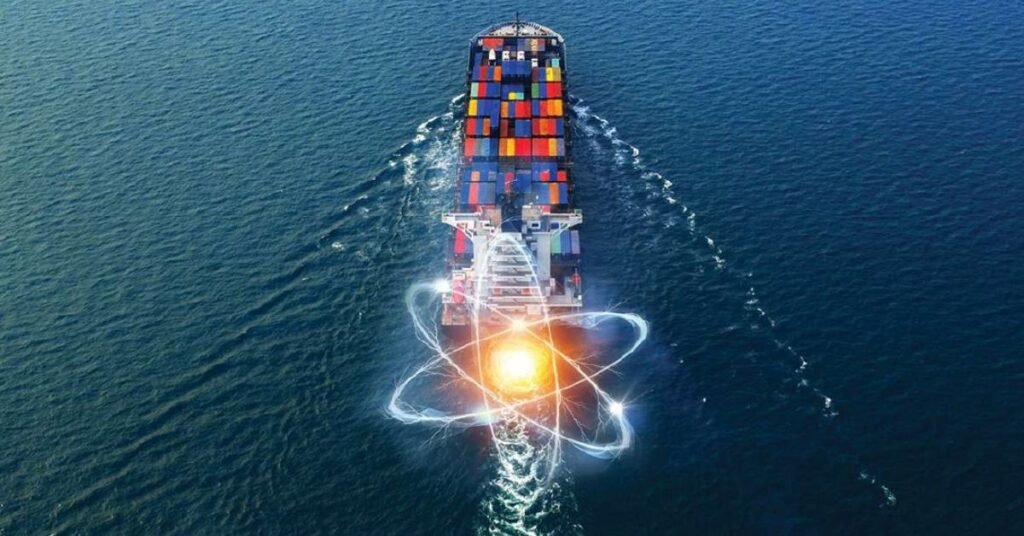
Growing collaboration between governments, regulators, classification societies and industry is accelerating the development of nuclear-powered commercial shipping, with new initiatives focused on establishing regulatory frameworks, validating reactor technologies and preparing ports for future deployment.
Recent discussions at Posidonia 2026, alongside new industry studies and technical projects, highlight increasing momentum behind nuclear propulsion as a potential zero-carbon solution for long-distance shipping.
Industry Calls for Clear International Regulations
At Posidonia 2026, Lloyd’s Register (LR) convened a high-level roundtable bringing together shipowners, reactor developers, regulators and industry organisations to discuss the practical steps needed to enable the safe commercial deployment of nuclear-powered vessels.
A key outcome of the discussions was the need for an international regulatory framework capable of evolving alongside reactor technology, rather than waiting for mature designs before establishing the rules governing their use.
Karine Herviou, Deputy Director General of the International Atomic Energy Agency (IAEA), stressed the importance of regulatory certainty as advanced reactor technologies continue to mature.
The discussions also underscored the need for close collaboration between the maritime and nuclear sectors to accelerate safe implementation.
Reactor Development Gains Momentum
LR CEO Nick Brown noted that regulatory development must keep pace with rapid advances in reactor technology, particularly the emergence of Small Modular Reactors (SMRs) and advanced microreactors.
That progress has since been reinforced by Deployable Energy, whose Unity demonstration reactor achieved criticality at the Idaho National Laboratory in early July.
Developed in just two years, the Unity Nuclear Battery has already secured orders to supply 500 reactor units annually for data centre applications between 2030 and 2035.
LR Advisory has been supporting the reactor’s development while exploring how advanced microreactor technology could be adapted for maritime applications.
Brown also highlighted the growing importance of initiatives such as:
- ATLAS (Atomic Technologies Licensed for Applications at Sea)
- UK Maritime Nuclear Consortium
- Nuclear Energy Maritime Organization (NEMO)
These programmes aim to establish regulatory pathways and assurance frameworks for civil nuclear technologies in shipping.
IMO Targets Nuclear Code by 2032
Regulatory work is also progressing at the International Maritime Organization (IMO).
During a recent NEMO workshop, the IMO announced that it now expects to adopt a dedicated nuclear shipping code by 2032, four years earlier than previously anticipated.
The accelerated timeline reflects growing international interest in nuclear propulsion and the rapid pace of reactor technology development.
New Project Explores Nuclear-Powered Car Carrier
Alongside regulatory work, technical feasibility studies are advancing.
At Posidonia, Lloyd’s Register announced a Joint Development Project (JDP) with:
- HD Hyundai Heavy Industries
- Korea Shipbuilding & Offshore Engineering (KSOE)
- Hyundai Glovis
- G-Marine Service
- Korea Atomic Energy Research Institute (KAERI)
The project is evaluating the integration of a Molten Salt Reactor (MSR) aboard a Pure Car and Truck Carrier (PCTC).
The study is assessing:
- Reactor integration
- Radiation shielding
- Vessel stability
- Propulsion arrangements
- Cargo capacity
- Containment systems
- Operational safety
The concept has already received Approval in Principle (AiP), confirming its technical feasibility at the preliminary design stage.
According to Sung-Gu Park, President – North East Asia at Lloyd’s Register, establishing technical feasibility at an early stage is critical for understanding future design, operational and safety requirements.
Ports Prepare for Nuclear-Powered Vessels
Attention is also turning to the infrastructure required to support nuclear-powered merchant ships.
In June, Lloyd’s Register, the Port of Rotterdam Authority, CORE POWER and A.P. Moller – Maersk published a joint study examining how nuclear-powered commercial vessels could make routine port calls at Rotterdam.
The study evaluated:
- Emergency response planning
- Regulatory responsibilities
- Port infrastructure
- Stakeholder coordination
- Operational procedures
The work forms part of a broader industry effort to develop the supporting ecosystem required for commercial nuclear shipping, extending beyond vessel technology to include regulation, assurance, port readiness and operational frameworks.
Recent Posts
Events
Singapore International Bunkering Conference and Exhibition (SIBCON) 2026
Methanol
Deendayal Port to Begin Construction of 150 TPD e-Methanol Plant
Marine
NTNU to Acquire Kongsberg HUGIN 6000 for Ocean Technology Research